On Saturday, June 6, Colombian presidential hopeful Abelardo de la Espriella called Peru’s Keiko Fujimori to express his support for her candidacy ahead of the second-round vote the next day: “God willing, together, you as president of Peru and me of Colombia we’ll be able to strengthen the ties between our two nations and enjoy an unbeatable relationship on trade and the fight against transnational organized crime.”
More than a month later, both Abelardo and Keiko have emerged as victorious presidents-elect, the latest in a series of victories for right wing candidates in Latin America. It is now easier to list the countries that have not elected a right, or right-adjacent, leader in the past three years.
Much has been written about this reverse pink tide, new right, “blue tide,” or even “Orange Drift” (in reference to the pro-Trump orientation of many candidates). Typically, these analyses stress the pro-U.S., and more specifically pro-Trump facets of new Latin American leaders.
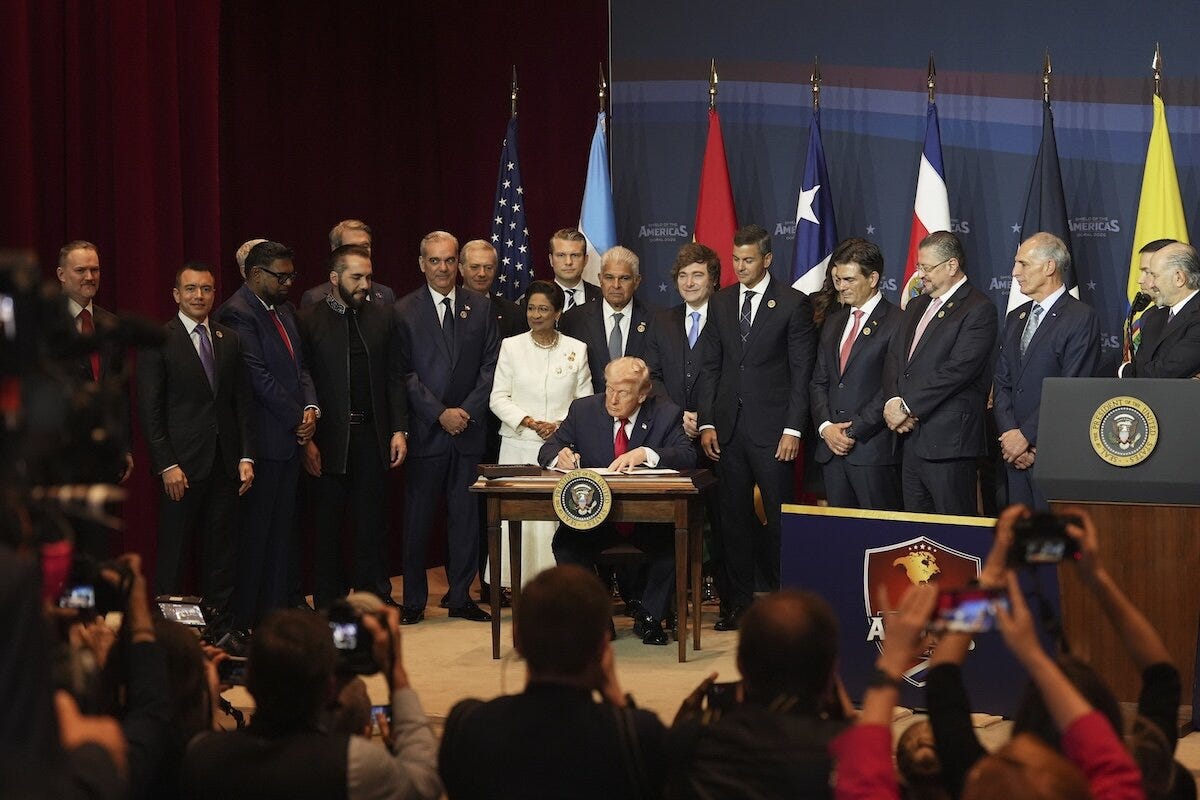
This is understandable to an extent for the simple fact that Latin America’s “new right,” if it can even be called that, has little in common save for a broad alignment or desire for alignment with Washington. Rodrigo Paz in Bolivia bears little resemblance to Abelardo de la Espriella, and calling Keiko Fujimori an emissary of a “new” right-wing is surely a mischaracterization. The Shield of the Americas and Americas Counter Cartel Coalition is even more diverse in its ideological composition, including Guyana, governed by Irfaan Ali’s center-left People’s Progressive Party/Civic, and in Guatemala, Bernardo Arévalo might be the most left-wing leader the country has had since Jacobo Árbenz.
This is important to keep in mind as, for the purposes of this article I’ll be mainly referencing leaders and parties that identify with the right. It strikes me that the rise of a wave of leaders who are at least nominally on the same page when it comes to their relationship with the United States could present a unique opportunity to forge a consensus on other issues as well. And it would be very funny, not likely, but funny, if the right is the one to achieve Latin America’s dream of regional integration.
Regional integration has for decades, if not centuries, been the ever-elusive goal of Latin American leaders of all stripes. Indeed, the Americas were the birthplace of many of the ideas we now associate with the modern international order. But it seems these very ideas have still struggled to take root at home. While the Americas boasts a plethora of multinational institutions, the OAS never acquired the same diplomatic or economic clout as the European Union, and the Rio Treaty never produced the same level of security and defense integration as NATO.
The question I hope to tackle with this post therefore is whether the shared desire for closer alignment with the United States among new pro-U.S. governments might also plant the seeds of greater intra-regional cooperation.
Strength in Numbers
The ascendancy of the Latin American right wing over the past two years both is and is not remarkable. I suspect most readers have their own theory of the trend and I’m no different. My very rudimentary sense is that much of it comes down to cyclical voting patterns and an anti-incumbent environment.
Every election, however has its own dynamics. In Peru, Trump notably demurred from issuing a forceful endorsement of Keiko Fujimori, even as his social media accounts threw their weight behind Abelardo de la Espriella in Colombia. But in both cases, my sense is that Washington had a relatively minor impact on the final outcome. By contrast in Argentina’s midterm elections, forceful U.S. assistance in the form of currency swaps and promises of future investment likely played a vital role in resurrecting Milei’s La Libertad Avanza party’s chances on the heels of a corruption scandal.
The most interesting feature of recent elections in my view is the consistency of the trend. In several coin-flip elections, including Peru, Colombia, and (an odd three-sided coin) Honduras, the right has eked out a victory. One might expect that we should see at least one outlier, but the pattern seems to hold up, even where the U.S. declines to explicitly endorse a particular candidate.
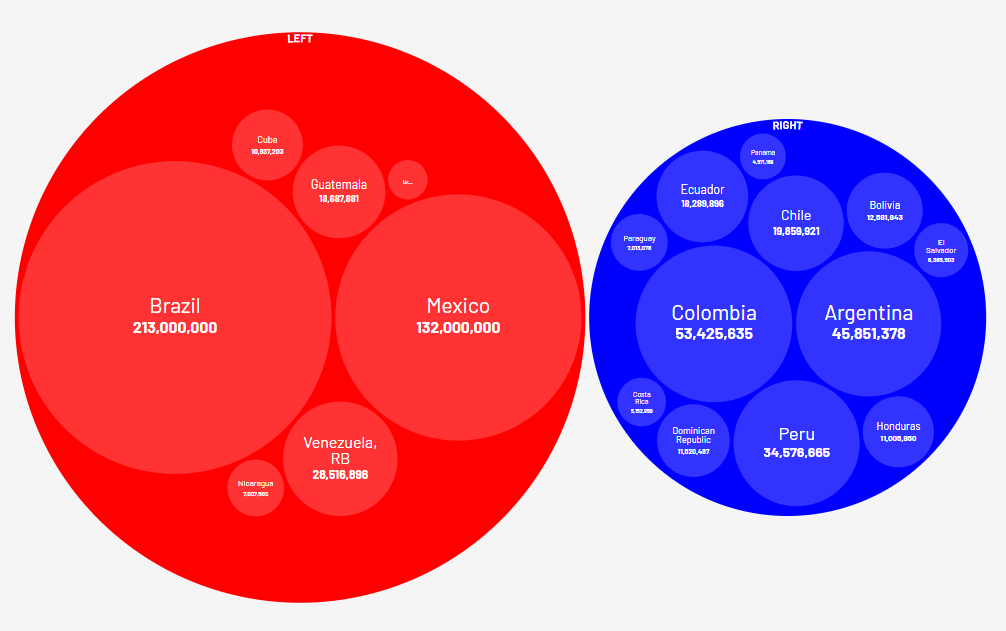
Still, we shouldn’t overstate the scale of the new conservative wave either. The region’s biggest players, Brazil and Mexico, are led by leftists, meaning more than half the population of Latin America, and more than half the region’s GDP, is still governed by the left. This could change if (and that’s a big if) Flávio Bolsonaro wins October’s elections, meaning that virtually all South America would be governed by some flavor of pro-U.S. government.
Even without total victory, in theory the rightward shift of the region opens new opportunities for collaboration among like-minded leaders. At a bare minimum, ideological alignment should help allay some of the intra-regional crises that tend to flare up between governments of opposing political stripes. Some examples from the past few years include the recent trade war between Ecuador and Colombia, Mexico’s refusal to recognize the legitimacy of Dina Boluarte’s government in Peru following Pedro Castillo’s abortive self-coup, and of course, the dramatic saber-rattling between Venezuela and Guyana over the Essequibo, a dispute which hasn’t gone away just yet.
There is some anecdotal evidence to suggest that the rightward drift in the Americas has led to progress on the diplomatic front. At the 2026 Mercosur summit, both Chile and Paraguay extolled the virtues of the Paz government in Bolivia. The chummy FaceTime between Abelardo de la Espriella and Keiko Fujimori suggests to me that the dispute over Isla Chinería may be put safely returned to the back burner after Gustavo Petro elevated the issue last summer.
The recent Hondurasgate scandal also suggests that some of the new right governments may be cooperating with one another in a more sinister fashion. According to a series of recordings released by Canal Red earlier this year, former Honduran president and now-pardoned narcotrafficker Juan Orlando Hernández worked with current president Nasry Asfura, Javier Milei, the United States, and Israel to organize a coordinated disinformation campaign targeting progressive governments in the Americas.
The veracity of these recordings continues to be disputed, but the idea that right-leaning governments are coordinating media and messaging campaigns to aid one another isn’t particularly novel. Expressing support for ideological allies via social media is a low-cost, and potentially high-impact method for leaders to support one another, and even arch-isolationists like JD Vance have taken to the digital public square to back right-wing parties and leaders in Europe.
While I don’t wish to downplay the gravity of the scandal, unpacking it fully would require a post all its own, and helping your ideological comrades-in-arms garner clicks, or even win elections, is in a certain sense the easy part. The real acid test now is what the Latin American right will do in their moment of triumph.
What Regional Integration Really Means
Traditionally, the right has been far less interested in reaching across borders than the left. The “pink tide” of the 2000s saw the birth of new multinational groupings like the now-defunct Bolivarian Alliance for the Peoples of Our America (ALBA) as well as the Community of Latin American and Caribbean States (CELAC) framed as a regional alternative to the U.S.-dominated OAS.
By contrast, right-wing governments on average tend to be more inward-looking and concerned with their domestic agendas. For example, El Salvador’s Nayib Bukele hasn’t pushed particularly hard to elevate his profile in inter-American fora despite his many admirers among the Latin American right.
Still, it would be a serious own goal for the current crop of right governments to not engage in more substantive cooperation on trade, infrastructure investment, and security.
Of these three, security is probably the most promising avenue for closer regional integration. Transnational criminal operations demand transnational responses, with porous borders allowing billions of dollars in illicit commercial activity each year. It is also the one area where there is at least in theory already a U.S.-led multilateral framework in the form of the Shield of the Americas and Americas Counter-Cartel Coalition.
Ecuador for instance, is notably not a major cocaine producer, but has been flooded by cocaine trafficked in from Colombia and Peru, the world’s first and second largest coca growers respectively. The Noboa administration has not been shy when it comes to venting its frustrations over this situation. Ecuador not only imposed tariffs on Colombia over the Petro government’s alleged security failures, in March the Ecuadorian military dropped bombs along the border with one allegedly landing on Colombian territory. Now that Abelardo de la Espriella has pledged to bombard drug traffickers and illegal miners on day one of his administration, there should be considerably more alignment between Quito and Bogotá. Add Keiko Fujimori’s more aggressive approach to public safety to the mix and it’s easy to see a broad Andean coalition dedicated to waging war on crime taking shape.
A bit further south, Chilean President José Antonio Kast could run into a bit more trouble even with friendlier governments in Peru and Bolivia. Kast’s platform included a hefty pseudo-Trumpian anti-immigration plank, and since his inauguration Chile has begun digging several kilometers of trenches along the country’s northern borders. The border has been a persistent sore spot for both Lima and La Paz, and that sentiment is unlikely to go away even as both capitals have turned towards the right. Still, Kast likely has better odds of smoothing over border tensions with Fujimori and Paz next door.
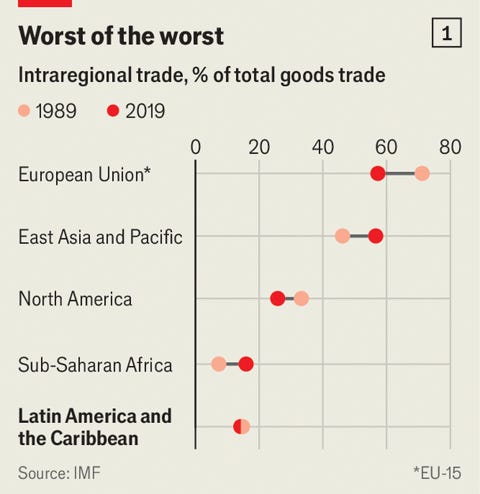
Economic issues are a thornier issue, and one where Latin America has historically struggled no matter which direction the electoral winds were blowing. Intra-regional trade accounted for just 15 percent of Latin American trade in 2019, lower than East Asia, North America, and Sub-Saharan Africa. The region faces challenges when it comes to harmonizing tariff rates, dismantling regulatory barriers, and modernizing labor mobility, making it difficult to leverage comparative advantages. Add to that the fact that most Latin American economies depend heavily on raw commodity exports, meaning countries in the region are more likely to compete than complement one another.
There have been some qualified successes, most notably the Mercosur trading bloc between Argentina, Brazil, Paraguay, and Uruguay. Other projects like the Pacific Alliance have also driven some greater integration, but remain a long ways away from rewiring trade away from the U.S., East Asian, or European markets.
Compounding these challenges is a dearth of infrastructure connectivity. The region lags in terms of port, airport, road, and rail connectivity. Part of this is a feature of geography, with dense jungles, high mountain ranges, and arid deserts that complicate construction. But equally important is the difficulty of pooling resources at the regional level to get new projects off the ground in the first place. This contributes to a vicious cycle wherein low intraregional trade makes it unprofitable to build or modernize infrastructure, driving up transportation costs and further diminishing trade between Latin American states.
While ideological alignment is hardly necessary to strengthen regional economic integration, it can provide a useful catalyst to get countries to the negotiating table together. Nevertheless, these will remain hard challenges and the window of opportunity for the current collection of leaders to put in meaningful work on resolving them is closing just as quickly as it opened.
The United States Won’t Save You
For now, it appears as though most of the new right leadership have staked their hopes on a stronger relationship with Washington in lieu of stronger intra-regional ties. While this is understandable, it is short-sighted. Despite powerful rhetoric, U.S. engagement with Latin America has so far been less of a comprehensive strategy, and more a series of one-offs, particularly when it comes to economic issues.
This is further complicated by the fact that Venezuela, the country currently receiving the lion’s share of U.S. attention as well as foreign assistance, is not a member of the new right at all, but rather the rump of a kleptocratic and ostensibly socialist authoritarian regime. The ongoing humanitarian crisis in Venezuela is likely to continue U.S. attention and resources, and with good reason given the scale of the need in that country. Still, this means other pro-U.S. leaders could find themselves competing for a slice of a shrinking pie.
In other moments of crisis, U.S. assistance to the Americas has struggled to move beyond the rhetorical. When Bolivia was paralyzed by mass protests and roadblocks, the United States rallied fellow Shield of the Americas members to issue a joint statement condemning efforts to sabotage the Paz presidency, but it was Brazil that offered to deploy humanitarian aid to relieve dwindling food stocks. In a similar manner, as Panama faced retaliation from China over its Supreme Court decision to revoke the port concessions given to CK Hutchison, the United States, together with Bolivia, Costa Rica, Guyana, Paraguay, and Trinidad and Tobago expressed solidarity with the Mulino government, but seemingly hasn’t pressed the issue much since even as Beijing continues to detain Panama-flagged vessels at increased rates.
In addition, as the number of right-wing, pro-U.S. governments grows, the number of governments vying for the White House’s attention does as well. Even if it likes them, Washington doesn’t want to have to bail out its allies on a regular basis. Indeed, while the 2025 National Security Strategy first articulated the “Trump Corollary” as U.S. policy, it also made clear the United States would view burden sharing as the norm with even its closest allies and partners.
This tendency was on display at the recent Conference of Defense Ministers of the Americas, where Elbridge Colby admonished the region’s militaries to spend more on their national defense, holding up the new NATO standard of 3.5 percent of GDP as an example to be emulated. Even in the United States’ own neighborhood, Washington is signaling that its friendship is not unconditional.
I’m not saying that there’s no utility for governments to pursue greater collaboration with Washington, and some forms of U.S.-Latin America partnership will take time to cultivate. But for leaders under pressure to deliver results quickly, it seems a risky gamble that Washington will provide the kinds of transformative change in the security and economic domains that voters want.