

Security forces throughout Latin America and the Caribbean (LAC) are being pushed to extremes. On one side are hapless local police forces who are outgunned and outmanned in the face resurgent transnational criminal groups. On the other you have the sledgehammer of military intervention, which tends to deliver at best ephemeral security gains while presenting major human rights questions.
Today, I hope to argue for a third option, that LAC governments should embrace gendarmeries, special military units with an explicit domestic law enforcement role, in order to curb organized crime threats.
This is probably the worst time to argue for the expansion of paramilitary forces in the Americas (maybe that means it’s really the best time). With the United States set to triple the budget of ICE, fears of a politicized paramilitary force seem to be at a high-water mark. Looking to the region, Mexico also just passed a raft of national security laws that empower its own National Guard’s law enforcement and surveillance capabilities.
To be clear, I think such moves in both countries are corrosive to democracy, and will not yield the security gains their proponents expect. At the same time, I do not believe that gendarmerie forces are inherently incompatible with democracy and the rule of law. Indeed, in France (where the concept originates) and several other European states, gendarmerie forces operate with a seemingly negligible impact on the quality or strength of democratic institutions. In the United States, deployment of the National Guard in response to emergencies is at least generally viewed as a legitimate mission.
In the case of some LAC countries, the presence of an intermediate force could actually be preferable to relying on the armed forces for imposing order and fighting crime when conventional police are overwhelmed.
Militarization without militarism?
We take as gospel that a militarized security policy is a bad thing. AMLO campaigned in part on a promise to end the militarized approach to internal security taken by his predecessors and supported by the United States under the Mérida Initiative. I’m personally quite sympathetic to critiques of militarized policing and skeptical that the core drivers of lawlessness can be addressed by force of arms alone.
But I also think that most of these criticisms fail to seriously contemplate what happens when the threats to public safety are themselves militarized. In LAC’s most deadly hotspots, gangs are not merely gaggles of at-risk youth menacing their neighbors, they boast anti-materiel rifles and machine guns, drop bombs from drones, carry out assaults with improvised armored fighting vehicles, and recruit mercenaries with experience in active war zones. While I can understand the impulse to get the military out of domestic policing, in these scenarios I’m not sure what can replace it in the short term. If an armed group is menacing your citizens from an armor-plated pickup truck, it seems like you’d want your security forces to have some way of taking out that truck.
Take the Yanomami humanitarian crisis in Brazil for example. Beginning around 2019, the Yanomami indigenous group, whose protected territory runs along the Brazil-Venezuela border, began to suffer repeated incursions from wildcat miners. These mining outfits were backed by powerful criminal organizations, including the notorious First Capital Command (PCC) who brought disease, forced displacement, as well as labor and sexual exploitation with them. When President Luis Inácio Lula da Silva took office in 2023, he launched an operation to be spearheaded by the Brazilian environmental agency Ibama to clear out the miners. But in the remote and punishing environment of the Amazon rainforest, this operation relied on military logistics for resupply, air cover to detect illegal flights, and naval support to interdict riverine smuggling. The operation was successful initially in clearing out several large mining operations, but as soon as military support began to flag those gains started to be rolled back.
In an interview with Reuters, Brazil’s leading expert on indigenous groups Sydney Possuelo identified the lack of military support for the operation as a key point of failure: “Ibama and the police simply do not have enough personnel there to get rid of the miners…The Air Force is not enforcing the no-fly zone. The Army and the Navy are doing nothing.” Clearly in this case, the problem was not excessive military involvement, it was the lack of sufficient military engagement.
However, the more countries rely on their armed forces to suppress criminal activity, the worse their militaries tend to perform. That is because internal security is not the intended function of these forces, and time spent patrolling neighborhoods, or administering prisons not only takes away from training to defend the nation, it also chips away at the ethical and professional standards militaries should adhere to. Over time, this can transform a country’s armed forces into an organization optimized for internal repression. The Central American dictatorships of the Cold War should serve as a chilling example of the kinds of abuses such a posture can lead to.
Anatomy of a gendarmerie
With these sensitivities in mind, how do you design a force that won’t simply fall into the same vices that have plagued previous military and militarized security policies? In my view, some general principles for an effective gendarmerie force would include the following.
First, the force should be a new entity rather than a specialized division of an existing police or military force. This may be more logistically taxing, but creates an opportunity to ensure the new gendarmerie is fit for purpose rather than replicating existing public security pathologies. Furthermore, when countries seek to carve out special forces-type police units, they often end up over investing in weaponry and equipment rather than focusing on retraining these units to employ their new tools effectively. For instance, after the Bolsonaro government increased the budget of Brazil’s Federal Highway Police and provided them with new armored vehicles and equipment, killings by this force spiked. When you get a new hammer, it’s hard not to go looking for nails to try it out on.
Second, the gendarmerie should focus on training and patrolling areas of otherwise limited state capacity, much like the French Gendarmerie Nationale, which has responsibility for public safety in low-density areas. As a rule, they should not be used to respond to protests unless in extraordinary circumstances, and should be laser-focused on tackling violent organized crime.
Finally, the force should be equipped with, and trained on, military equipment including rifles, armored vehicles, and transport helicopters. While the exact mix of equipment may necessarily vary based on the country context, as a general rule, the force should be capable of taking on anything a criminal group can throw at it. To this end, it may also be worthwhile to invest in new and emerging technologies, especially drone and counter-drone systems sooner rather than later.
Not all countries in LAC need such a force, Brazil, Ecuador, and perhaps Colombia would be good places to start. Two other countries, Chile and Mexico, are currently in possession of a national gendarmerie, though there are some radical differences between the two. A brief overview of these two cases can hopefully further illuminate ingredients in the successful or unsuccessful development of such a gendarmerie force.
Chile’s Carabineros
The Carabineros de Chile are a nearly century-old police force recognized as an arm of the military but reporting to the Ministry of the Interior. Once one of the most trusted institutions in the country, today, the Carabineros are navigating countervailing winds of public opinion. Their role responding to the 2019 mass protests that gripped the Chile saw a surge of complaints of abuse and misconduct. General Ricardo Yañez, former commander of the Carabineros was recently indicted on charges of violating human rights and corruption during this period. At the same time, surging criminality and violence in Chile, particularly in its northern border regions, has led to renewed calls for a more muscular security policy. Insecurity is now a top issue for Chileans, while public opinion on the Carabineros has seemingly rebounded, especially after three of their members were killed along the P-72 highway. Accordingly, the organization seems torn between calls for reform, and the need to address urgent security threats.
Despite these challenges, I believe the existence of the Carabineros remains an important pressure release valve for growing security concerns in Chile. Debates in that country have mostly stressed the scope and powers of police forces to curtail organized crime, rather than whether or not to deploy the military. To the extent that Chile has used the armed forces domestically, this has largely been confined to border security deployments, a mission set that while perhaps undesirable, is not beyond the pale for military operations. I would also contend that the Carabineros have been beneficial for civil-military relations. Even accounting for the abuses and need for reform post-2019, Chilean security services handled mass protests better than in neighboring Peru, where military intervention to quash protests led to more severe victimization and killings in a much shorter period of time.
Chile will have its presidential election this November, and at the moment it seems highly likely a right-wing candidate will win. Given the salience of security policy in the election it is entirely possible this may kick off a new round of discourse on the military’s role in domestic policing. Rather than uplift the military, Chile should work on bolstering the Carabineros, and more broadly criminal investigation capabilities, to better enable them to do the work they were designed for. Given Chile’s reputation as a good-governance country, I am optimistic that this outcome lies within reach, but cautious of the consequences should the next administration fail to thread the needle.
Mexico’s National Guard
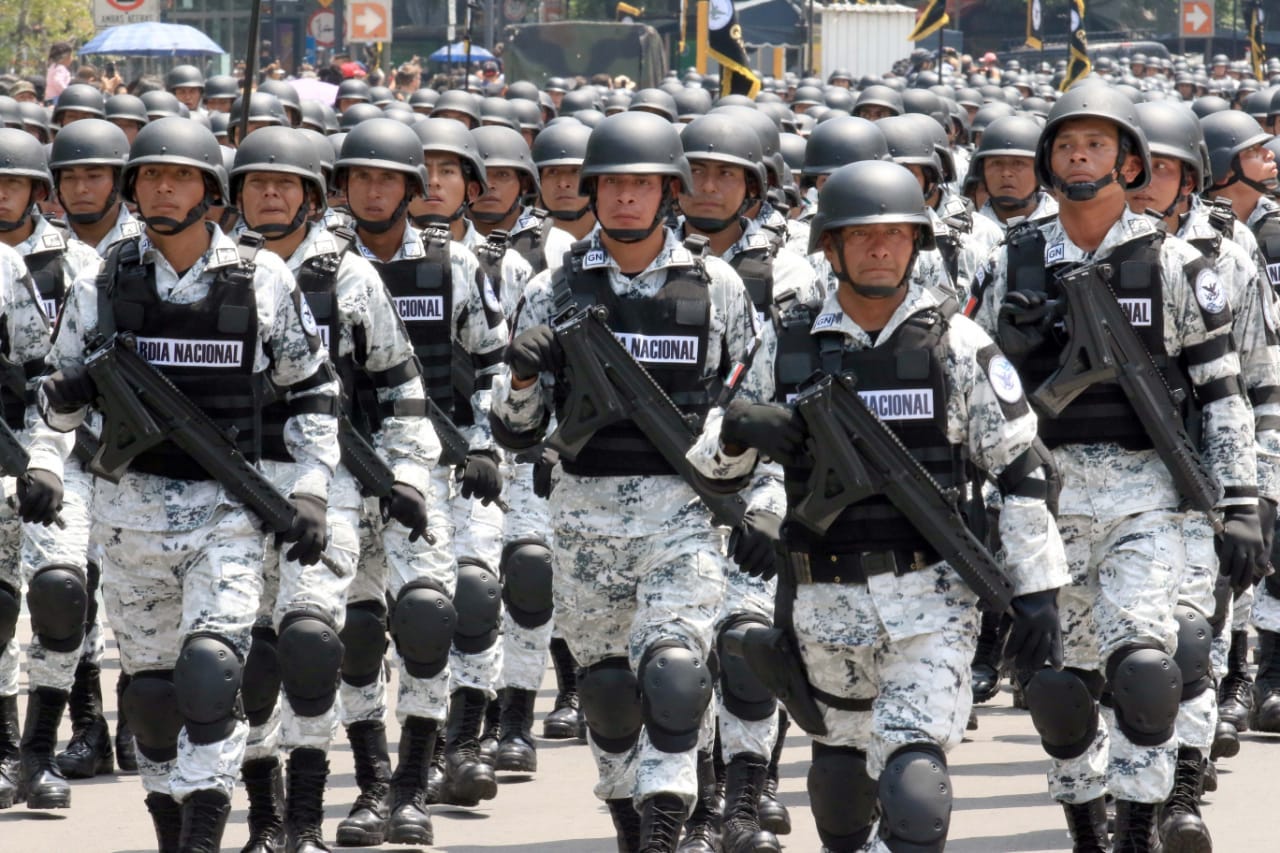
Compared to Chile, Mexico’s National Guard is a far younger institution, established in 2019 as one of AMLO’s signature security initiatives. As of last fall, the organization is officially enshrined in the constitution as a branch of the military subordinate to the Secretariat of National Defense (SEDENA). I won’t dig too much into the criticisms of the legislative frameworks that underpin the National Guard, and for those interested I highly recommend the two substacks linked at the end of this piece.1
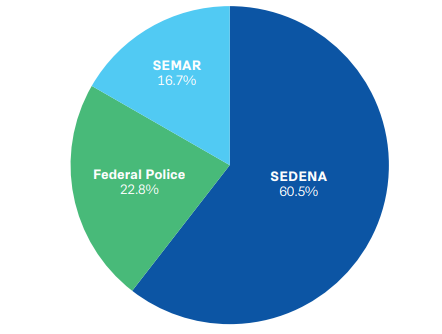
To an extent the subordination of the National Guard to SEDENA is merely formalizing what was already the case. The vast majority of the organization’s personnel come from the armed forces, with a minority contingent of ex-Federal Police. As I have argued, this is not necessarily a bad thing given the right mission scope. However, Mexico’s problem is that it wants to lump the functions of the U.S. National Guard, FBI, and DHS (and also perhaps the SSA, HUD, and the FAA) together in one uniformed package. In doing so, it dilutes the best qualities of having a gendarmerie force and magnifies its attendant risks.
In particular, new laws expanding the National Guard’s ability to gather intelligence are especially troubling from a democracy perspective (for more on that I again recommend this excellent explainer). Ideally, Mexico would embrace a more parsimonious vision for the National Guard focused on enforcement and counter-crime missions in hotspots while a separate federal-level criminal investigations force would serve as the primary intelligence arm. I am somewhat encouraged by moves by the Secretariat of Security and Civilian Protection to recruit for intelligence roles could point to the emergence of such an investigative force emerging, but time will tell.
However, I would also be highly skeptical of efforts to disband the National Guard. As it stands, the National Guard is a good idea hampered by poor execution. But Mexico has suffered from too many public safety organizations that perish with the change of administration. The National Guard for instance replaced the Federal Police, which were themselves established in 2009 by merging the functions of several national security agencies. Sheinbaum in this regard at least offers consistency with her predecessor, and an opportunity to build upon an existing institution rather than restarting from scratch. The pressures she faces to address Mexico’s spiraling insecurity may also make her more willing to adapt the National Guard and make it more fit for purpose than the sprawling and somewhat amorphous entity she inherited.
Crime in the Americas is evolving, the response should evolve alongside it. While military and paramilitary responses should rightly be subject to a high level of scrutiny, rejecting them out of hand seems premature. At the very least, I feel the potential of gendarmerie forces to contribute in the fight against organized crime merits greater debate than it has received.
“Mexico's Vanishing Civilian State,” by Emiliano Polo, and “What Are Mexico’s New Security and Intelligence Laws? Everything You Need to Know,” by Alexandra Helfgott both provide excellent overviews of Mexico’s recent national security legislation and many of the most salient critiques, I encourage you to follow them for more coverage.