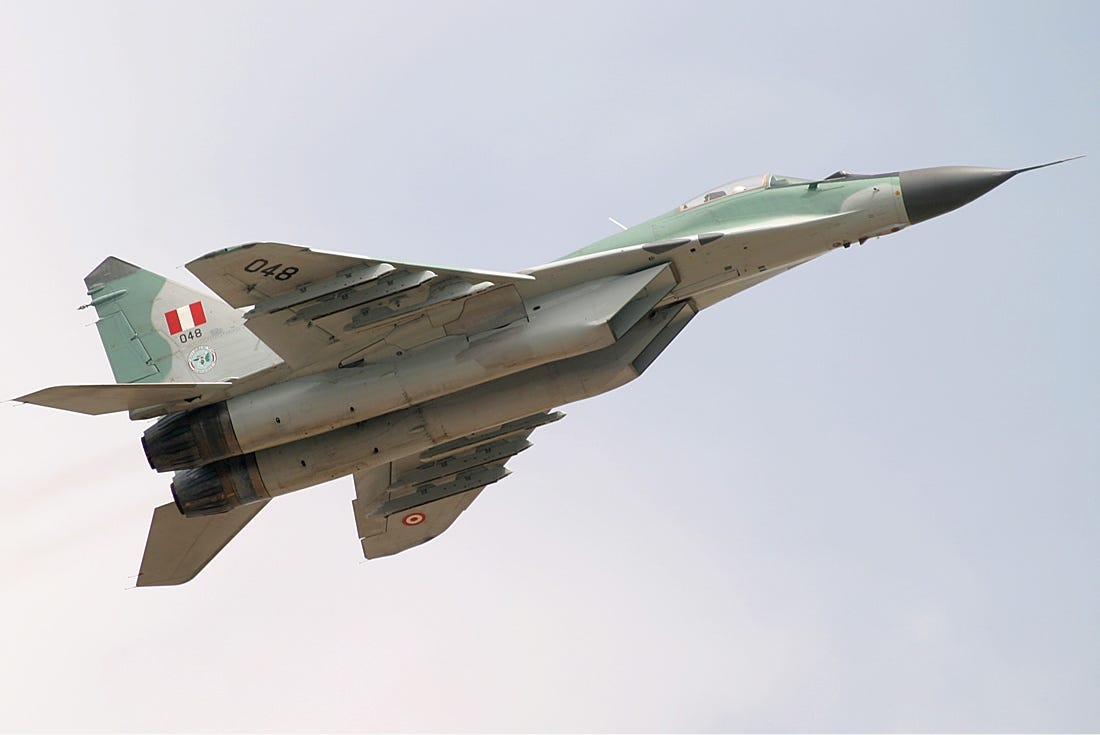
In 1996, Peru signed a deal to purchase a dozen MiG-29 fighter jets from the early post-Soviet Republic of Belarus. The move was in part a matter of prestige for the Peruvian military, and in part a practical step to repair the country’s air capabilities after years of underinvestment, and clashes with Ecuador in the year prior had left these seriously eroded. Unfortunately for the government of then-President Alberto Fujimori, Belarus had failed to consult with the neighboring Russian Federation on the deal, and lacked the technical know-how to ensure a steady supply of spare parts and munitions for the planes on its own. Without Moscow’s assistance, the MiGs risked becoming expensive display pieces in no time.
Ultimately, Peru was able to hammer out agreements with Russia to handle maintenance and repair issues, but the immediate chaos surrounding the purchase turned what should have been a moment of pride for the Peruvian Air Force into a somewhat more embarrassing incident.
Even with Russian assistance, Peru’s MiGs were old before they arrived, and as Moscow’s invasion of Ukraine grinds on, the Kremlin is in little position to aid in their continued maintenance. In addition to the MiGs, Peru operates a handful of Su-25 ground attack planes, and even older French Mirage 2000s.
For the Peruvian air force, fighter modernization has long been a priority. In an interview with Pucará Defensa, former Air Force commander General Carlos Chávez Cateriano claimed the effort had been ongoing for 14 years, only gaining Congressional procurement authorization in the past two.
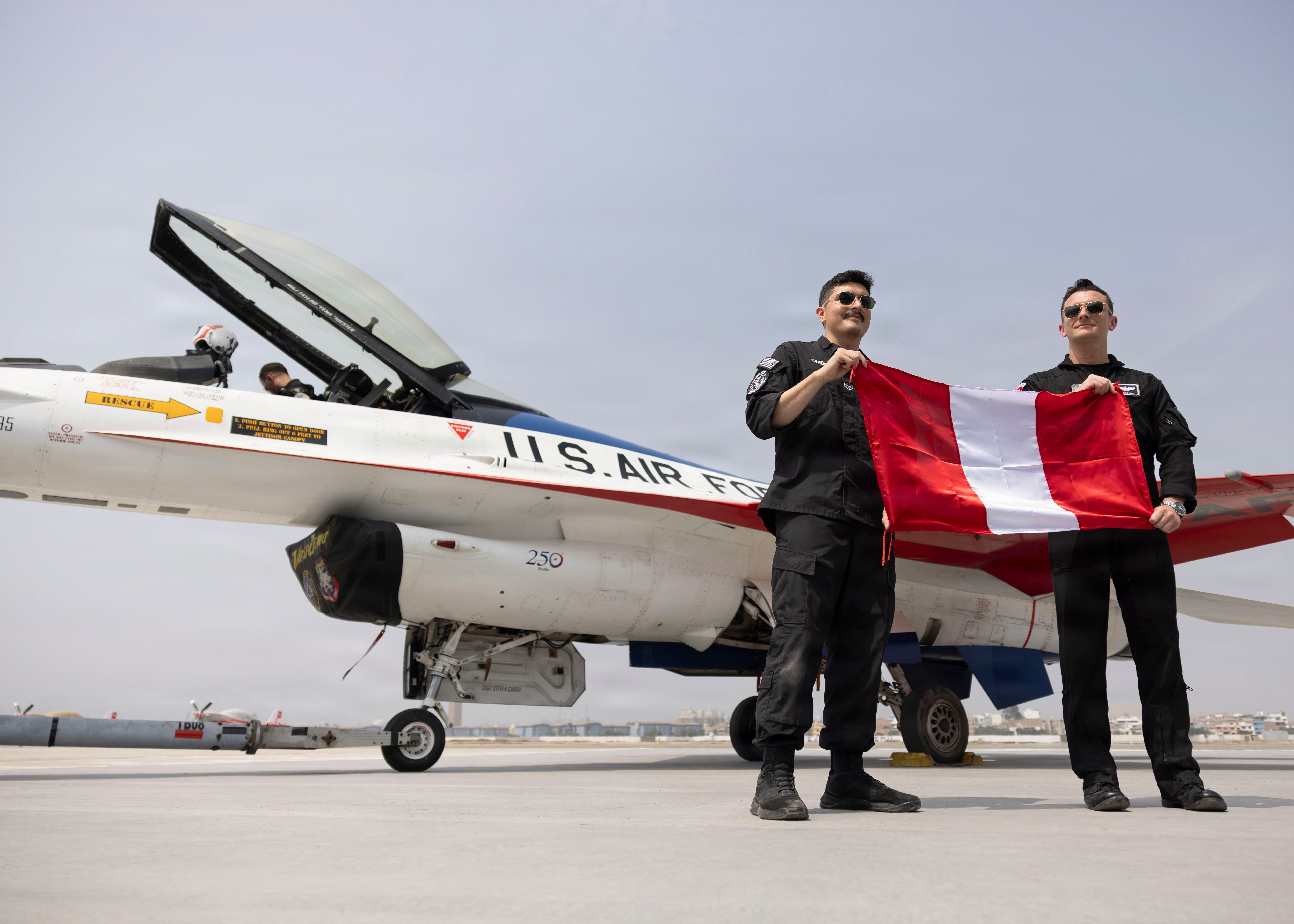
Today, like in 1996, Peru seems to have stumbled right at the finish line, and the controversy and uncertainty that has surrounded the April decision to purchase a dozen F16 Block 70 jets risks undermining an otherwise sound move by the country to upgrade its defense capabilities. This time around, the added drama of a presidential election has fanned the flames of scandal.
First as Tragedy, Then as Farce
While Peru’s search for new fighters has taken more than a decade, I started following the procurement campaign in 2024 when news first came out that Congress had appropriated $3.5 billion for the purchase of 24 modern fighters. In that time, I’ve seen probably half a dozen premature reports that Peru had made a decision on its future fighter planes. Most of these have come from less-than-reputable outlets that think a request for information amounts to the inking of a contract.
These reports began to gain steam in the fall of 2025, just in time for Peru’s political crisis to be thrust back to the fore with the impeachment of Dina Boluarte and inauguration of José Jerí. Jerí was himself summarily removed from office in February 2026 and replaced by octogenarian José María Balcázar, the third person to hold the office of president in less than 12 months.
Balcázar initially said that he planned to respect a deal allegedly signed by Jerí confirming the purchase of the Lockheed Martin F-16 Block 70. News of that, however, kicked off a fierce response from Swedish defense manufacturer Saab, which, hot on the heels from a recent agreement to sell the JAS 39 Gripen to Colombia, was pushing hard for Peru to be next.
Ultimately, Balcázar retracted his comments, and the fighter decision was placed under military secrecy. Peru had already tipped its hand however, and while Saab kept fighting the good fight, the F-16 was starting to look like the presumptive winner. It seemed neither Balcázar nor Jerí wanted to be on the hook for a purchase that was bound to result in controversy. The air force had already waited 14 years for a new plane, surely they could hold out a few more months for a new president to be voted in.
This was not to be, however, and according to a news release from the U.S. embassy, Lockheed was notified on April 14 of its selection, with a “ceremonial signing” scheduled for April 17. That day, Balcázar took to the radio to claim the agreement had been signed behind his back and claiming the next president should make the final decision.
This kicked off a firestorm from the U.S. embassy, while Peru’s defense and foreign ministers both tendered their resignations, but not before a “technical signing” of the deal reportedly took place on April 20 while the Ministry of Economy confirmed a $462 million down payment on the jets had already been transferred. Whatever the interim president’s goals may have been in backing away from the deal, it seems the facts on the ground moved without him.
All of this came at a time when Peru was facing a political crisis on a much larger scale, dealing with the aftermath of a messy first-round election that saw runner-up candidate Rafael López Aliaga fiercely contest his loss to the point of leveling physical threats against the country’s election authority.
Given the circumstances, why would the United States, and its allies in the Peruvian government, try to ram through a deal that has been a hot potato for months at a time of massive political upheaval?
The answer is probably that the very same political crisis made it less costly for the United States to throw its weight around on the comparatively less salient issue of defense procurement. A weak, unelected, lame duck interim presidency can’t do much to stop the process once the gears got turning. While the controversy did prompt high-level resignations, Peru’s next president would have undoubtedly reshuffled the cabinet once they entered office.
Another piece of the story is Washington’s new ambassador in Lima, the Floridian businessman Bernie Navarro who has made an impression as a walking, tweeting, incarnation of the Donroe Doctrine. To this end, locking up a major arms sale within his first three months on the job is almost certainly a feather in Navarro’s cap, and a victory that the ambassador could not risk being swallowed up by intractable domestic Peruvian politics.
A final factor could be the desire to lock in the agreement now, scandal be damned, as insurance against future presidential caprice. While a victory by Keiko Fujimori in the runoff would likely see the F-16 waved on through, a win by Roberto Sánchez, inheritor of left-populist and failed coup leader Pedro Castillo, could jeopardize the program. With polling still showing the race between Fujimori and Sánchez within the margin of error, it makes sense to push for an agreement on fighters now, instead of waiting for the coin toss to resolve.
This approach is not without risks. While Sánchez has said he would respect the agreement, with a fresh popular mandate (even a slim one) it would not be overly difficult for him to scrap it once in office.
In all likelihood however, the current order is a done deal. The $462 million transferred from Peruvian government coffers has been paid, and reneging now won’t get that money back, but will alienate a U.S. government that is much more willing to throw its economic, and military, weight around in the Americas. If Sánchez wins he will have bigger problems to deal with, and trying to undo the fighter deal would be a costly first battle to pick.
When all is said and done, therefore, it seems like the pressure campaign to get Peru to finalize its selection of the F-16 was worth it for the interested parties. Already, the scandalous nature of the agreement’s signing is beginning to fade into the background, and in the baseline scenario, both Fujimori and Sánchez will likely go about quietly cooperating on the deal.
There remains one possible snag in this otherwise tidy conclusion. Notably, according to all public accounts, the technical agreement signed between Lockheed Martin and the Peruvian government was for 12 planes, not the 24 the Peruvian Air Force planned to procure. While Navarro has indicated that we are merely in the first phase of the transfer, and a second batch is to be expected, without seeing the text of the agreement, we can’t be sure of that.
If, after taking delivery of the first fighters in 2029, Peru finds itself without a contract for another 12 fighters, that could reopen the wounds of April 2026 with potentially damaging consequences. Domestic political pressure would likely pull in the direction of selecting non-U.S. fighters in the event of a new procurement process. From the air force’s perspective however, the prospect of integrating and training on a brand new platform is unappealing to say the least.
Failure to reach a deal for the full two dozen planes means Peru could find itself pulled in opposing directions that, in a worst-case scenario, might scuttle a future tender altogether.
It’s a Good Plane, Sir
With the political rationale behind Peru’s choice clear, what is the operational case for (or against) the F-16?
On balance I think the F-16 checks several boxes that make it a sound decision for the future of the Peruvian air force. The Block 70s that will be sold to Peru can carry a wide range of payloads allowing it to perform missions ranging, from air defense, to ground attack, to electronic warfare and reconnaissance.
Interoperability with the U.S. military is also a big plus given Peru’s new Major Non-NATO Ally status, and will allow for closer cooperation on joint exercises and trainings with U.S. Southern Command.
The plane also fulfills the demand from many Latin American militaries for proven capability. There are nearly 3,000 F-16s in service across dozens of national air forces, and in South America Argentina and Chile both fly the plane giving it a strong track record for Peru to assess. The Gripen has also made inroads in the Americas recently, but remains a less proven platform.
Other competitors ran into similar challenges, the Rafale for instance is a well-regarded fighter in service in at least 7 countries, but counts no Latin American operators. Meanwhile South Korea’s early offer to add Peru to its KF-21 program was likely tempting as a way for Peru to grow its domestic defense industrial base, but with no models in service yet, the risk was far too great.
Still, the F-16 was not a slam dunk, the Gripen E/F boast solid sensors, open and adaptable digital architecture, and are optimized for short takeoffs that may make it better suited for operating out of rugged Amazonian airfields. Saab’s marketing also tends to stress the Gripen’s lower cost per flight hour as a plus for militaries with shallower pockets. The numbers behind these calculations have been the subject of much debate that I won’t wade into here except to say my hunch is the difference is probably less than Gripen fans make it out to be.
I’ve also seen some commentary arguing that Saab’s Brazilian Gripen production line worked against it in Peru as Brazil could theoretically veto the delivery of new fighters to Lima. I wouldn’t put too much stock in that argument, the Peruvian air force already flies Brazilian Super Tucanos and relations between the two countries have been historically stable in the security and defense space.
On balance, however, while the exact timing of the agreement may have been political, at least the momentum towards the F-16 was already building long before Bernie Navarro touched down in Lima.
The good news is that Peru seems to be managing other large-scale defense programs more handily than the fighter procurement saga. Peru has partnered with South Korea to great effect on armored vehicles and naval shipbuilding. Even as the F-16 drama was playing out, the Peruvian air force reached an agreement to acquire a new C-27J Spartan transport aircraft to strengthen the country’s disaster response and logistical capabilities. Scandal grabs headlines, but Peru’s procurement does genuinely seem to be on the right track.
The Future of Flight in the Americas
Still, big military purchases by Latin American governments tend to draw harsh criticism when they break into mainstream coverage. Typically, the commentary around this stresses the absence of interstate conflict in the Americas, deeply entrenched fears of military aggrandizement, and unfavorable comparisons between the cost of weapons systems and social programming.
More recently, other critics have pointed out that the multi-billion dollar price tag of fighter jets and other high-end systems is difficult to justify in the modern age of combat. For the same dollar amount Peru plans to spend on 24 new fighters it could acquire hundreds of Turkish TB2 Bayraktar medium altitude long-endurance UAVs, and/or an arbitrarily large quantity of cheap one-way attack drones and surveillance quadcopters.
Longtime readers of this blog will know that I tend to push back especially against the first category of arguments. I think Latin America broadly needs to spend more, not less, on military procurement.
Both criticisms of Peru’s fighter procurement in my view misunderstand the purpose of national militaries in Latin America. For these forces, maintaining a mix of high- and low-end capabilities is critical to the diverse set of missions they are asked to fulfill. The region’s militaries are called upon to act as first responders in the wake of disaster, as airmobile police forces protecting isolated communities and going after criminal activity in inhospitable environs, and yes, as guardians of their countries’ sovereign territory against interstate rivals.
If you care about controlling your country’s airspace, for instance, there actually aren’t many more cost-effective alternatives to a 4th generation fighter like the F-16. Against a foreign aggressor with an air force, most countries would prefer to have some way to contest the skies. Even if the current probability of interstate conflict is low, it often takes far longer to build up a capable and modern force than it does for peaceful conditions to deteriorate.
Even for lower-end missions like counternarcotics, fighter jets have a role to play. Drug traffickers can use speedy private jets that can easily outpace turboprop planes and UAVs. You can plug some of these vulnerabilities by investing heavily in air defenses, radars, and of course drones, but one way or another this still requires greater investment in national defense.
Similarly, overfitting for domestic counterinsurgency or counter-crime missions not only means you risk being caught woefully underprepared for interstate clashes, it also drives down the threshold for the use of military force on domestic targets. It’s probably a good thing for civil-military relations therefore that Peru’s national security apparatus views defense against foreign aggression as a core mission.
As other Latin American countries look to modernize their forces, Peru’s fighter acquisition should serve as a reminder of how easily large defense procurement processes can become captured by narrow interest groups. Even now, when it seems like all’s might be well that ends well, the corrosive influence of politicization still redounds to the detriment of the national defense and domestic stability.