

Like much of the world, South America is undergoing a major military modernization effort. Unlike other regions however, countries in this region continue to face shoestring budgets for procuring new weapons and equipment. Thus, while military expenditure has ticked up ever so slightly over the past decades, the continent has yet to experience the same wild growth that has characterized the global arms market.
But a lack of spending does not mean a lack of interest. Many South American, and more broadly Latin American, militaries procured large quantities of equipment during the late 20th century when they were either governed by military regimes or else fighting dedicated insurgencies in their territory. The commodity boom of the late 2000s also saw procurement numbers increase as government budgets swelled across the board. Today this gear seems increasingly outdated as global conflicts underscore the rapidly shifting nature of modern war.
While South America may not face the same pressures to modernize that, say Eastern Europe or Southeast Asia does, it has not been immune to these shifts. From the adoption of drones by organized criminal outfits, to the proliferation of semisubmersible “narco-subs” or incursions into national waters by vast foreign illegal fishing fleets, South American militaries are facing evolving challenges on several fronts. Meeting the moment demands procuring new gear and modernizing capabilities that have been left to wither on the vine for years.
However, South America faces more than mere budgetary constraints in this effort. The region has a vanishingly small defense industrial base. This means that South American countries must look elsewhere for more exquisite systems like supersonic fighter jets, main battle tanks, or submarines. Foreign suppliers of these capabilities, like the United States, tend to be cautious about who they sell to, and at what price. Meanwhile Russia, long the favorite of countries looking for no-strings-attached arms deals, has all but vanished from the South American arms market as war in Ukraine consumes much of its defense industrial output.
Into this vacuum, some analysts (myself included) predicted that China would seize the window of opportunity. While I think it’s still a bit too early to dismiss that possibility in the long run, for the time being, that does not seem to have happened. China’s bid to sell JF-17 fighters to the Argentine Air Force, desperate to replace their A-4 Fightinghawk jets (of which just 6 were reportedly operational in 2021), floundered amid fierce U.S. opposition. Eventually, Washington was able to cajole the United Kingdom into dropping its objections to Argentine jet acquisitions, and authorized the transfer of 24 used Danish F-16s in 2024. Subsequent efforts by China to market other jets, like the J-10CE, have also failed to drum up much interest.
Instead, two relative underdogs seem to be emerging as big winners in South America’s modernization push: Sweden and South Korea. In the former case, Swedish defense giant Saab has inked two major deals to supply the J-39 Gripen multirole fighter to Brazil and Colombia. It is rumored to be on the verge of a third as Peru looks to procure new jets as well. South Korea has made big plays in the maritime space, with Hyundai Heavy Industries (HHI) signing a nearly half-billion-dollar agreement with Peru to build four ships as part of the country’s naval modernization effort. Korean-made ships now feature in the armadas of Chile, Colombia, Ecuador, and Uruguay providing a solid foothold from which to expand into the broader regional defense ecosystem.
While these two players are by no means the largest defense partners for South America, which remains dominated by actors like the United States, France, and U.K., their current position already provides an outsized degree of influence. Arms sales are a notoriously “sticky” form of influence. When a country buys a weapons system from another, they are not merely purchasing the hardware, they are entering a usually multi-year partnership for training, maintaining, and sustaining that system. This goes double for advanced systems like fighter jets, which require a greater degree of logistical support and hence reliance on the supplier country. Understanding Sweden and South Korea’s success in this regard may therefore provide insights into the future directions of South America’s armed forces.
Stockholm and Seoul’s secret sauce
Why exactly have these countries been so successful at courting South American countries? In my opinion this rests on a combination of three factors. First, they have both aggressively targeted higher-end capabilities in the maritime and air domains that South American companies need, but can seldom pay top-dollar for. Second, they are willing to engage in technology transfer and co-production at a level that most other defense contractors are unwilling to do. Finally, their status as U.S.-aligned nations allows partner countries to diversify their suppliers without attracting undue U.S. opposition.
Guarding the seas and skies
Navies and air forces are some of the most capital-intensive service branches to equip properly. Partially for this reason, there are few militaries with truly first-rate air forces, and even fewer with first-rate navies. However, air and maritime capabilities are some of the most important, especially for countries in the Western Hemisphere.
Maritime domain awareness is vital for policing the vast coastlines and exclusive economic zones found throughout South America. In particular, fending off ecological destruction by illegal fishing fleets, and seizing cocaine and other narcotics are key missions requiring at least a moderately sized navy with modern sensors. In the case of countries like Argentina and Chile, maintaining a capable navy is essential for continuing to exercise sovereignty in the Antarctic, often under punishing and inhospitable conditions.
Modern fighters mount powerful radars that can provide critical domain awareness over extensive territory that would otherwise be nigh-impenetrable. For countries facing major challenges from coca cultivation and illegal mining, the ability to detect operations and interdict clandestine flights carrying this illicit cargo is a key national sovereignty concern.
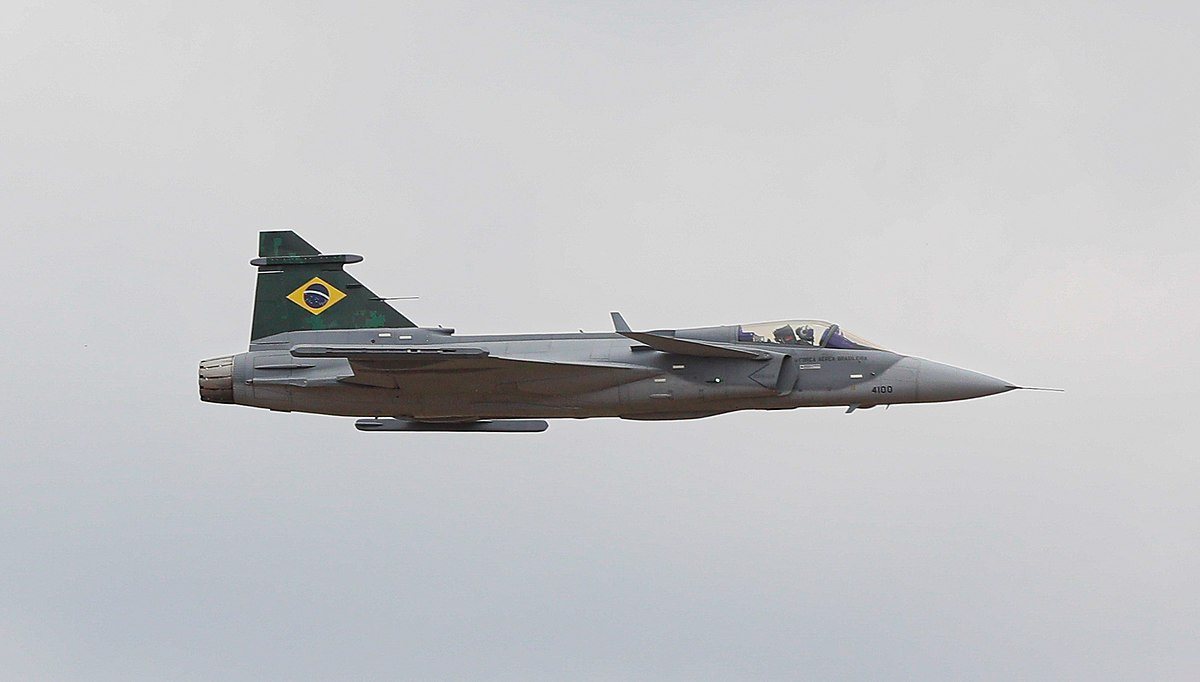
While other suppliers may dominate the market for armored personnel carriers, light helicopters, or MANPADs, the bulk of Swedish and South Korean sales to the region have been for relatively high-end (and expensive) capabilities. This means that they do not need to sell large quantities to nevertheless have a major effect on the recipient military’s capabilities. The Brazilian air force for instance noted that adequate comparison between the Gripen and the country’s previous supersonic fighter, the F-5M, was “not feasible because the F-5M, an excellent aircraft modernized in the early 2000s, is a design from the late 1950s…it is impossible to compare systems and aircraft with a nearly 60-year difference.”
But selling high-end kit can also provide a foot in the door for a broader set of deals. South Korea’s maritime cooperation with Peru likely paved the way for Lima to acquire a batch of K-808 armored personnel carriers in late 2024. These are unlikely to be the last, especially as Peru pushes forward its defense modernization agenda.
Building together
The second, and perhaps most noteworthy feature of both Sweden and South Korea’s moved in South America is their willingness to engage in co-production and technology transfer as part of their arms transfer. The warships HHI will build for Peru will all be produced at the SIMA shipyard in Callao, just outside Lima. Of the 36 Gripen E/F’s Brazil ordered from Saab, 15 will be manufactured at Embraer’s production facility in Gavião Peixoto. Meanwhile, when Peru initially began its search for new fighters, Korea offered to let it join the KF-21 program, which would allow Peru to work alongside Korean and Indonesian defense firms to design and build its own jets.
Industrial cooperation can foment a virtuous cycle. Co-production facilities in one country can serve as entry points for further regional expansion. Indeed, one of the selling points for the Gripen over the Dassault Rafale to Peru is the existence of an active regional production line in Brazil. While Dassault has reported record demand for its fighters, the company has a backlog of 239 aircraft, including 186 for export to other foreign buyers already in the queue. With a smaller backlog and production already ongoing in the region, Saab is likely better able to deliver fighters quickly than the French aerospace titan.
In a statement to defense journal Zona Militar, Saab remarked that “Brazil is becoming a central hub for Saab in the region, especially in the aerospace sector. This hub model allows us to support other countries.” While the comment evinced the willingness of Saab to work hand-in-hand with Brazil, it also ruffled some feathers in the region. It’s one thing to rely on a supplier an ocean away for your fighters, but current and prospective South American buyers may rankle at the prospect of relying on Brazil to help build and maintain their fighters.
The truth however is that Brazil is probably one of the only (if not the only) countries in South America that can realistically benefit from co-production of fighter jets. As home to a globally competitive aerospace sector, Brazil can better incorporate the insights gleaned from technology transfer and incorporate them into its commercial and defense ecosystem. In doing so it also underscores why it is good to have your own defense industry. In order to take advantage of co-production a country must have sufficient preexisting industrial base that the external supplier can integrate with, co-production for co-production’s sake means little.
In South Korea’s case, the local manufacturing offered by HHI has been essential to the expansion and revitalization of the Peru’s state-run shipyard, Servicios Industriales de la Marina (SIMA). The shipyard is expected to be busy through 2029 building the frigate, offshore patrol vessel, and two landing craft ordered from HHI by the Peruvian navy, keeping it humming while also expanding the range and technical sophistication of ships constructed. This has important knock-on effects for the rest of the Peruvian navy as well. For instance, in June SIMA completed the modernization of one of Peru’s four legacy German submarines, with plans to refurbish the remaining three in short order. SIMA will only grow in importance, especially as Peru and HHI hope to move forward with joint production of a brand-new submarine design for the Peruvian navy.
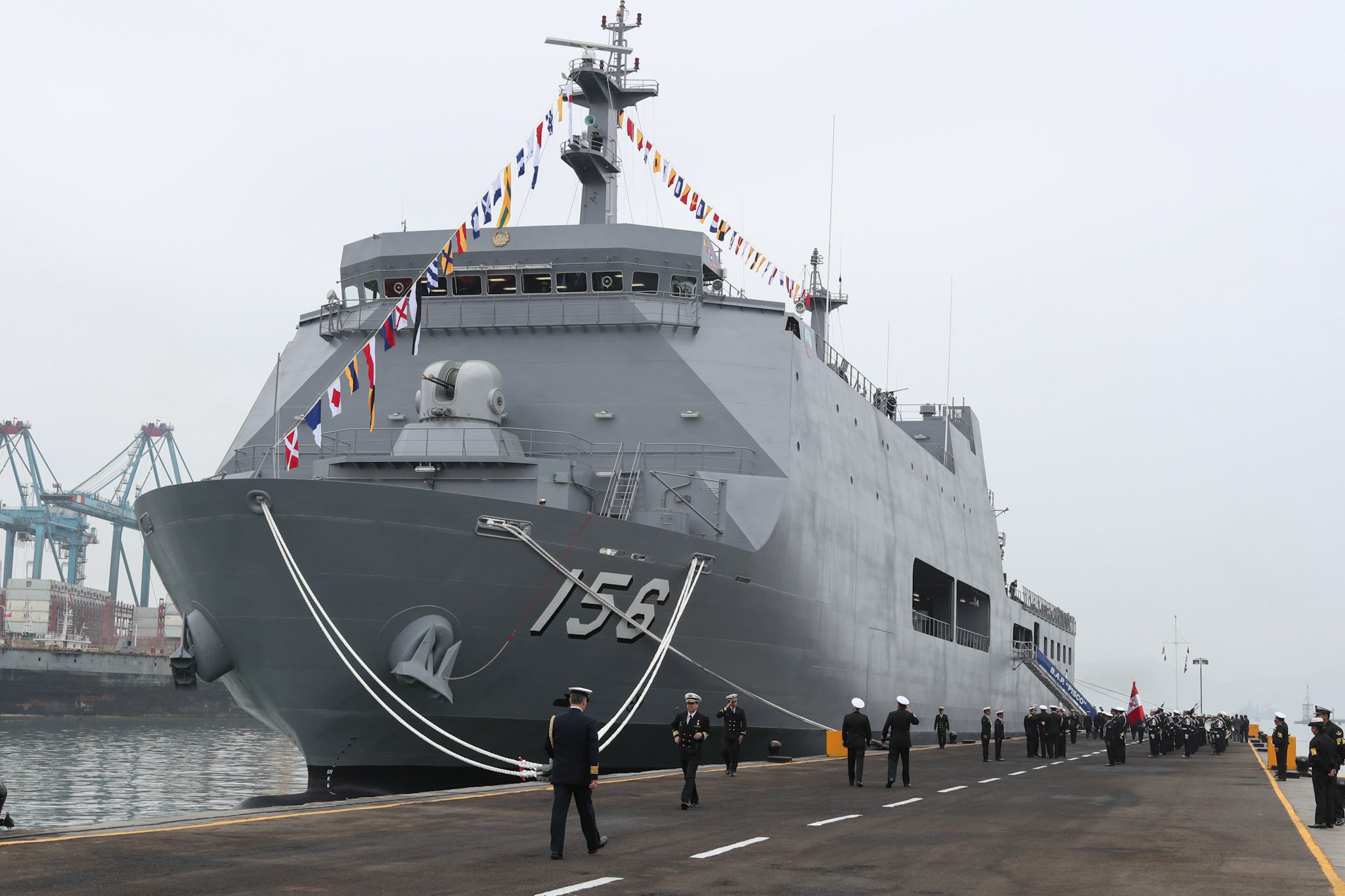
Sweden and Korea are not the only countries to engage in co-production. Notably, France and Brazil are currently collaborating to design and build the latter’s first nuclear-powered attack submarine, a major coup for the latter country. Willingness to engage in technology transfer and shared manufacturing is therefore one way that other ambitious defense exporters could seek to capture a greater share of the South American market.
Navigating fault lines
Even if they may end up competing with U.S. weapons sales, the fact that Sweden and Korea have been successful in the South American market is a geopolitical win for Washington. Being able to present an option with more flexibility than U.S. foreign military sales, without the baggage of being direct adversaries likely helped both countries market themselves, especially when vying to supply high-end capabilities.
Painfully drawn-out as it was, the multi-year drama surrounding Argentina’s F-16 purchase was perhaps a signal for other countries looking to modernize that buying high-end kit from China is a third rail for the United States. Meanwhile not only has Russia bowed out from the South American arms market, a steady stream of images and video of destroyed Russian equipment has tarnished its reputation for international buyers.
This does not mean that Swedish and South Korean exports have been wholly unblemished. In the wake of the Thailand-Cambodia border clashes, the Gripen is now “battle tested” having been employed by the Royal Thai Air Force to conduct precision strikes during that exchange. However, it has also stirred up rumblings of uncertainty, as Sweden reportedly reconsidered whether to move forward with a planned delivery of 12 additional Gripens to Thailand. While South American operators in theory hopefully shouldn’t need to worry about a border conflict scuttling their plane deliveries, nobody likes to be reminded that your supplier could pull out (see the ongoing drama in Canada around F-35 purchases). Closer to home, the United States is currently investigating Saab’s North America division for alleged irregularities in its involvement in Brazil’s fighter procurement process. While previous probes have not found evidence of wrongdoing on Saab’s part, corruption in military procurement remains a risk across the region, and feature that less-than-scrupulous actor can exploit.
So what?
Analyzing trends in arms procurement by South American countries may be an interesting academic exercise, but why does any of this matter, after all, it’s not like there’s any real risk of war breaking out in South America?
This is a question that inevitably comes up in any conversation on defense policy in the Americas. Indeed, this region is remarkable for just how infrequent interstate conflict is, though of course there is intrastate violence aplenty. The Cenepa War between Ecuador and Peru was 30 years ago and little more than a glorified border clash. The last high-intensity clash in the region was the 1982 Falklands War and to find a true major interstate war between powers in the Americas one needs to look back to the 1932-1935 Chaco War between Bolivia and Paraguay. With this in mind, why would South American states need to buy fighter jets, submarines, and other kit that is mainly directed at peer adversaries?
I have a few thoughts on this matter. First of all, I think that even in the absence of an immediate threat, most governments would prefer to have capable armed forces. Militaries are surprisingly versatile tools, while their most obvious role is defending the country from armed incursion, in South America, militaries participate in vaccination efforts, disaster evacuation, construction, and of course responding to organized crime which is one of the leading threats to the health and well-being of civilians across the continent. Militaries bring the right combination of discipline, logistics, and organized violence that you want to have access to in the event of a crisis. But there’s no shortcut to having a good military, you either invest the time and resources in professionalizing, training, and equipping a force to take on a diversity of missions, or you acknowledge that you simply won’t be able to respond to certain emergencies.
Similarly, you need your military to have the right tools for the job, that means you need air and sea lift to get into challenging environments, sensing to obtain domain awareness, precise and diversified fires, and of course the logistical “tail” to keep all of this working. Don’t have enough helicopters? Good luck taking down that illegal mining operation in the heart of the Amazon. No spare offshore patrol boats? You’ll have to ask for help interdicting that cocaine shipment.
Additionally, the absence of conflict at present does not mean the absence of the potential for conflict. South America remains heavily affected by stag hunt/credible commitment problems, there is no NATO-equivalent mutual defense partnership to curtail malicious incentives. In this scenario, it is better to remain armed than risk finding yourself exposed while others have built up.
Consider for instance Venezuela’s recent threats towards Guyana. While tensions have been long-simmering over the disputed Essequibo territory claimed by both countries but administered by Guyana, they spiked in December 2023 and have remained an on-again-off-again concern since. While it would likely be disastrous for Venezuela to invade, it is able to continue to threaten action due to the small and underfunded state of the Guyana Defense Force. If Guyana possessed a more capable military, it seems realistic to suggest that Venezuela would find its strategy of coercion harder to implement. Indeed, Georgetown seems to be moving to correct this, nearly doubling its military expenditure between 2023 and 2024.
Finally, a modern military can support a robust defense industry, with a number of knock-on effects for a country’s economy. Much has been said about the role defense spending has played in fueling technological breakthroughs in the United States, but it is worth considering how it might benefit South American states. South American economies tend to be afflicted by the same broad dependency on commodity exports to drive economic growth. The region has long sought to capture higher rungs of the value chain, often through protectionist trade barriers and halting industrial policy.
Defense manufacturing offers one way to engage in a more targeted industrial policy, focusing on a small segment of the broader economy to build up advanced manufacturing knowledge that ideally spills over to other industries. Engineers trained on building armored vehicles can go on to jump-start commercial automotive companies, welders can find employment on warships and cargo ships in equal measure, and savvy defense entrepreneurs might expand their operations into the civilian market in search of new profits.
None of this is in any way easy or straightforward, and, with the exception of Brazil perhaps, South America has struggled to cultivate a globally-competitive defense industry. However, the kinds of technology transfers offered by Sweden and South Korea could act as springboards for the region to more rapidly incorporate more leading-edge technology and methods.