Last month, The Economist ran a story suggesting that the Italian mafia may be coordinating to keep fentanyl out of the country. It was a classic gangster with a code story, sure the mafia deals in cocaine, heroin, human trafficking, extortion, and assassination, but the scourge of fentanyl is one step too far. I remain skeptical that such criminal codes of conduct are indeed the driving factor behind the apparent lack of uptake in fentanyl within European drug markets. Still, the story provides a useful opportunity to think about how and when criminal organizations cooperate with one another.
While “the mafia” is hardly a unitary actor, instead consisting of multiple rival factions and power structures, it appears as though the modern Italian criminal underworld has fairly robust mechanisms to limit internecine conflict before it boils over. Contrast this with Mexico, where the incentives to defect from any set of shared rules are so strong, the country’s multitudinous criminal wars now boast death tolls in excess of several major world conflicts.
One of the key reasons for this state of affairs in Mexico is the absence of a criminal hegemon powerful enough to impose its will throughout the country. Instead, Mexico finds itself in a lamentable position wherein the Jalisco New Generation Cartel (CJNG), often regarded as the most powerful criminal group in the country today, is strong enough to continue expanding the geographic scope of its operations, but not powerful enough to suppress all of its would-be challengers everywhere at once. In international relations parlance, non-CJNG criminal groups are balancing against an unconsolidated hegemon.
Pulling on this thread a little further suggests that the security situation in Mexico, and elsewhere in the Americas, would likely improve significantly if the CJNG, or any other group, emerged victorious over its rivals. This would bring about peace not as a consequence of a stronger Mexican state, but rather a “Pax Mafiosa” enforced by the dominant criminal actor in the country (some readers, surely, will recall that this is essentially the premise of Sicario).
The same dynamics can be found throughout the Americas. In cities and countries where organized crime has become sufficiently entrenched and consolidated, violence trends downwards. By contrast, when states crack down on individual gangs, violence often increases in the aftermath as other illicit actors fight over the scraps.
In today’s post, I want to wrestle with this idea that criminal consolidation reduces violence, and what implications that has for how we think about security policy in the Americas.
Unstable Equilibria
The literature on why states, insurgencies, and individuals clash with one another is a deep and rich about. Chris Blattman, in his 2023 book Why We Fight, presents a set of explainations for violence that apply in theory to each of these levels, from gang rivalry in Chicago to high-stakes peace negotiations between countries.
One important factor Blattman highlights is information asymmetry. If two parties have perfect information about one another’s respective capabilities and resolve, it should be possible to strike a bargain without a costly and destructive fight. However, in the absence of such information, war stands in as a bloody method for groups to credibly reveal their relative strength to one another.
Blattman draws upon previous literature, notably James D. Fearon’s 1995 article “Rationalist Explanations for War” but notably applies them at the subnational level as well. The first chapter of Why We Fight, appropriately named “Why We Don’t Fight” deals with a skirmish in the game room of a Medellín prison.
The backdrop to this fight concerned a rivalry between two criminal outfits whose leadership was based in the same prison facility, but extended outward to control street crime and extortion revenues from Medellín proper. When an argument in the prison billiards room turned into a bloody skirmish, it seemed like this rivalry was primed to ignite into a wildfire of gang-on-gang violence. Instead, the leaders of the rival outfits met, and determined the cost of war was not worth the damage it would do to both of their businesses. Following tense negotiations, and concessions from one side, both walked back from the brink.
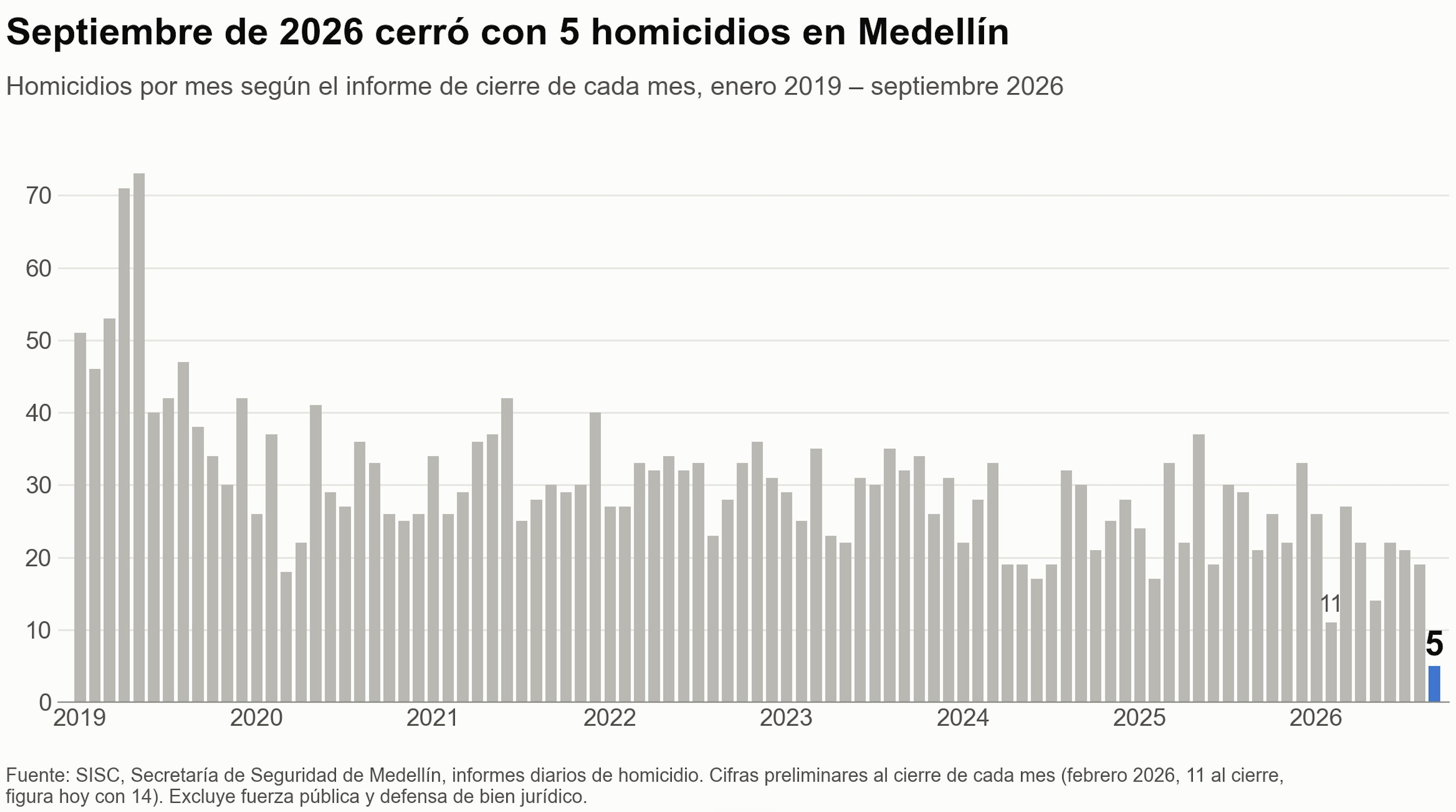
This tense, but stable arrangement between gangs has kept Medellín remarkably peaceful. Even as Colombia as a country grapples with resurgent criminal violence, its second-largest city reported just 5 homicides during the month of September. At the same time, criminal control over the city has hardly been diminished, with extortion in particular remaining stubbornly high.
For its part, Medellín’s government has contributed to this state of affairs by avoiding direct confrontation with the gangs, instead opting to police around the edges and deter the most egregious forms of violence. By contrast, several studies allege that harsh crackdowns on organized crime by so-called “mano dura” policies can often inflame violence rather than tamp it down.
One mano dura policy that has drawn extensive critique is the “kingpin strategy” which relies on targeting high-level cartel and gang leaders to disrupt the lower rungs of their operations. In practice, decapitating illicit networks causes these to splinter into brutal internecine conflicts. Former lieutenants smell blood and move in to claim a piece of the old kingpin’s empire for themselves, almost inevitably clashing with one another in the process. The ongoing civil war within the Sinaloa Cartel also illustrates how other criminal groups can exacerbate these succession struggles, with the CJNG moving to back the Chapitos faction in this conflict.
Meanwhile, Mexico’s recent reductions in violence seem to be attributable at least in part to the remarkable lack of factional splintering within the CJNG following the killing of El Mencho in February.
This all leads to the unpleasant conclusion that the easiest way for most Latin American countries to bring violence down would be to pursue some form of accommodation with organized crime. Whether this takes the form of a criminal leviathan capable of subduing all rivals, or a kind of armed peace like that which prevails in Medellín, the empirical outcomes seem to be best when states give up on trying to stamp out crime entirely.
But I remain unconvinced that this represents a model worthy of emulation throughout the Americas. Pursuing détente with organized crime still means accepting high levels of illicit economic activity that corrodes civil society, rule of law, and development. It means granting a de facto license to gangs to shake down businesses, push drugs, and run private resorts inside prisons. Furthermore, should the Pax Mafiosa ever fail, it could mean the government that welcomed it will face a criminal threat that has grown richer and more powerful as a consequence of the free reign it had during peacetime.
Ecuador, for instance, pursued an accommodationist policy under Rafael Correa that had success in curbing homicide rates. However, as the country grew in importance as a transshipment hub for the global cocaine trade, new rivalries and factions drove up criminal conflict, and violence followed.
In a similar fashion, former president Gustavo Petro’s “Total Peace” agenda was undone partly by rivalries between Colombia’s disparate nonstate armed groups. These factions would negotiate a ceasefire with the government to reduce pressure from police and military forces, only to turn around and intensify their campaigns against rival insurgents or gangs. Even when the state itself seems committed to a Pax Mafiosa, the criminals ecosystem may not support such a regime.
A Farewell to Arms
Between Mano Dura and Pax Mafiosa, which policy works best for Latin American governments? The case of El Salvador suggests that one answer may be to pursue the latter first, before pivoting to the former.
According to reports from outlets like El Faro and ProPublica, Salvadoran President Nayib Bukele struck deals with the country’s largest gangs to keep violence at manageable levels (as some of his predecessors had done as well). These secret pacts held until Bukele’s effort to crack down on the extortion of bus drivers threatened to compromise a key illicit revenue stream. In March 2022, El Salvador’s gangs unleashed a weekend of violence that left scores of civilians dead. From the gangs’ perspective, this was something of a negotiating tactic intended to bring the government back to the table and secure assurances that their protection rackets could remain untouched.
Instead, Bukele unleashed a massive anti-crime operation that would eventually become today’s permanent state of exception. At the time however, gang leaders reportedly instructed their foot soldiers to lie low, and wait for what they assumed would be a temporary crackdown to pass. It never did, while the very connections that had sustained the covert deal between the Salvadoran government and the gangs also provided the state with a detailed understanding of the criminal leadership structures within the country.
Quickly, MS-13 and Barrio 18 leaders found themselves behind bars, with cell service and visitation rights cut off, unable to coordinate an effective response. Without clear direction, their rank-and-file members were swiftly caught up in police and military dragnets (along with thousands of regular civilians). The gangs were never able to mount a challenge and violence cratered.
What happened in El Salvador is not necessarily a replicable template for other countries in the Americas. It nevertheless provides some useful insight into why certain mano dura approaches seem to work, while other flounder.
In my view, much of this comes down to the question of whether the criminal groups being targeted are willing to contest the state. In El Salvador, they were not, elsewhere in the region, they seem more prepared. In Santa Marta, Colombia, the death of gang leader José Pérez Villanueva at the hands of state forces triggered a wave of violence throughout the coastal city. The level of chaos the criminals were able to unleash in Santa Marta is largely a function of how embedded they have become in the social and economic fabric of the city thanks to years of accommodationist policies.
It may be the case that a prolonged Pax Mafiosa dulls the sharp edges of criminals and in turn makes them less prepared when the hammer of the state comes down in the future.
Or perhaps eventually the criminals over time come to exist at the margins of society in a way that are more palatable to all involved. The United States, of course, can hardly claim to have eliminated crime, but these days it is difficult to imagine any a street gang or mafia orchestrating roadblocks and mass bombing campaigns in response to the detention of one of their capos.
Ultimately, I don’t feel I have a tidy conclusion for this piece. I do think however that we should be more honest in our discussions about the tradeoffs governments in Latin America confront when thinking about security policy. It’s fair to acknowledge that the kingpin strategy is ineffective as a means of reducing violence, but does that mean governments should never arrest kingpins? When we talk about how Pax Mafiosa reduces violence and insecurity, we should consider what life actually looks like under a criminal hegemon and whether an end state worth pursuing.