

We’ve all seen the images by now, shock-white walls, tattooed men stacked on triple-decker bunks, staring out with blank expressions as breathless journalists snap pictures and politicians pose for photo-ops. Images from El Salvador’s Terrorist Confinement Center, or CECOT by its Spanish initials, have become synonymous with hardline security policies throughout the Americas.
Already notorious among Latin America watchers, the facility reached new levels of notoriety, after the United States shipped more than 200 alleged members of the Tren de Aragua gang there in February 2025. Later the case of Kilmar Ábrego García, a U.S. resident who was rendered to CECOT without due process as a result of an “administrative error,” captured public attention and earned national, as well as international opprobrium.
But while Trump and Bukele’s scheme to position El Salvador as a hub for Prison as a Service failed, CECOT continues to garner admirers throughout Latin America and the Caribbean. Most recently, Chilean president and anti-crime crusader José Antonio Kast toured the facility prior to his inauguration.

Indeed, perhaps the single most remarkable part of El Salvador’s journey from one of the most homicidal countries in the Western Hemisphere to one of the most peaceful is the fact that the country was able to maintain control over the prison system even as incarceration rates skyrocketed. That hasn’t happened more or less anywhere else in the hemisphere.
This feat is all the most impressive when you look at the state of prison systems in most other Latin American countries. As a rule, these tend to be violent, overcrowded, and porous, sustaining all manner of illicit economies within their walls. Some of the hemisphere’s most feared gangs, like the Brazilian First Capital Command (PCC) and Venezuelan Tren de Aragua got their start within these sordid carceral facilities.
Most of us are familiar with this problem at some level. Stories abound of prisons-turned-resorts for their inmates, where booze, drugs, and even exotic pets flow easily in and out. But it strikes me as well that prisons should, in theory, be one of the easiest problems to solve. Unlike the ever-shifting drug trafficking routes, or the thorny task of community policing in dense urban agglomerations, prisons represent a finite number of static locations that should possible to secure one after another.
Unlike most other aspects of the illicit economy, locking down a prison isn’t like squeezing a balloon. If the state can achieve lasting control over one facility, inmates housed there won’t just be able to migrate to another site with weaker supervision. Meanwhile, governments have far more tools at their disposal to disrupt the power of gangs once their members are already behind bars.
Now, just because prison reform seems like it should be easier than other counter-crime interventions, that doesn’t mean it’s easy by any stretch of the imagination. Vast amounts of blood and ill-gotten treasure have been spent keeping Latin America’s prisons overcrowded, under-resourced, and riven by corruption. Often the key links in these networks are prison administrators themselves, who line their pockets handsomely with the kickbacks that come from turning a blind eye to prison-based smuggling networks.
So even though on paper prisons seem like natural starting points for combatting criminal gains, in practice there’s an overwhelming sense that the system in some countries may be so rotten that nothing short of throwing it out and starting over from scratch has any chance of success.
Still, I think it’s too early to throw our hands up in defeat at this prospect however and hope to outline in this post why prisons throughout Latin America have failed, why I think prison-based gangs are still weaker than we might assume, and how governments could begin to course-correct.
How Prisons Fail
It’s easy to understand how prisons can become breeding grounds for organized crime. Keeping hundreds, or even thousands of lawbreakers under one roof is a challenging task even for well-resourced states. In the United States for instance, prison gangs remain some of the most resilient and brutal illicit organizations around.
The logic of prison-based gangs is simple. Leadership remains on the inside, sending orders to foot soldiers and lieutenants on the outside. These lower-level gang members obey their incarcerated bosses because failure to do so risks forgoing the gang’s protection if and when they themselves are arrested and jailed. For gang leaders, running things from behind bars is also appealing, you’re already locked up so there’s no need to worry that getting arrested will compromise your operation.
Meanwhile, prison guards and administrators allow their charges to have free reign within their cells, and overlook (or even facilitate) smuggling into prisons in exchange for a promise by the gangs to maintain a modicum of order. Failure to strike this deal tends to unleash bloody riots and massacres that most facilities are unable to contain.
The Tren de Aragua gang exemplifies this phenomenon. In 2011, Venezuela adopted the “pran” system in its correctional facilities, devolving responsibility to individual inmates to reduce conflict and violence among various prisoner factions. Tocorón prison, in Aragua state, was a model of this new system, and over time morphed into an inmate-run playground for criminals.
When, in 2023, the Venezuelan police and military raided Tocorón, they found quarters for inmates’ families, artillery shells, a swimming pool and even a private zoo on the grounds. These discoveries made for lurid headlines, but the raid did little to disrupt the Tren de Aragua’s actual operations, as the group had long since metastasized into a truly transnational outfit with tendrils snaking through Colombia down into Peru and Chile, among other geographies.
Reform in this environment is a wicked problem. In order to successfully manage their operations on the outside, prison-based gangs have successfully co-opted virtually every layer of the carceral system. Guards turn a blind eye to violence and illicit commerce, wardens are either on the take or under the gun, and any attempt to reassert state control is met with fierce resistance both within and outside prison walls.
In 2024 for instance, Elmer Fernandez, the newly appointed director of Colombia’s La Modelo prison was gunned down in Bogotá after pledging to crack down on gang activity in the penal system. In Ecuador, the spate of violence that saw gunmen take over a live TV broadcast was precipitated by the escape of José Adolfo Macías Villamar, leader of the Choneros gang, as he was about to be transferred to a new prison. The brutality, coordination, and resources of these gangs tend to far outstrip a conventional law enforcement approach to securing prisons.
More recently, Guatemala declared a 30-day state of siege following coordinated riots that took over three prisons. The violence was reportedly aimed at securing more favorable conditions and transfers to lower-security facilities for Barrio 18 gang leadership. While Guatemalan authorities quickly regained control over the facilities and seem to have stabilized the situation relatively effectively, it remains unclear how durable any gains in prison security will prove.
Inability to reform the carceral system in my view undergirds virtually every failed “mano dura” campaign in Latin America over the past two decades. Politicians, wanting to show they are tough on crime, send the military and police to the streets, where they usually end up arresting a lot of people. But expanding the prison system costs money and takes time, things that aren’t very politically expedient, so the influx of prisoners exacerbates conditions within the carceral system and strengthens the hand of gangs that run these facilities.
The prison, intended to sequester violent individuals from society, is paradoxically at the heart of the violence plaguing several Latin American countries.
The El Salvador Exception
El Salvador stands out as perhaps the only country in recent history to have effectively dismantled its own prison-based gangs and restored state control over the carceral system. It has done so despite nearly tripling its prison population in the space of four years. This is partially a consequence of policy and partially happenstance.
Policy-wise, the Bukele government implemented a number of draconian measures intended to limit the ability of gang leadership to coordinate with their forces on the outside. This included shutting off cell phone reception on prison grounds, limiting family visitation rights to prevent the smuggling of contraband, and housing members of rival gangs in the same blocks. Such practices are avoided elsewhere in the hemisphere as they tend to exacerbate violence within prison facilities.
However, in El Salvador’s case, the speed and scale of the crackdown proved sufficient to catch prison-based gang leadership off guard. This is more a matter of coincidence than a coherent strategy. Several reports now indicate that Nayib Bukele’s government negotiated with gangs, including MS-13, to keep levels of violence within acceptable bounds. When the initial state of exception was declared, gang leaders allegedly ordered their members to lay low, believing it best to wait out the crackdown before returning to business as usual.
By the time it was evident that there would be no such restoration of the status quo, it was too late, while thanks to their negotiations with the Salvadoran government, the Bukele administration conveniently had a rather comprehensive picture of what the gang leadership structure within its prisons looked like. Finally, the construction of new facilities, like CECOT, gave the government expanded capacity to transfer gang leadership and break up networks of command and control.
However, it is still worth noting that most of El Salvador’s prison population is not housed in CECOT, and while the facility has been the subject of harrowing stories of abuse and deprivation, it seems like inmates in other penitentiaries may have it even worse. According to a recent report from the NGO Humanitarian Legal Aid, 40.9 percent of the 470 deaths recorded in Salvadoran prisons since March 2022 have occurred in Izalco prison, while another 18.9 percent were documented in the La Esperanza Center.
While CECOT’s doors are open to a rotating cast of international media outlets, the rest of El Salvador’s penal system is far more opaque, and gang influence there runs deeper. Izalco for instance was populated initially by Barrio 18 members, and even split into two sections to separate rival factions when the gang fragmented between 2009 and 2010. For Bukele’s prison strategy, breaking the power of criminal networks at facilities where the gangs are more entrenched has seemingly required a higher dose of state brutality.
As with most elements of El Salvador’s crime crackdown, the more layers you peel back of the narrative concerning the country’s success at controlling its prison system, the more complicated, and less replicable it appears. However, the dream of replicating Bukele-style policies remains tantalizing for countries grappling with seemingly intractable criminal networks. When Ecuadorian President Daniel Noboa announced the construction of two new maximum-security facilities, he made sure to note “For all the Bukele lovers, it is an identical prison [to CECOT].” Noboa was not exaggerating, Ecuador is currently contracted with the same Mexican Salvadoran firm that built the now infamous detention facility.
The Weaknesses of Prison Gangs
El Salvador’s story also reveals something that may seem counterintuitive at first, while prisons-based gangs can appear implacable, this criminal organizational model is weaker than it lets on.
Prison-based gangs are something of an evolutionary dead-end for organized crime. The structure confers a number of advantages, such as built-in shelter, and recruitment mechanisms, but these ultimately don’t make up for the liabilities in the face of a sufficiently determined government. Command and control is especially susceptible to destruction at either the individual level by transferring individual prisoners, or system level, but blocking cellular communications or housing members in the same cell blocks as their rivals.
El Salvador illustrates how this can genuinely put criminals on the back foot. When Bukele’s crackdown began, MS-13’s prison-based leadership council, the Ranfla Nacional, quickly found its ability to communicate with the outside world cut off, leaving their followers disoriented and vulnerable to being mopped up piecemeal by police and military operations.
Notably, Mexican cartels, arguably the most successful transnational criminal groups in the Western Hemisphere, are not prison-based. In fact, the cartels go to pains to get their top leaders released from captivity or otherwise escape from prison when they are captured. Sinaloa cartel boss Joaquín “El Chapo” Guzmán escaped from prison not once but twice, in 2001 and 2015. The Sinaloa cartel would later use the threat of mass violence and unrest to successfully spring El Chapo’s son Ovidio Guzmán in 2019, and again (unsuccessfully) 2023.
This isn’t to say that Mexican cartels don’t exert massive influence within the country’s prison system, they assuredly do. Rather, controlling prisons seems to be more like the byproduct of the cartels’ efforts to penetrate and co-opt as many institutions as possible, not an integral feature of cartel organization.
Of course, the second most successful criminal groups in the Western Hemisphere, Brazil’s PCC and rival Red Command (CV), among others, are prison-based. PCC leader Marcos Willians Herbas Camacho, alias “Marcola,” has been incarcerated since 1999 while his network has proven resilient despite cycling through multiple different penitentiaries.
My sense with these organizations however is that they benefit most from Brazil’s sprawling and under-resourced carceral system. According to World Prison Brief, Brazil’s incarceration rate has grown more than 90 percent between 2014 and 2024. Without commensurate spending on renovations, new facilities, and better wages for guards, shuffling gang leaders around often simply means opening new vectors for recruitment or violence.
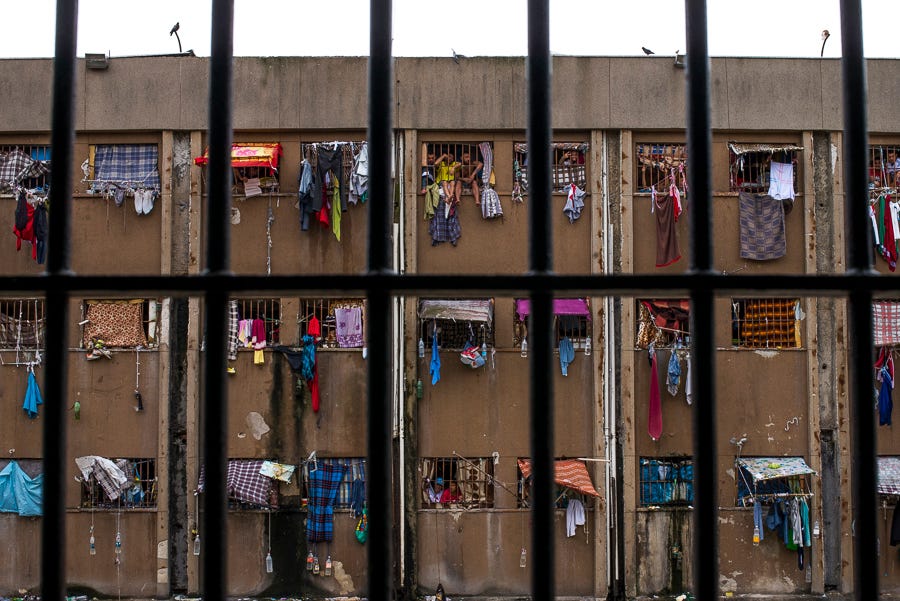
On top of this, groups like the PCC and CV also control territory in urban centers and along key drug trafficking routes in the Amazon and Triple Frontier regions. The CV has also benefitted from a franchise model that delegates significant authority to local bosses, making it resilient to senior leadership decapitation.
A similar phenomenon could be said of the Tren de Aragua, which by the time of the raid on Tocorón, had long since franchised out its name to a coalition of gangs ranging from Arizona to the Andes. Ultimately, it seems as though the more a group grows in power, the less it tries to rely on control over prisons.
Making Prisons Work
The greatest enabler of prison-based criminal groups is state neglect. Governments don’t like spending money on prisons, lest they be accused of lavishing more funding on outlaws than honest citizens. In Ecuador for instance, then-president Lenín Moreno slashed the nation’s prison budget by 15 percent during the Covid-19 pandemic, just before a string of prison massacres would herald the country’s spiral into insecurity.
Even when new prisons get built, there is a disconnect between the time it takes for those facilities come online and the desire to show immediate results, especially arrests, and without constant attention it is easy for the same pathologies of corruption and mismanagement to crop up.
I’m not going to pretend I can offer a step-by-step guide for carceral reform that works in all circumstances. But I do think the region’s security forces should think critically about how to turn the structural weaknesses of prison-based gangs to their advantage, namely the fact that the locations of gang leadership are known at all times and restricted to a finite set of facilities.
In this regard, I think the first step towards reform starts with a six-month to one-year pilot program in moderate-risk facility. The program should involve a comprehensive audit by federal authorities of the prison administration, and endeavor to root out any possible graft within the system and replace corrupt personnel.
Staffing numbers should be increased with clear objectives to reduce, and ideally eliminate, violence within the facility. When sufficient staff levels have been reached, guards should lead targeted seizures of contraband, especially weapons, drugs, and cell phones, and relocate known gang leadership cells to different wings of the facility. The overall goal should be to ensure that the state has complete visibility into goings-on at the pilot prison.
Ideally, states could implement the pilot program at the same time that they build new and more modern maximum-security prisons. Upon completion of both, the trainings and best practices from the pilot facility could be rolled out to other prisons in the system, while the new prisons would help alleviate overcrowding and contain the highest-risk inmates. Then, rinse, and repeat the same program in another facility or two.
Implementing this is likely to trigger a violent response from gang members within and outside the facility. Governments should expect and prepare to contain a spike in violence outside the prison walls while pressing on with reforms in the pilot facility.
Notably, I don’t think Bukele-style violence is necessary to achieve control over prisons. If anything, the culture of impunity and brutality El Salvador has cultivated is undermining El Salvador’s progress in carceral reform. Outside CECOT, some prison administrators in El Salvador seem to have picked up where the gangs left off when it comes to operating smuggling networks behind bars.
Above all, the region needs better prison administrators and guards. Latin America is littered with the bloodstained and hollowed-out remains of what were once state-of-the-art prisons. While I do believe that the region also needs to build more prisons as an essential step towards reducing overcapacity, simply building your own CECOT is clearly no silver bullet.
The problem with running comprehensive carceral reform is that it takes time and costs money, neither of which are popular with electorates. Nevertheless, I’m increasingly convinced that there is no credible path to combating organized crime anywhere in the Western Hemisphere that does not first run through the carceral system.
Notably, this seems like one area where the United States may suffer some of the same problems as the rest of the region. Id have to look at the actual data more, but anecdotally it seems like prisons gangs are one of the few remaining US-origin organized crime groups.