

In December, the Armed Conflict Location and Event Data Project (ACLED) released its annual Conflict Index. The index, which includes “an overall ranking of the top 50 most severe and difficult-to-resolve conflicts in the world” listed four countries in the Western Hemisphere in the top 10: Mexico, Ecuador, Brazil, and Haiti. This was both troubling for me as someone who cares about violence and insecurity in the Western Hemisphere, but also left me scratching my head. Yes, violence in the region is terrible, but is it really the case that the unrest in Mexico constitutes a more serious and intractable armed conflict than what we’re observing in Ukraine?
My point is not to criticize ACLED’s rankings (as my friends know, I’m something of a superfan of the organization), the Conflict Index addressed my initial quibble by providing four indicators – “deadliness, danger to civilians, geographic diffusion, and the number of armed groups.” Ukraine is the deadliest conflict in the world, but Mexico experiences greater civilian victimization and is home to many more violent factions. That all tracks, yet I still find myself grasping for something else when it comes to the way we conceptualize criminal armed conflict.
What does it mean for us to say criminal groups control 40 percent of Mexican territory? Or that gangs rule 90 percent of Port-au-Prince? How can the government of Colombia negotiate peace with groups whose raison d’etre is trafficking illegal drugs and extorting civilians? Extreme organized criminal violence produces the kinds of effects we’ve come to expect from insurgencies or civil wars, but without the familiar ideological or political trappings we’ve come to rely on to guide our theories of change or victory.
From the outside, it may seem like all this bloodshed is culminating in something, a tipping of the scales that delivers a country wholesale into the hands of organized crime. But I would argue that in much of the Americas, criminal violence is less than the sum of its parts. Rather than grand schemes or strategic gambits, fighting in the region is characterized by an endless drip of assassinations, reprisals, and counter-reprisals, rising and falling sometimes at random, sometimes in response to a broader development in the security situation.
The result is a kind of conflict that is atomized and pushed to the background. Violence melds into the pattern of daily life, a steady drumbeat of headlines reporting murders and disappearances, neighborhoods slowly becoming hollow, and hushed reminders to friends and family to make it home before dark. Occasionally, this background noise erupts into the foreground, a massacre, a bombing, a weekend of coordinated killing. In response, the state moves in forces, and, if people are lucky this means violence declines, if not, violence increases for a much longer period. Ultimately, the fighting again fades from the foreground as life flows around it. This is a kind of conflict markedly distinct from even counterinsurgency, one where death tolls can rise to eye-watering amounts without ever seeming to cross the line into true warfare.
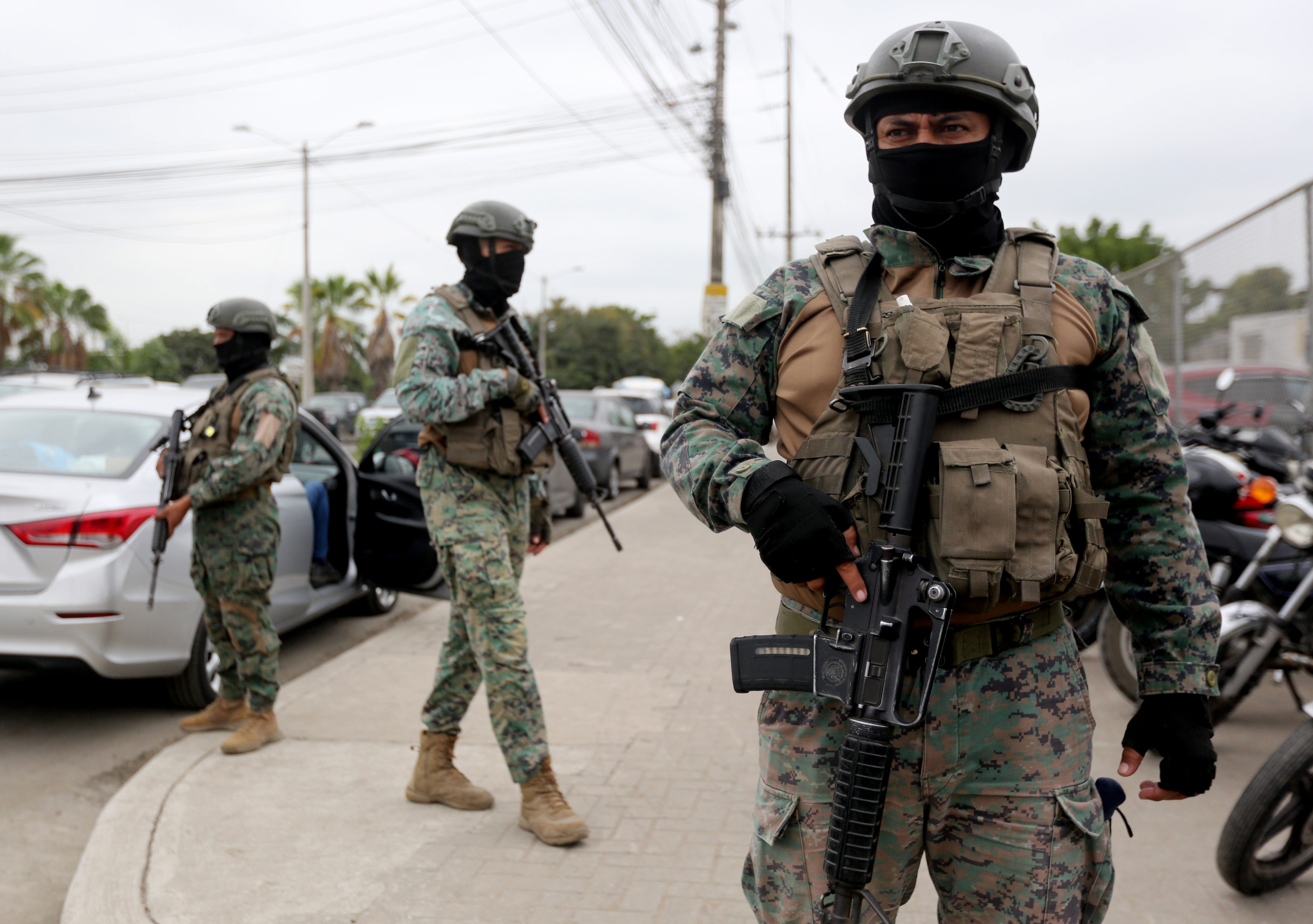
I call these periods Weeks of Lead, violent eruptions organized by criminal groups that are typically time-bound and generally oriented towards specific, limited, political goals.
In contrast to Years of Lead, the violence that springs from Weeks of Lead is less legible to an external observer. A key feature of criminal armed conflict is that the groups involved are not inherently political, but can become political for specific periods in order to achieve certain objectives.
Example Weeks of Lead include the first Culiacanazo, which took place in October 2019 when Sinaloa Cartel boss Ovidio Guzmán was captured by Mexican authorities. In response, the Sinaloa Cartel burned the city of Culiacán, attacked police and National Guard, and victimized countless innocent civilians until the Mexican government caved and released the son of El Chapo. Another, less successful example would be the weekend of killings that took place in March 2022 in El Salvador, when gangs killed 62 people in a single day, likely to protest efforts by the Bukele government to crack down on extortion. In this case, the violence backfired, and El Salvador has by and large managed to dismantle gangs in its territory, but the same cannot be said for most countries in the region.
This makes it hard to predict what the center of gravity for a given criminal actor is, or how it will respond to increased state pressure. Nevertheless, getting the theory right is of vital importance, especially as the United States barrels down the path towards a new Global War on Crime. The Trump Administration has made clear that they view this as an armed conflict, and the criminal networks of today as equivalent to the ISIS and Al Qaeda of yesteryear. This rhetoric is certainly good for stirring passions, but is this accurate?
Ecuador Explodes
“Know that you should not mess with the mafia!” a masked gunman shouted into the camera of a Guayaquil television station on January 9, 2024. This incident soon became synonymous with the ongoing wave of violence that has transformed Ecuador from an island of peace into the deadliest country in South America. It also served as the catalyst for at the time newly-elected President Daniel Noboa to declare a state of “internal armed conflict” and designate some 22 gangs as terrorist organizations, mobilizing the military to combat them.
The TV station takeover was set against a backdrop of a dramatic escape of Adolfo “Fito” Macías Villamar, leader of the Choneros gang, from Ecuador’s Litoral prison on January 7. The violence that gripped the country following Fito’s escape was likely partially orchestrated by the Choneros and their allies to either deter the Ecuadorian government from seeking to recapture him or otherwise distracting the security forces by presenting them with multiple competing crises. From that perspective, it was a canny strategy, but the Choneros’ plans likely did not go much beyond this point. Certainly, there was no total war envisioned against the Ecuadorian state, or at least not one that left the pages of gang propaganda. In the weeks and months that followed Quito’s declaration of internal armed conflict, homicides fell, then, they began to tick back up. Gangs content to lie low to avoid the heat from the military began to get restless, and marshalled gunmen to their banners.
In 2025, Ecuador’s homicide rate was about 29 percent higher than the previous year, and more than seven times higher than it was in 2019. Fito was recaptured last summer, but prison massacres and gang reprisals remain the norm. In ACLED’s Conflict Index this year, Ecuador was catapulted up 36 places to claim the rank of sixth most severe conflict in the world. Looking into the data further sheds some light on the nature of this internal armed conflict as it enters its second year.
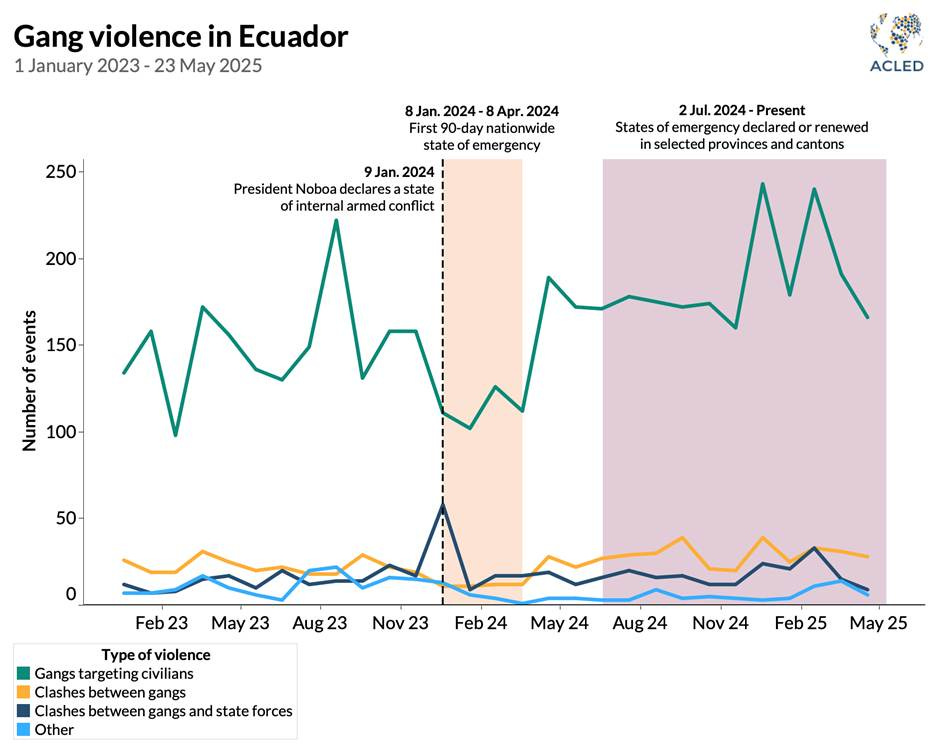
You can probably spot a few notable trends on this graph. For one, the overwhelming majority of political violence in Ecuador takes the form of violence against civilians. This declined somewhat following Noboa’s initial declaration of internal armed conflict, while battles between the gangs and state forces trended upwards. However, since the summer of 2024, civilian victimization has remained stubbornly high. Intra-gang violence is also somewhat up, likely as state persecution has driven fragmentation and competition between armed groups. Overall, levels of conflict seem either unchanged or higher than they were before the government decided to go to war.
The gangs themselves do not have a political agenda, but the Ecuadorian state lacks the language to address the threat they posed as anything other than political. The result is something of a mismatch between government action and criminal reaction, often to the benefit of the latter.
Critically, gangs are more or less able to fight this war on their own terms. When state forces clamp down in one region, they can lie low and escalate operations in other territories. Doing so might put a dent in profits, but in the illicit economy such losses are often priced in already. When the focus shifts and pressure eases up, the criminals can revert to their old ways.
Inter-gang conflict adds another element of randomness to the picture. Prison massacres, for instance, are not directed at the state but rather rival groups housed in the same facility. Nevertheless, they serve as indictments of the Ecuadorian state’s ability to control what should be its most secure locations, while the murder of an incarcerated gang leader can spur retaliatory attacks far beyond the prison walls.
It is a somewhat tired analogy but the situation at present in Ecuador appears much like a game of Whac-a-Mole. State forces can clamp down on one region or group for a time, but almost inevitably violence escalates somewhere else, pulling resources away and allowing violence to break out anew in the formerly pacified region. The country is at war, but despite mobilizing the full might of the state crime and disorder still seem to be winning.
Mexico’s Two Wars
Mexico is one of the most interesting cases of organized crime seemingly bootstrapping itself into a quasi-insurgency. The process through which this has occurred is the result of a fierce arms race between organized crime in the country which has pushed illicit organizations to adopt more and more advanced tactics.
The leading criminal outfits in Mexico lay mines, fly drones, dig trenches, and drive around in convoys of improvised armored fighting vehicles. They employ dedicated units of ex-military and mercenary soldiers for high-intensity operations like the Jalisco Cartel New Generation’s “El Mencho’s Special Forces.”
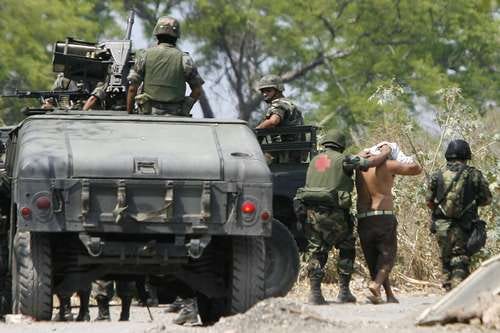
Mexico’s cartel wars have always been tricky for me to wrap my head around. The level of tactical innovation we’ve observed among criminal groups in the country seems vastly beyond even what should be needed to resist police crackdowns, but for the most part these groups have kept both feet firmly planted in the criminal realm, not seeking to challenge so much as co-opt the state in their territories.
My sense is that Mexico faces two distinct modalities of criminal conflict. In one corner is the urban bloodbath, characterized by extortion, money laundering, and heavy civilian victimization, often public in nature to instill a sense of fear in the local populace. In the other is the rural insurgency, where criminal outfits contend with one another as well as the state to control the more rugged terrain on the outskirts of cities in order to either deny their rivals access to these lucrative urban centers or control key smuggling routes.
The interplay between these two conflicts is a key driver of cartel innovation. Criminal outfits must be able to preserve their lines of communication and supply lest they find themselves cut off and encircled by rivals. But once a group has gained access to a key town or city it must be willing to employ extreme violence in order to establish its dominance over the illicit economy there.
Both forms of conflict come with their own demands and challenges for security forces. Urban violence is hard to predict, with killings being executed by small teams or individual operatives while efforts to crack down risk serious collateral damage as cartels meld into dense residential blocks. By comparison, the rural insurgency features larger concentrations of fighters, symbolized by the convoys of up-armored pickups bearing columns of loosely disciplined yet heavily armed gunmen. However, equipped as they are cartel forces are often more than a match for local state police (if they are present at all in the first place) and are spread over a much wider area, making it hard for the Mexican state to achieve local superiority.
This 2022 article from InSight Crime, which recounts the story of a gunman working for the United Cartels in their conflict against the CJNG was always evocative for me. As he describes his journey through Mexico’s criminal armed conflict, his duties evolve from providing security to their local boss as he collected extortion fees, to confronting the narco-tanks and drones of the CJNG in battle on the grounds of an abandoned lime farm. The following passage does a good job in my opinion of capturing some of the intensity, and idiosyncrasy, of inter-cartel fighting:
“Each side had snipers wielding .50 caliber assault rifles, as well as a smattering of soldiers with AR-15s, M16s, and AK-47s. They each also had what they call Monsters: dump trucks and other similar-sized vehicles they’d fashioned into Mad Max-like tanks, some of which had turrets. But the Jaliscos had many more Monsters than the United Cartels. To slow these down, the United Cartels blew holes in the roads or brought backhoes to break up the highways…Still, Carlos said the fighting was sporadic, with shots traded across the lime farm in the middle of the night for a couple of hours, before becoming mostly quiet during the day. Supply lines were also strong. Carlos had six cartridges with 30 rounds each across his chest and another 12 cartridges within reach. Helpers also brought the soldiers good food from the local town, soda, fresh fruit juice, cigarettes, and, of course, marijuana and cocaine.”
This style of warfare is almost feudal in nature, with most fighters being drawn from and operating in geographically bounded regions. They are heavily armed, but poorly-disciplined, making pitched battles rare but skirmishes common. The most powerful cartels succeed by being able to move specialized and higher-quality forces from elsewhere into a contested area to achieve local superiority.
Compared to Ecuador, Mexican cartel tactics conform more closely to our understandings of irregular warfare. But there remains an important difference, despite the fact that the strongest cartels in Mexico wield immense firepower and resources at their disposal, they remain committed not to overrunning the state, but rather pursuing ever-expanding profits.
This helps us make sense somewhat of why homicide rates in Mexico have been falling over recent years, but the overall security situation still seems headed to hell in a handbasket. The actual level of daily bloodshed is not as important to the cartels as their ability to inflict violence, which has been largely unaffected by the state. Hot spots like Sinaloa (and even more specifically Culiacán) have seen their homicide rates skyrocket during the same period while state intervention has struggled to make a dent.
Staunching the Bleeding
What troubles me the most about this type of armed conflict is how difficult it seems to be to reverse. Once organized crime has reached a critical level of penetration in your country it seems you are destined to more or less be locked in to a certain level of baseline violence. Indeed, El Salvador pretty much the only country in the region which has successfully made major strides in breaking the influence of violent, consolidated, organized crime.
Before El Salvador, there was Colombia, which similarly made big strides in the security domain leading up to the 2015 peace agreement between the government and FARC rebels that brought an end to decades of civil war. But it is notable that the Colombian government was still fighting a politicized insurgency in the form of the FARC, which espoused clear goals that could be addressed directly in peace negotiations. Ideological insurgencies still have a role to play in Colombia’s security picture, but the tapestry has become more complex since then. Not only have Marxist insurgencies like the ELN become more criminalized, as the conflict transitioned from a civil war to flawed peace, paramilitary units set up originally to combat the FARC refused to stand down but instead transformed into more explicitly criminal enterprises.
This is probably a big reason why President Gustavo Petro’s “Total Peace” agenda failed, his government sought to negotiate with armed groups with the goal of reaching an agreement wherein they would feel comfortable laying down their arms. In practice, these groups were more than happy to pay lip service to the government in order to redirect their attention to fighting with each other for control over illicit economies.
Failure to understand the nature of organized crime in the Americas is also why I am cautious about U.S. rhetoric proclaiming to treat the cartels like Al Qaeda or ISIS. My worry is that we may be learning the wrong lessons from the Global War on Terror, namely that leadership decapitation can break up nonstate networks and keep them from being able to execute complex plots against the United States or regional allies.
This fundamentally misrepresents the nature of the challenge. Criminal organizations are not interested in complex operations, they are opportunistic and malleable. There is no one figure who can order the drug boats to stop launching, not matter how many get blown up. At best you can make certain forms of smuggling unprofitable, but trust that these groups will find a way to recoup the lost revenue some other way.
Now that doesn’t mean we are bound to lose this new war on crime, but it will require updating the way we think about the threats posed by violent organized crime. As I’ve tried to argue here, these groups sow terror and insurge against the state, but they are not terrorists or insurgents in the traditional sense. We should not expect the same tactics that worked against different opponents to be one-for-one applicable.
The task for the United States as well as its allies in the Americas will be how to choke off the revenue streams for organized crime, defeat corruption at the local level, while building up the kinds of intelligence and rapid-response capabilities to stymie Weeks of Lead when they do break out. By no means is this easy, and I confess I am ending this article here in part because I don’t have very good specific recommendations yet, but hopefully developing better frameworks for thinking about criminal armed conflict can allow us to start asking better questions about how we move forward.
Great article. One question, isn't there something to be learned from Bukele, given his success? Yes, he's also eroding democracy, but maybe there's a universe where a less power-hungry leader can use a state of emergency to initially crack down on gangs and also have a clear plan to return to normalcy once the gangs are significantly weaker?
Democracy matters and should not be flippantly sacrificed for safety, but ignoring the only success story doesn't seem like the best path either (not saying you are btw).