

Lately I’ve been feeling particularly frustrated by the pessimism that abounds in most conversations about public safety strategy in the Americas. It seems to me that the median reaction from analysts, myself included, to any given security policy is skepticism. Whether it’s Mexico’s achievements in reducing homicides, or Colombia’s ultra-mano dura policy, most coverage seems to invariably conclude that either the effort isn’t doing enough, or that qualified successes are being outweighed by deterioration in other sectors.
This is understandable, the truth is fighting crime is hard, and previous few countries in the Americas have actually succeeded in dismantling well-armed and entrenched criminal networks. Analysts are skeptical of government policies because their predecessors also brought supposedly revolutionary crime-fighting ideas that never survived contact with reality. Plus, if there’s one thing worse than a perennial skeptic, it’s the commentator who thinks they’ve stumbled upon one simple trick to fix the security situation in Latin America.
For today’s post, therefore, I’ve decided to share my one simple trick to fix the security situation in Latin America.
It’s called “spend more money on security.”
In all seriousness, calls to devote more resources to a policy problem are as unimaginative as they get, and certainly there’s good reason to expect that simply turning the money hose onto organized crime won’t yield magical results. However, I hope to argue in this post that many Latin American countries are spending much less than they should be on public safety relative to the criminal challenges that they face.
The reasons for this, in my opinion, can be traced to a broader problem with the region. Low average tax rates, high levels of informality leaves governments strapped for cash, especially for funding politically-sensitive social programs, which means that security agencies are often left fighting for scraps with other ministries. Resolving this is not easy, indeed, it will likely require Latin American leaders to confront powerful interest groups, and weigh costly tradeoffs with other forms of spending. Still, right-sizing spending on security is likely one of the most straightforward mechanisms for governments to combat organized crime.
Putting Your Money Where the Violence Is
More money lets governments hire additional personnel, deploy and integrate equipment like security cameras, cargo scanners, marine and air patrol craft, as well as improve state presence in rural communities that are especially vulnerable to criminal predations.
Nevertheless, the conversation around increasing security and defense spending in Latin America remains a contentious one. In fact, one study by the Inter-American Development Bank included certain security sector investments, like the cost of prison administration, as part of its tally of the cost of crime. The logic behind this is that, if crime was lower, governments could reallocate funds spent on police and prisons to more productive sectors.
That may be true, but I think it misunderstands the sequencing that needs to happen to bring violence levels down. For countries facing resurgent criminal threats, they may need to spend more on defense and security first before there can be a peace dividend to reap.
Within Latin America Ecuador is probably one of the biggest spenders on security as a proportion of government budget. Combined spending by the Ministry of National Defense and the National Police made up nearly 10 percent of the government’s 2023 budget, the first year of the country’s “internal armed conflict.”
Still, increased funding has not kept up with the magnitude of the security threats Ecuador faces. Between 2020 and 2025, military and police budgets increased by about 33 percent (the overall government budget grew by 30.3 percent). Meanwhile in that same timeframe, the number of annual homicides in Ecuador grew by a factor or more than 6. Adjusting for inflation in the U.S. dollar paints an even more dire picture, suggesting that real spending on security has barely budged.
In Mexico former president Andrés Manuel López Obrador had been surprisingly fiscally cautious for most of his term, only to spend lavishly in the runup to the 2024 elections, leaving his chosen successor Claudia Sheinbaum with a strong mandate but brewing budgetary crisis. Mexico’s Secretariat of Security and Citizen Protection (SSPC) was one of the biggest victims of this fiscal crunch, seeing its budget cut by 36 percent in the government’s 2025 proposal, only to sustain another 18.6 percent reduction in 2026.
Expenditure on national defense has fared better, and some of the variation can be chalked up to the 2024 transfer of responsibility for the National Guard from SSPC to Mexico’s Secretariat of National Defense (SEDENA). Still, SSPC and SEDENA’s occupied a shrinking share of both the 2025 and 2026 budgets.
But perhaps the most emblematic case of this currently is the bind that Colombian President Abelardo de la Espriella has found himself in over the country’s budget. Despite campaigning on a platform of slashing government spending, his 2027 budget entails a roughly 16 percent increase from the previous year. If implemented, it will bring the country’s deficit to a soaring 9.4 percent of GDP, and even the proposed “rescue” law will merely reduce this to 7.2 percent.
Some of the biggest drains on the new budget will include debt service, pension payments, as well as fuel price stabilization driven by ongoing chaos in global oil markets. Meanwhile, uncertainty over how the Colombian state plans to make up for the shortfall in government finances has left international investors skittish.
None of this bodes well for De la Espriella’s security policy, which requires more resources for the Colombian armed forces and national police to modernize equipment, recruit more personnel, and sustain a high operational tempo. The security assistance package the United States announced over the summer may help alleviate some of this pressure, but not enough.
Informality, Inequality, and Demography
A recent data visualization from Latinometrics highlights how Latin American countries consistently fall below the OECD average for tax revenue as a percent of GDP. Indeed, all four of the Latin American OECD members, Chile, Colombia, Costa Rica, and Mexico, rank below the supposedly laissez fair United States when it comes to tax collection.
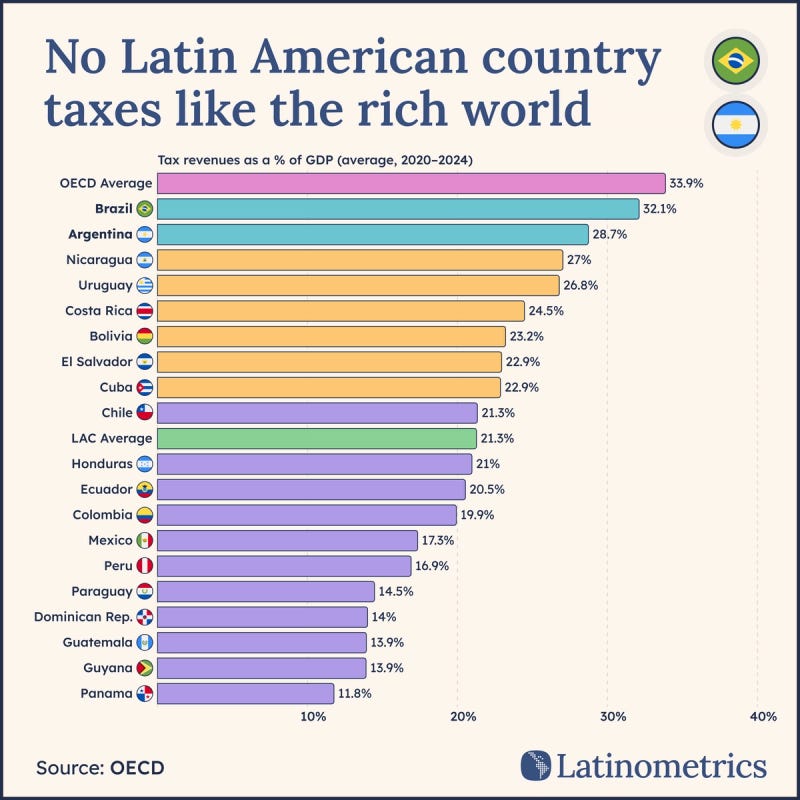
The reasons for this are multifarious, and I won’t have time to give a deep dive into all of these in a single post. My rough diagnosis of the problem most countries face rests on three interlocking challenges, a small base from which to draw taxes thanks to high levels of informal employment, the structural power wielded by a small number of financial elites who have an interest in keeping their own taxes low, and more recently added pressure from demographic factors and ageing populations.
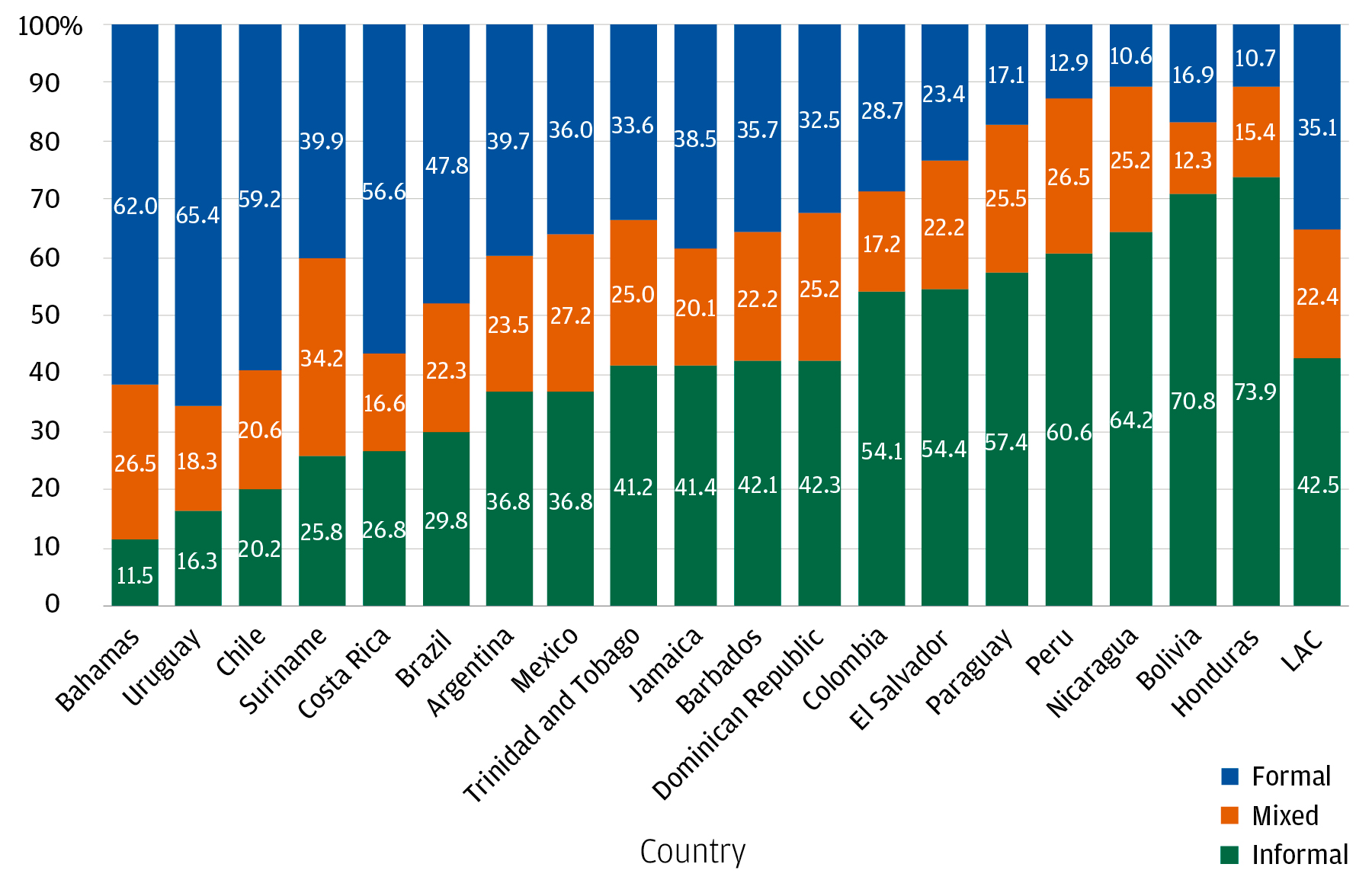
Beginning with informality, more than half of Latin America’s workforce is employed in the informal economy. These range from the proprietors of small and micro-sized enterprises, to rural farmers, to gig workers cycling between multiple jobs to make ends meet. While it is not true that people who are informally employed do not contribute to the tax base, this vast, largely cash-based sector is a persistent challenge for public finances. Beyond taxation, informality is an economic development problem for Latin America as businesses with no formal registration struggle to attract financing that would otherwise allow them to scale operations.
On the other side of the economy, the region infamously ranks as one of the most unequal in the world, where wealth is concentrates in a small number of hands. Wealthy households are part of the formal economy, and represent a major source of revenue for the state. Furthermore, in many countries wealth concentrates specifically around commodities such as oil or minerals, with a limited number of firms competing. This grants the special interests that control said industries significant influence over national economic policy. However, these individuals and companies tend to leverage their power over the formal economy to push for lower tax rates for themselves, further exacerbating inequality.
Poor delivery of government services fuels another vicious cycle. Upper class households don’t see the benefits of their contributions to state coffers, and accordingly are unlikely to support further tax increases. In mid-2000s Mexico for instance, business elites were reticent to pay into President Felipe Calderón’s war on crime, preferring to deal with the cartel threat as best they could through private security or simply by eating the occasional extortion payment.
Demographic trends will only turn up the fiscal heat in Latin America. The region’s total fertility rate has been below replacement for nearly a decade now, with birthrates in some countries approximating those observed in significantly more affluent countries in Europe and North America. An ageing population coupled with low levels of formal employment will only put more pressure on the tax base and means virtually every country will need to consider painful, and politically costly reforms to keep their pensions solvent.
The above factors are general problems that most Latin American governments will face when seeking to balance budgets, but they also mean investments in public safety are competing over how to divide a shrinking pie. Even with strong popular support for counter-crime initiatives, actually getting resources for policing and security efforts has been a persistent challenge.
Don’t Spend it All in One Place
Of course, there’s lots of reasons why merely throwing money at security problems might not yield desired gains. Large infusions of cash can quickly become magnets for corruption, or else can be frittered away through bureaucratic bloat. Absent efforts to hold security agencies accountable for how they spend their bigger budgets, we should rightly be skeptical of proposal aimed at significantly increasing government spending.
In addition, it seems like even if smart investments in security could yield gains, getting the money will be an uphill climb for the structural reasons outlined above.
There’s still hope. Between 2002 and 2009, the Uribe administration in Colombia managed to forge a durable consensus among economic elites to voluntarily increase their own taxes in order to help bring an end to the country’s long-running civil war. Known as the “Democratic Security Tax” these reforms specifically targeted the wealthiest Colombians and corporations, with revenues ultimately constituting 20 percent of the Colombian armed forces’ budget and 1 percent of GDP. Together with U.S. assistance through Plan Colombia, the increased resources had an undeniable impact on the size and professionalism of the Colombian armed forces.
As far as tax reforms go, the Democratic Security Tax is anomalous in Latin America. It was a levy imposed on a small fraction of wealthy Colombians and companies wealthiest to pay for a public good. This was made possible thanks to close cooperation between political and economic elites that reassured the latter, as well as the truly dire nature of the security situation Colombia faced heading into the early 2000s which helped forge greater public consensus on the need for increased defense spending.
The confluence of factors that made Colombia’s Democratic Security Tax possible may not be easy to replicate, but there are lessons that can be drawn for Latin American countries to responsibly increase tax revenue.
In particular, it highlights the importance of earmarking new taxation for specific (hopefully popular) security initiatives to generate public buy-in. While people are distrustful of new levies when these go into the black box of government revenues, they can be more easily sold when there is a clear public benefit the additional monies will be contributing towards.
This could be particularly effective at the local level, where the returns from improved security conditions are more immediately apparent to taxpayers. Successful cases of local security tax hikes could in turn pave the way for a stronger national consensus.
Another factor here will be the United States’ evolving attitude towards security assistance. U.S. financial aid can be a key factor in relieving pressure on cash-strapped governments, though the Trump administration’s slash-and-burn attitude towards overseas aid could complicate matters.
There are still signs that security assistance may persevere, even as development aid withers on the vine. The United States’ $1 billion security assistance pledge to the De la Espriella administration in Colombia, and recent reports that the Trump administration is considering reallocating some $52 million in foreign military financing from Europe and the Middle East towards regional allies in Colombia, Ecuador, Panama, and Peru suggest that there could be more funding to come.
When a policy proposal sounds simple, the first thing you should ask is why it hasn’t been implemented already. In the case of public safety spending in Latin America, the reasons we haven’t seen an increase already appear to be well-known and difficult to dispense with. That doesn’t mean, however, that governments interested in improving their citizens’ security situation shouldn’t try anyways.

.