

When U.S. special forces stormed into Maduro’s bunker on January 3, they weren’t fighting Venezuelans. Instead, 32 Cuban officers belonging to that country’s elite “Black Wasps” special forces unit were among the dead when the first casualty reports came out from Caracas. Much has been written about the close ties between Havana and the Maduro regime, but it seems important to note that, of all Venezuela’s authoritarian allies, only the Cubans were willing to fight and die to protect Maduro.
While Russia issued a strongly-worded condemnation of U.S. actions, and Chinese diplomats met with Maduro the day before his capture, neither country was willing to risk a showdown with the United States over an indebted and fragile dictatorship in the Western Hemisphere. This fits a broader pattern where neither Moscow nor Beijing have seemed willing to lift a finger to back their ostensible allies in Syria or Iran.
If I were a tin pot dictator looking for a lesson from the past two years, I think it would be that if you want someone to trade with in peacetime, call the Russians or Chinese, but if you want help for when the shooting starts, call the Cubans.
Of course, there are important reasons why Havana might be more invested in the Maduro regime’s survival than Beijing or Moscow. Venezuela was at best a convenient partner for Russia and China, but for Cuba maintaining a supply of Venezuelan oil was a matter of existential importance. But beyond pure material concerns, the presence of Cuban special forces in Venezuela is in line with the broader history of the Communist Party of Cuba’s extremely proactive foreign policy.
Cuban military advisors have traveled the world helping bolster anti-capitalist insurgencies, Cuban sympathizers have penetrated the highest rungs of the U.S. diplomatic corps and intelligence agencies, and the Cuban revolution exerts a powerful ideological pull within left and left-leaning spaces. Whether you think this is admirable or damnable, it is undeniable that the island nation has punched well above its weight on the global stage.
Cuba strikes me as one of the last bastions standing against what Francis Fukuyama deemed the end of history, a communist regime dedicated to third worldist revolution and willing to invest its blood, and what little treasure it has, in fighting the imperialist West wherever it can. But the rest of the world no longer thinks the same way, and the cracks in Cuba’s façade are increasingly apparent.
Cuba’s overseas medical missions, where the country sends its doctors abroad to provide care in exchange for money or in-kind support from the host country, are a good example of a program which is noble in theory. However, the program has faced accusations of labor exploitation as the island has come to rely on them more and more for income. Potentially tens of thousands of Cubans are also fighting on behalf of Russia in Ukraine, many of whom were recruited under false pretenses as part of a smuggling operation Havana has seemingly been reticent to crack down on. Finally, decades of economic mismanagement (U.S. embargo notwithstanding) have left the country circling the drain while highlighting the regime’s need for increased repression to stay in power.
Now as the White House moves to try and give the Communist Party one final push off the ledge, today’s post hopes to trace some of the ways Cuba has cast a far larger shadow over world affairs than one might expect, and why, after nearly 70 years of dueling with the superpower to the north, it seems like the project could be on the verge of coming undone.
Cubans in Angola
On November 10 1975, the Portuguese flag was lowered from Fort São Miguel, Angola, with little fanfare by a military which had spent more than a decade waging grinding counterinsurgency wars throughout Portugal’s African colonies. The next day, Angola declared its independence, but for the Popular Movement for the Liberation of Angola (MPLA) however, the war for independence was but a prelude to an emergent civil war.
By late 1975 the MPLA was no longer fighting colonial armies, but was instead embroiled in a three-way civil war against the U.S.-backed National Liberation Front of Angola (FNLA), and the National Union for the Total Independence of Angola (UNITA) which received backing from both the CIA and China. On top of this internal power struggle, apartheid South Africa, fearful that the independence of both Mozambique and Angola could precipitate more unrest at home or in occupied Namibia, soon became involved.
By 1975 Pretoria was building up an invasion force to deploy into southern Angola codenamed Task Force Zulu. The primary target of this operation was the MPLA, who could at that time muster between 5,500 and 8,000 troops under its armed wing, the People’s Armed Forces of Liberation of Angola (FAPLA) at independence. The invasion moved swiftly, delivering a series of defeats to FAPLA troops in the south and eventually threatening the capital Luanda.
In the face of a rapidly deteriorating situation, Cuba organized a massive air and sea lift of Cuban troops to bolster the MPLA and retake the south of the country. The island nation had cooperated with the MPLA for about a decade, but until now its role had mainly been supplying trainers, never more than a few hundred. Prior to 1975 Havana also hoped Angolan independence would allow it to draw down these forces. Now that would have to wait. Unwilling to let the MPLA fall, the Cuban Revolutionary Armed Forces (FAR) embarked on a colossal strategic and logistical undertaking known as Operation Carlota.
Approximately 30,000 troops were deployed to Angola in the first waves, alongside heavy artillery and multiple rocket launchers, crossing 6,000 miles of ocean to turn the tide. The origins of this taxing intervention reveal several underlying dynamics in the Cuban-Angolan relationship. Its very name, which drew upon the actions of Carlota Lucumí or “Black Carlota” who led a Cuban slave revolt in 1843, deliberately evoked Cuba’s deep ties to the African continent. Indeed, Cuban rhetoric often framed its deployments to African countries, Angola included, as recompense for the island’s historical role in the Trans-Atlantic Slave Trade.
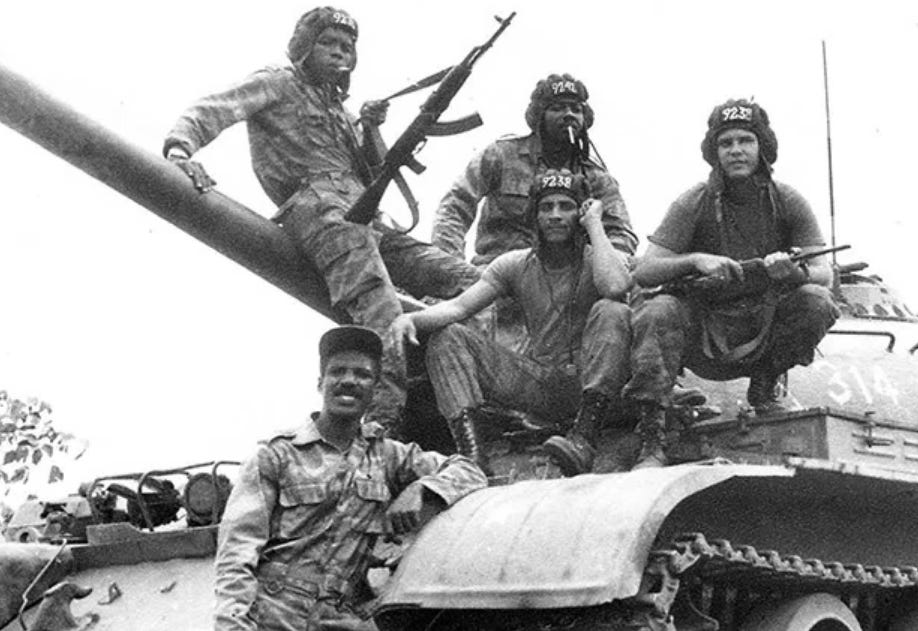
Ultimately over 400,000 Cubans would serve in Angola between 1975 and 1991. The majority of these individuals would fill military postings, but some would also serve as doctors, teachers, and administrators helping the MPLA consolidate control over the new Angolan state.
It’s worth dwelling on the magnitude of this effort for a moment. Here you have a small island nation, locked in its own Cold War with a much larger adversary to the north, conducting expeditionary logistics to sustain a major fighting force an ocean away. This is the type of operation that is expected of great powers, and in terms of personnel levels and the duration of their deployment, I think we have yet to see either Russia or China embark on an equivalent mission in recent memory.
Perhaps the high-water mark of Cuban combat involvement would come after August 1987 when the FAPLA began building up forces at Cuito Cuanavale for a massive southward push against UNITA. The FAPLA’s first offensive began with 6,000 elite troops and 80 tanks advanced on UNITA positions along the west bank of the Lomba River. Upon reaching the Lomba however, Angolan forces confronted not just UNITA, but a 3,000-strong South African detachment, complete with tanks and artillery drawn up in defensive positions.
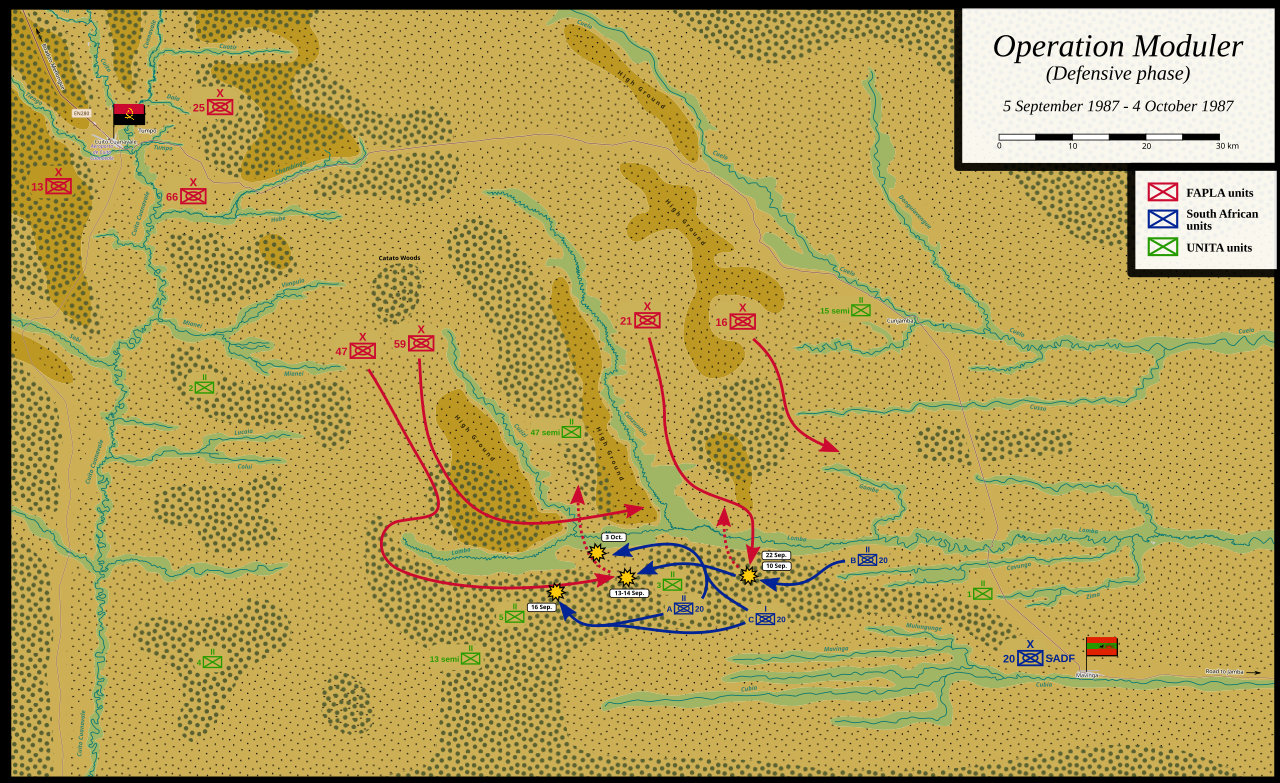
The FAPLA units were plagued by poor communications and battlefield coordination, leading several detachments to become pinned down by South African firepower along the opposite bank of the river. Badly mauled, the attacking forces sustained as many as 3,000 casualties while roughly three-quarters of its armored assets were crippled. Worse yet, the loss of such a large portion of FAPLA’s supposedly best units emboldened South Africa to press deeper into Angola. Thus, the MPLA found itself on the defensive against a joint South African-UNITA attack that was once again eyeing Luanda as its ultimate goal.
The MPLA brough new entreaties to Havana, and in response, Fidel Castro embarked on yet another major cross-Atlantic deployment, airlifting additional troops and equipment to Angola. Cuban forces embedded with FAPLA troops at the brigade level, constructing defensive fortifications along the Tumpo bridgehead on the Cuito River. These were supplemented by minefields and artillery emplacements to create deadly killing fields along all potential crossings.
Subsequently, Castro ordered the Cuban-FAPLA units to pull back, a savvy tactic which forced South African-UNITA forces to waste men and material penetrating empty defensive lines under punishing artillery fire. In early 1988 the SADF attempted four assaults on Cuito Cuanavale, and though they inflicted considerable casualties on both the Cubans and Angolans, the invaders were repulsed each time. While South Africa would maintain a nominal presence in southern Angola to rebuff future FAPLA assaults, the danger of a total collapse of the MPLA had seemingly passed.
At the tactical level the results of the battle were mixed, but Cuito Cuanavale was quickly mythologized as a turning point in the struggle against imperialism and a decisive blow against the South African apartheid regime in particular.
The Cuban intervention in Angola is to me one of the most interesting conflicts you’ve never heard of (Billy Joel fans maybe excepted). What’s also fascinating is that it seems like Cuba’s ideological commitment to Angola and the MPLA was genuine. Sure, Fidel and the Cuban leadership consistently sought to draw down their forces, and Cuba undoubtedly reaped benefits from its alliance with an oil and minerals-rich country like Angola, but the expected returns seem minimal compared to the risks of deploying tens of thousands of your own soldiers an ocean away.
Cloak and Dagger
In addition to coordinating both overt and covert military interventions, Cuba has proven adept in the field of espionage.
Perhaps the most famous case is that of Ana Belén Montes, who was arrested on by the FBI on September 21, 2001. For 17 years she reportedly acted as a double-agent, using her position within the Defense Intelligence Agency (DIA), where she eventually rose to become a senior expert on Cuba, to pass classified intelligence over to a Havana. Montes is regarded as one of the DIA’s worst counterintelligence leaks, and pled guilty to revealing the identities of at least four undercover agents operating in Cuba.
Montes never took a paycheck from Havana, her reasons for spying were rooted in sympathy for the Cuban cause. This is a pattern among Cuban double agents, who, more often than not are enticed by the romanticism of the Cuban revolution. In 2024 for instance, veteran diplomat and career ambassador Manuel Rocha was arrested and charged with spying for the Cubans as well.
Like Montes, Rocha was already sympathetic to Cuba when he entered the foreign service, and by his own admission pursued a career in diplomacy in order to better aid Havana. Cuba’s ability to cultivate highly-motivated double agents willing to climb the rungs of U.S. intelligence and diplomatic bureaucracies has afforded it an important window into Washington’s Latin America policy. It may also be a bargaining chip Cuba can deploy to garner support from its authoritarian allies.
In the summer of 2023, the Wall Street Journal broke a story that China had reportedly negotiated agreements with Cuba for access to signals intelligence facilities on the island. Previous investigations, as well as a slip of the tongue by Marco Rubio during the 2016 Republican primary debates, suggest that China has enjoyed privileged access for far longer. It may well be the case that Cuba opened the door for Chinese intelligence services in exchange for economic support from the PRC.
Two years ago, I worked on a project looking into open-source information on these sites. While we weren’t able to find a smoking gun, there seems to be plenty of circumstantial evidence to suggest that, at a minimum, these facilities are both active and have the requisite capabilities to gather signals intelligence on the United States. One of the sites, a circularly disposed antenna array under construction near Santiago de Cuba on the island’s southeastern coast, seems to have been abandoned following publication of our report as well.
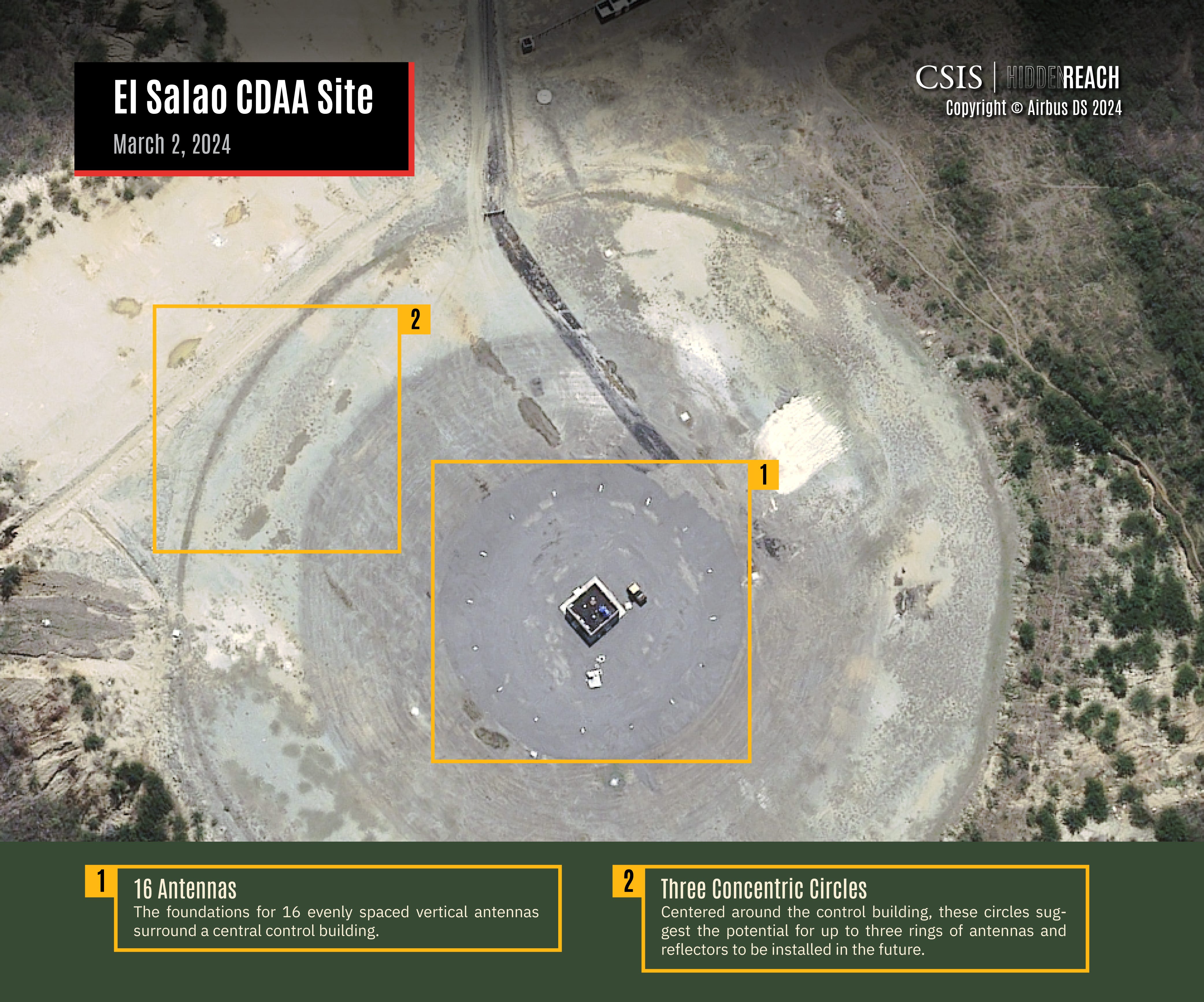
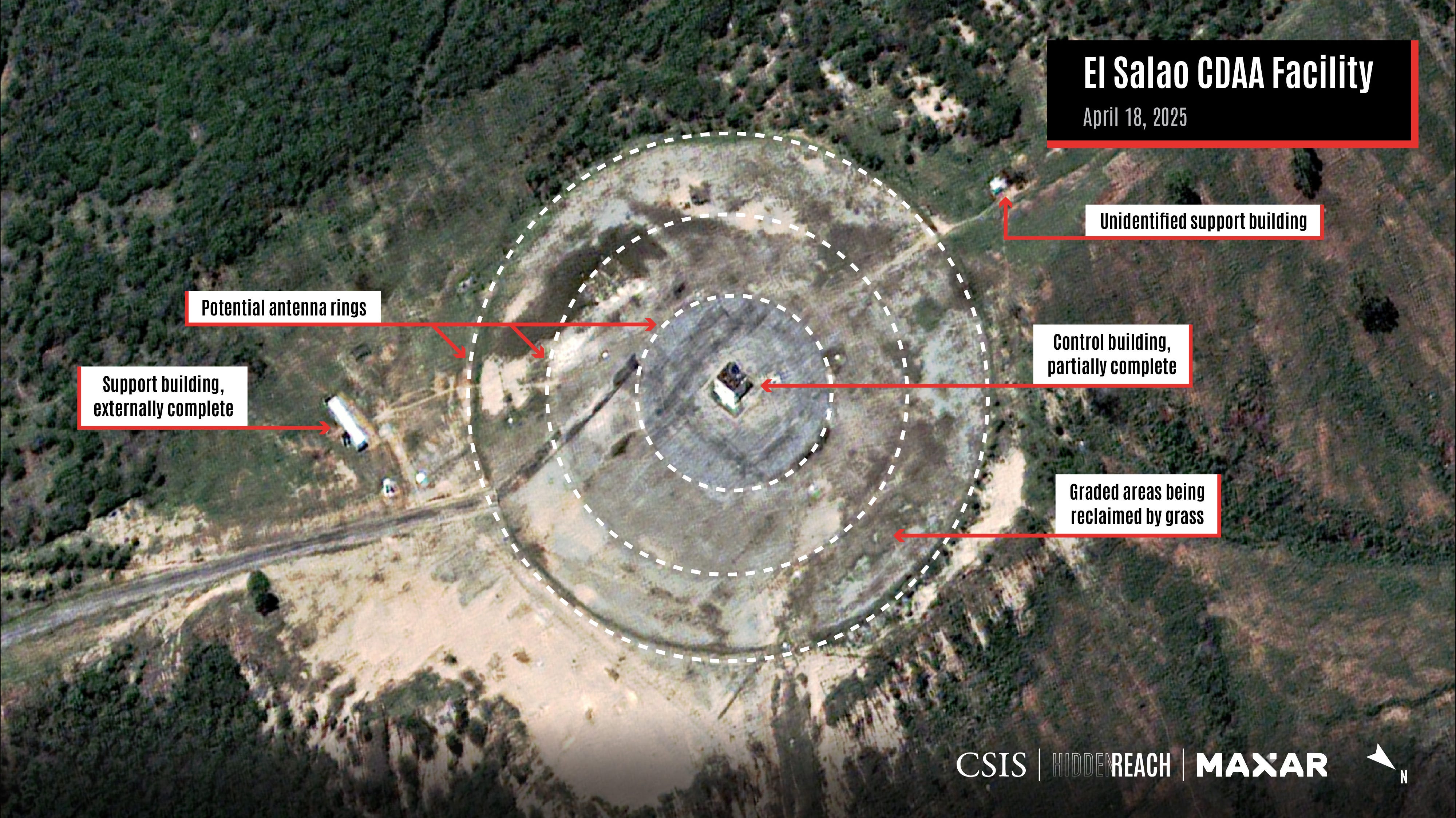
It may be the case that signals intelligence has supplanted human intelligence as the primary mode of espionage Cuban can trade in. Parsing fact from fiction in this area is difficult given the tendency of exaggerated or even wholesale fabricated takes to blow up when it comes to Cuba. Nevertheless, even if the ideological appeal of the Cuban revolution has dissipated following the end of the Cold War, Cuba’s intelligence apparatus is surely still a force to be reckoned with.
The Curtain Falls
Given the Cuban Communist Party’s track record of both opposing U.S. interests abroad, and remaining well-entrenched at home, it seems like the party should be well-positioned to weather a second Trump storm. Indeed, for most of the first Trump administration, there seemed to be little indication that the revolution wouldn’t keep marching on.
There are several reasons for why Cuba now appears to be trapped in an inexorable downward spiral, but the most clear-cut is probably Covid. The pandemic decimated Cuba’s economy, bringing the all-important tourism industry to a screeching halt. It further disrupted the island’s sugar industry, another key export sector and source of foreign currency.
In 2021 the death of Raúl Castro and ascension of Miguel Díaz-Canel also left the country, for the first time since the revolution, with a leader who had not taken part in the overthrow of the Batista regime. While Cuba had weathered economic deprivation before, now it faced hardship without a particularly charismatic leader to embody the spirit of revolution.
A negative economic shock turned into a worsening crisis as a lack of revenue left the Cuban government unable to respond to subsequent challenges. Cuba’s infrastructure, already dilapidated, suffered with blackouts becoming longer, roads more dilapidated, and public services less reliable. Cuba’s alliances helped, but not enough. Russia in 2022 set its economy alight upon the pyre of invasion, China invested in some new infrastructure, but the easy money of the early Belt-and-Road years was gone, and Venezuela could barely pump enough oil to keep its own regime afloat.
Worsening economic conditions also resulted in the onset of mass protests, and on July 11 thousands of Cubans took to the streets to voice their dissatisfaction. President Díaz-Canel immediately condemned the movement as a U.S.-led effort to destabilize the country, and deployed riot police to crack down. According to Cubalex, a total of 1,400 people were detained in the immediate aftermath, and a year later half of these remained incarcerated.
Large-scale protests movements were comparatively rare in Cuba, where the regime security forces excel in more precision means of silencing dissent and maintaining social control. Harsh crackdowns and mass arrests peeled back the mask for many, and earned international opprobrium, including from Havana’s allies on the left.
Cuba’s crackdown also most likely foreclosed the possibility of an Obama-style détente with the Biden administration. The White House could not be seen as easing pressure on a government which had just jailed hundreds of peaceful protesters, causing Biden to leave more or less in place the restrictions Trump placed in his first term on remittances to the island.
Still, had Operation Absolute Resolve not taken place, or had it failed, I think the Cuban regime ekes its way through. As it stands, the operation’s tactical success has further emboldened the Trump administration when it comes to foreign policy. This in turn has given the United States a powerful source of leverage to pressure both Venezuela and Mexico into cutting off oil exports to Cuba.
From the administration’s perspective, I understand why this is happening. Buoyed by the tactical success of Operation Absolute Resolve, it seems bizarre for Washington to continue to allow a hostile, authoritarian government to remain in power less than 100 miles off the coast of Florida.
The geopolitical conditions are also ripe. Since the Cuban Missile Crisis, Havana was protected from U.S. designs first by the fact that the Soviet Union could hold at risk U.S. interests in Europe, and post-Cold War by international norms that mostly deterred the United States from invading other countries without at least a plausible international legal rationale. Today, those norms have come apart at the seams, while none of Cuba’s nuclear-armed allies are willing to extend their security umbrellas to the island.
Finally, I imagine there is a strong personal political angle to all of this. Marco Rubio’s star continues to rise within the Trump administration, and toppling the Cuban Communist Party would be an immortalizing achievement.
None of this means I agree with the current U.S. strategy towards Cuba, but I do understand it. Worsening economic conditions and corroded popular legitimacy at home, coupled with abandonment by erstwhile allies has created the perception that the Cuban regime is teetering at the edge of a cliff, and the United States need only give it a final shove.
Epilogue: A Farewell to Hypocrisy
Last November I wrote about how easy it is to misuse historical analogies when arguing for regime change in Venezuela. Now it seems like we are at risk of using what just happened in Venezuela to analogize a potential regime change or regime management approach in Cuba. I would urge caution on that front for a couple of reasons.
For one, prior to Operation Absolute Resolve, the strongest argument in favor of regime change in Venezuela was the result of the 2024 election where Edmundo González won a blowout victory over Maduro. There is no such equivalent in Cuba, where the regime is far more entrenched and opposition political parties are nonexistent. If the United States wants to replace the Cuban Communist Party wholesale, it would need to throw its weight behind a new government with no demonstrated popular mandate.
Now of course the United States didn’t try to install the opposition in Venezuela, opting for a strategy of regime management rather than regime change. But that is equally uncompelling when applied to the Cuban case where, without a Castro in power, there’s no convenient boogeyman to pin the crimes of the Cuban government on. Díaz-Canel could be an option, but he strikes me as an uncompelling candidate for scapegoat.
There is also less to negotiate over in Cuba. The country has no major oil reserves that can be the focal point for a deal and a magnet for foreign investment. I could see Trump dredging up the expropriation of U.S. companies following the revolution, but it’s hard to see that messaging as compelling given the damage all happened nearly 70 years ago. While I don’t think Trump has any compunctions about using force against Cuba, he does seemingly obey the ironclad rule that any military action must be swift, decisive, and bloodless for the United States.
The baseline scenario that results from this bodes ill for the Cuban people. It suggests a stalemate in which the United States wants regime change, or at least a deal with Cuba that would precipitate regime change, but is unwilling to make the military commitment needed to effectuate this. Meanwhile, the depletion of oil reserves makes life worse and worse on the island, potentially until a popular revolt and subsequent crackdown gives the White House something approximating causus belli.
That is one outcome, but I judge another, less probable scenario in which the Cuban Communist Party embraces some of the hard-nosed realism we’re seeing from Delcy Rodríguez in Venezuela. In this world, the Cuban regime agrees to pay lip service to the Donroe Doctrine, shut down its alleged Chinese spy bases, and open the door for U.S. businesses (maybe real estate comes first given Trump’s penchant for waterfront development). Some elements of the Cuban leadership might still have to leave, while in the U.S. hardliners in Miami would feel betrayed, but it would give both parties something.
Finally, this might all vanish into nothing. If the administration decides to put all its chips on regime change in Iran, or another shiny new foreign policy objective bursts onto the scene, the Cuba issue could fade to the background. Even if I do judge this as possible, I do not think such a de-escalation will stick, and Cuba is liable to find itself back in the United States’ crosshairs before 2028.
Matias Spektor wrote recently that the world may come to miss the hypocrisy of the old U.S.-led, rules-based international order. While Washington consistently violated its own stated principles, it at least sought to justify its actions in relation to said principles. A world where U.S. foreign policy is dictated by plain-faced resource grabs or personal grievance is much more unpredictable and dangerous for all involved. Cuba will need to adapt to such a world or perish.
Im curious wether the Cuba of today could attempt an overseas military operation on the scale of Angola. I suspect the answer is no but would be curious what the key limitations are.