

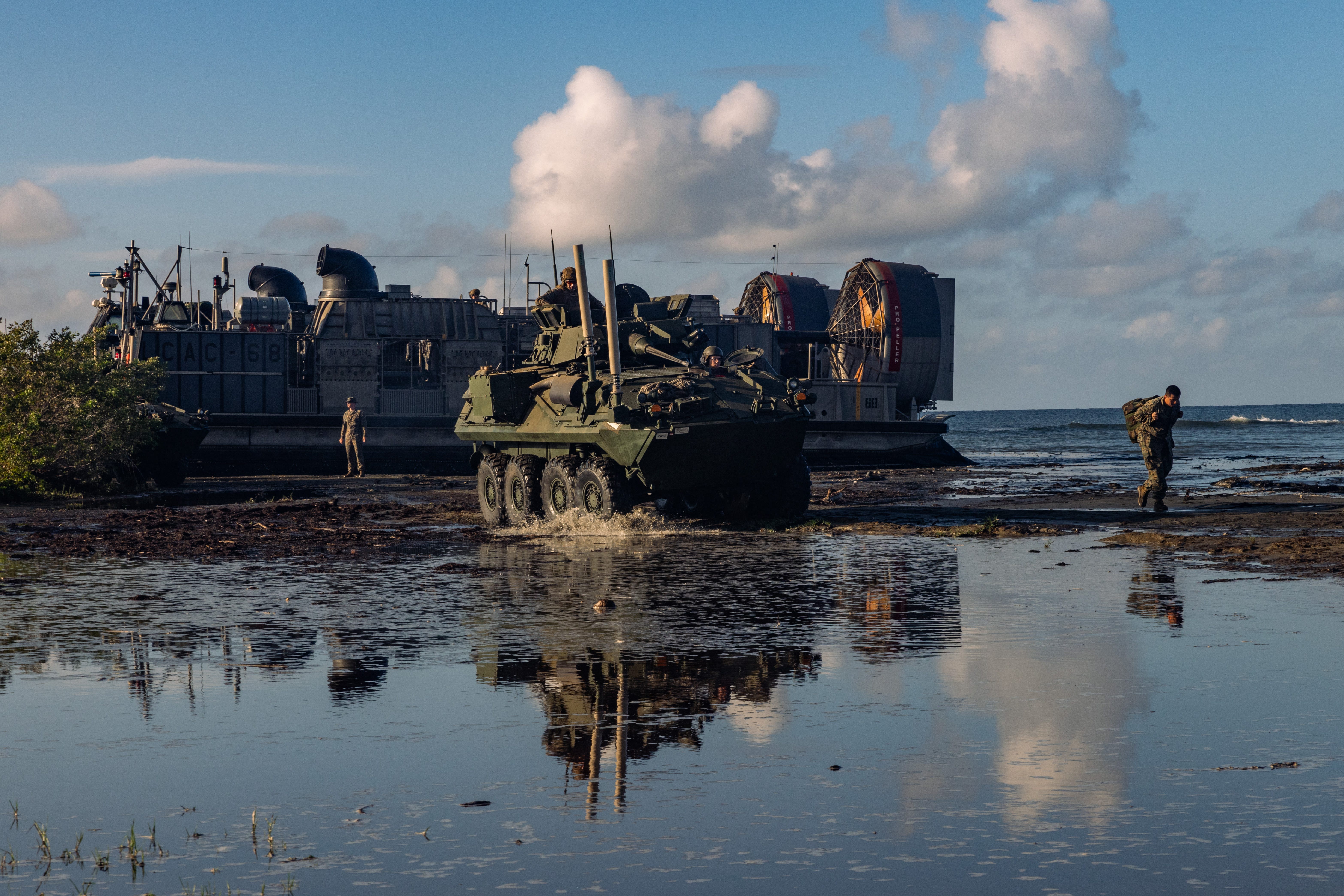
The United States is barreling towards something in Venezuela. Between the arrival of the Gerald R. Ford aircraft carrier, the announcement of Operation SOUTHERN SPEAR, and the pending designation of the Maduro-headed Cartel de los Soles as a foreign terrorist organization, that something certainly smells like it could be regime change. Of course, Trump himself has characteristically refused to give a straight answer on that, and there are plenty of ways the administration could get cold feet at the last second. Still, it has not kept laymen and seasoned analysts alike from speculating on wildly on what this might look like in a flurry of op-eds and twitter threads. I have not been immune to this tendency either, while I have my own theories about where this is all headed (more on that later), I want to take a break from prognostication to write today’s post about some trends I’m observing about how people talk about regime change in Venezuela.
Close to the heart of the current debate is an argument, not necessarily over Venezuela per se, but rather what historical analogy best fits the Venezuela case study. Opponents of regime change point to the chaos in Libya (or Iraq, or Afghanistan for that matter) to highlight the disastrous consequences of seeking to topple even a horrifically authoritarian government. Proponents brush off such parallels noting that Venezuela has far fewer ethnic and religious cleavages than those countries, and is in fact far more akin to Panama in 1989, an intervention which, while not without its critics, is probably a best case scenario for foreign regime change in the modern era.
Historical analogies are a perpetual-motion discourse machine, so it’s unsurprising that the conversation has converged on such a battle over case studies. But if they are going to debate analogies, both sides would do well to read up on Richard Neustadt and Ernest May’s seminal book Thinking in Time. Indeed, they seem to be falling into the exact pitfalls Neustadt and May warn decisionmakers about when it comes to applying historical analogies to current problems. While history is perhaps our single greatest tool for predicting the future, using historical analogies as a substitute for real analysis is the path to folly. At the end of the day, Venezuela is Venezuela, and no case study, however similar it might appear, can accurately model the complexities and contingencies that will bubble to the surface in a regime change scenario.
Venezuela is not Libya
For regime change skeptics, Libya is the archetypal failure mode for Venezuela. Like all good historical analogies, there are strong parallels to be drawn between the two. Of particular relevance given President Trump’s aversion to putting U.S. boots on the ground, Western involvement in Libya was limited to air support, letting rebel forces on the ground handle the actual task of deposing Muammar Gaddafi. U.S. force posture in the Caribbean currently seems to be angling for something similar, knocking Maduro out of power without boots on the ground.
But in Libya, NATO’s dream of fomenting democracy on the cheap quickly proved fleeting as the power vacuum left by Gaddafi’s death rapidly degenerated into a civil war redux. In this way, the Libya case has been bound together with Iraq and Afghanistan as the three great sins of the United States’ global war on terror. Indeed, while Iraq has stabilized for now as an imperfect democracy, and Afghanistan today seems to have reached an equilibrium, however authoritarian, under Taliban rule, Libya is still struggling to simply tread water. Through this lens, anti-interventionists are looking at Maduro’s military posturing and arming of various militias to argue that a similar quagmire awaits the United States in Venezuela.
But when people speak of a civil war in Venezuela, it’s unclear how exactly they see the factional lines being drawn. Certainly, the Maduro regime has every incentive to portray itself as willing to fight to the last breath against the invading Yankee imperialists, but the National Bolivarian Armed Forces (FANB) have never fought a real war. Like most institutions in Venezuela, they are riven by corruption and highly atomized. At the unit level it seems more likely that troops will be loyal to whoever pays them best, or promises to pay them. Other militias and internal security forces are closer to criminal cartels than insurgents, dangerous to be sure, but likely more interested in collecting rents than waging guerrilla war.
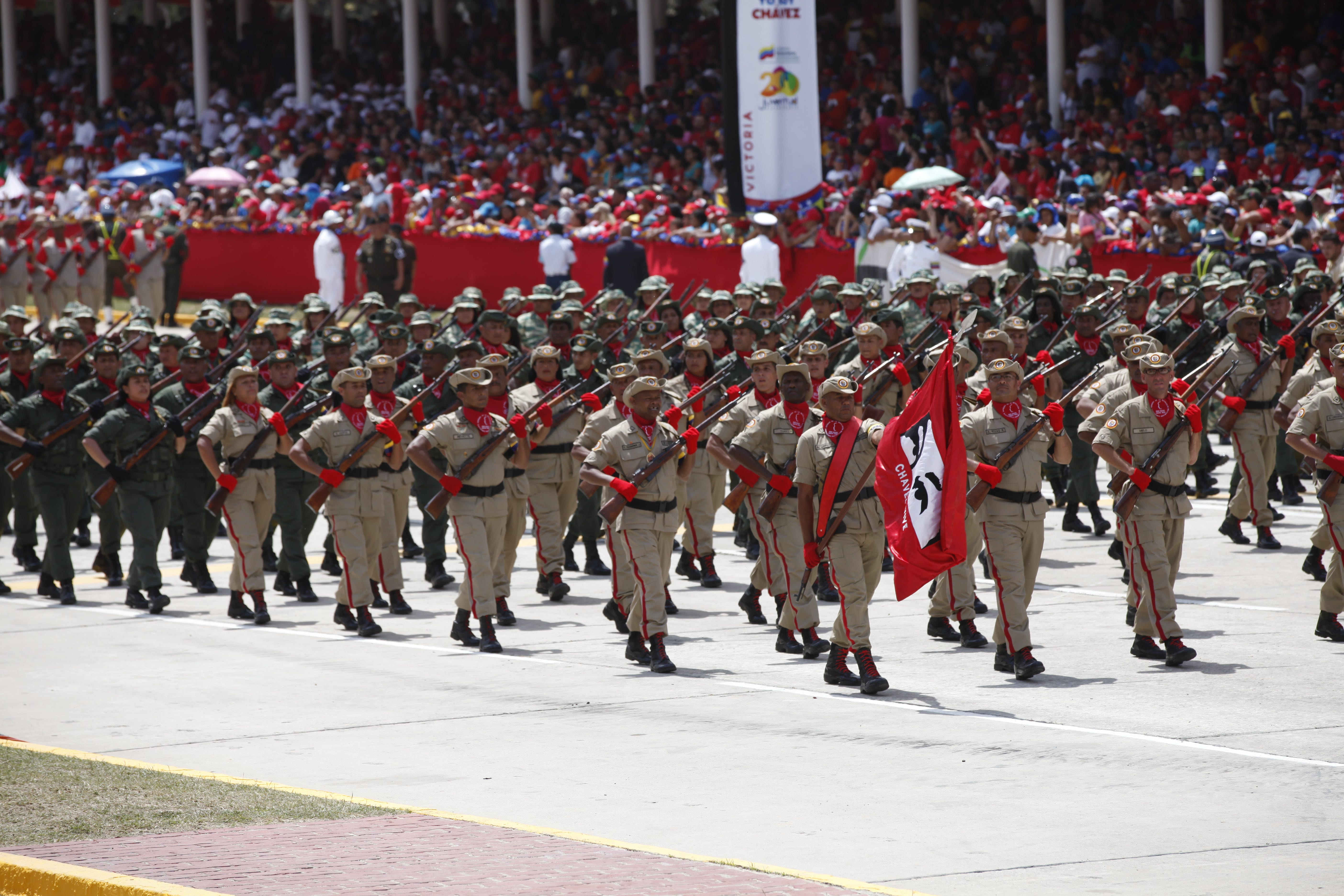
It is true that Maduro has coup-proofed his security apparatus to the extreme, but displays of loyalty to an existing hierarchy are not particularly good predictors of a willingness to engage in protracted guerilla war once that leader is gone. Indeed, the more coup-proofed a force is, the worse it may be at the duties of actual soldiering. South Vietnam’s armed forces, for instance, were heavily coup-prone, and subsequently coup-proofed. They mounted fairly paltry resistance to the North Vietnamese once U.S. support dried up, and insurgent activity after the fall of Saigon was relatively minor. In Iraq, coup proofing helped keep Saddam in power after Desert Storm, but the onset of insurgency in 2003 was a tragedy with many fathers. The uncontrolled sectarian tensions that heaped fuel on the fire in Iraq don’t map well onto the human terrain of Venezuela.
The point of this is that expecting regime change to beget civil war because “that’s what always happens” ignores the fact that (1) civil war doesn’t always happen after regime change, and (2) there are structural factors you can point to in a society that precipitate internal armed conflict. On point #2 I don’t believe those factors are nearly as present in Venezuela as they were in Libya in 2011, or even Iraq in 2003. Of course, how regime change actually happens could change that, but overreliance on historical analogies flattens our ability to appreciate local nuances and risk factors that let us make better predictions.
Other commentators have warned that toppling Maduro would attract combatants from around the hemisphere, and potentially the world, to fight the United States. I am skeptical of these claims as well, first of all because, for the reasons described above, it seems profoundly unclear who exactly they would be fighting for. Second, we’ve seen left-wing anti-imperialist insurgencies in the Western Hemisphere before, and none of them seemed to draw an appreciable contingent of foreign fighters. While the United States would do well to reflect on the lessons of the Global War on Terror, it is not a one-to-one comparison with Venezuela.
This doesn’t mean I believe Venezuela will immediately become a zone of peace with Maduro’s fall. Instead, the collapse of the Maduro regime promises to benefit existing criminal actors, not ideological warring factions. While far from ideal, there is a world of difference between a state with resurgent criminal challenges, and a state at war with itself. We have current examples of the former in countries like Mexico and Ecuador, where organized crime seeks to coopt rather than topple the state. It is brutish, violent, and deadly for civilians caught in the crossfire, but still falls meaningfully short of the conflagration promised by those who lean too heavily on Libya as a historical antecedent.
Venezuela is not Panama
On the other side of the coin, the pro-intervention camp points to Panama as an example of how U.S.-led regime change can be effective. In late December 1989, the United States invaded and deposed dictator Manuel Noriega before departing the country at the end of January 1990. As interventions go, the invasion of Panama was highly effective. Opposition leader Guillermo Endara, who had by all accounts won the 1989 presidential elections annulled by Noriega, was recognized as the legitimate leader, and Panama has been a healthy democracy ever since. No civil war or protracted insurgency broke out, the United States was not dragged into a quagmire, and indeed, regional stability very likely improved post Noriega’s ouster.
Panama in this way offers a useful counterfactual for advocates that regime change in Venezuela would not be nearly as bad as the naysayers claim. Like Maduro, Noriega was seen as a narco-dictator, who had grown rich by taking a cut of the profits from the drug trade to the United States (reports that this may have been facilitated by Cold War-era U.S. administrations notwithstanding). Like Venezuela, the opposition in Panama delivered an upset win in elections the regime had hoped to convincingly steal, delegitimizing the dictatorship and weakening its ability to rally society around the flag in the face of foreign intervention. Finally, it bears reminding that in pure geographic and cultural terms, Venezuela is also much closer to Panama than Iraq or Libya.
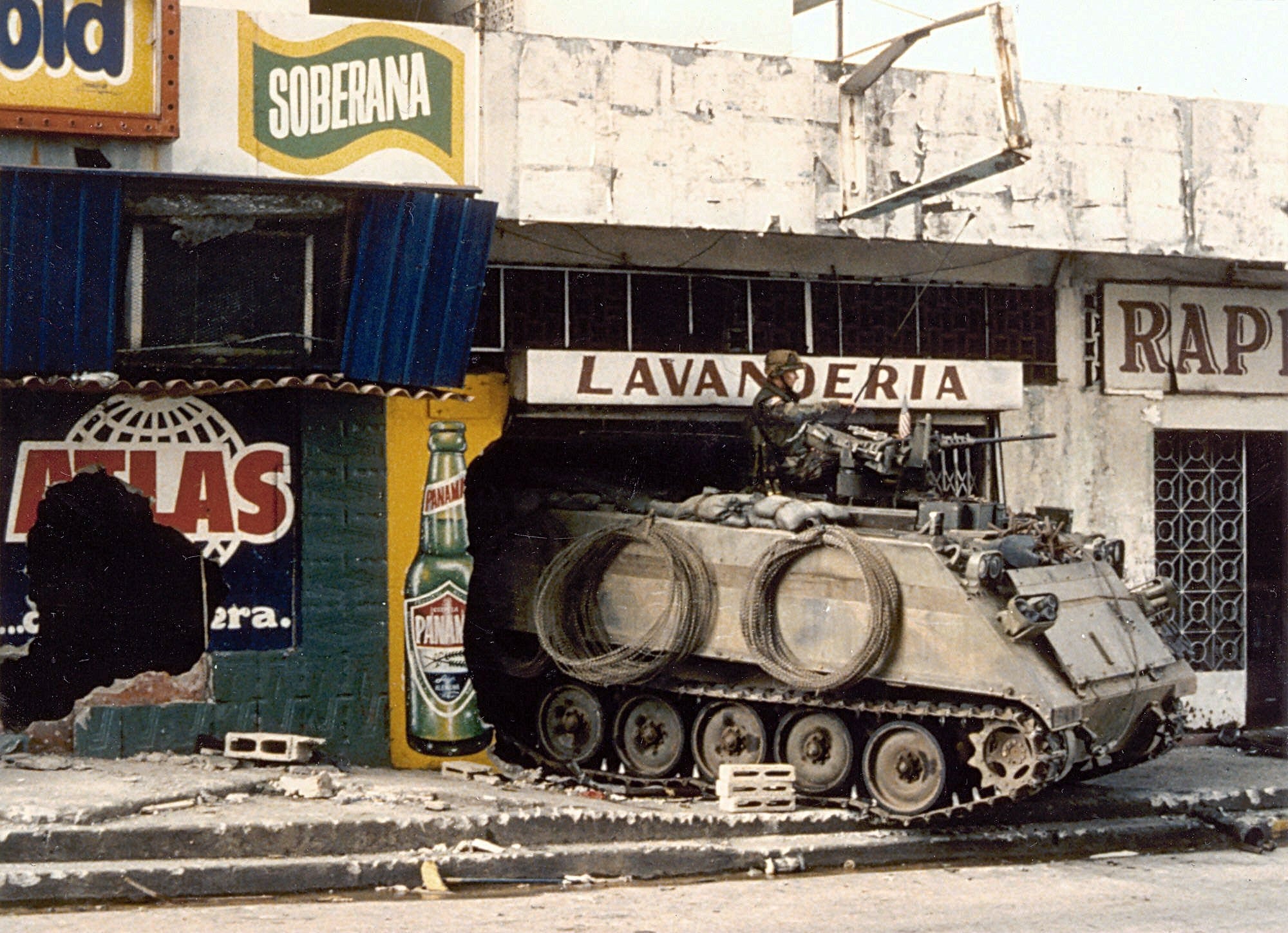
But these similarities are outweighed by major differences. Whereas Panama was an authoritarian, but ultimately functional, state, Venezuela is a country suffering from more than two decades of institutional rot. The Venezuelan state has become progressively more and more hollowed out by corruption, desperation, and incessant penetration by organized crime. In 1989, Panama had one of the highest GDPs per capita in Latin America, today, Venezuela’s economy is struggling to crawl out of death spiral years in the making. It is also worth noting that Venezuela is larger and more decentralized than Panama. While Operation Just Cause was able to concentrate on the centers of gravity around the canal and Panama City, and the U.S. had access to permanent military facilities to pre-position forces, Venezuela’s vast and inaccessible interior provides strategic depth for irregular forces to withdraw to.
There are some who argue that removing Maduro will cut off the head of the snake, and without his backing, the criminal groups that previously benefitted from his patronage will wither on the vine. I disagree with this assessment. It’s unclear to me what support these groups are receiving now from Maduro that they could not live without. Certainly, groups like the ELN and FARC dissidents are grateful that Venezuela acts as a safe haven for them to withdraw to, but I have serious doubts as to whether an opposition-led Venezuela would be able to extirpate them.
Would the post-Maduro Venezuelan security forces, facing simultaneous reckonings over corruption, human rights abuses, and loyalty to the new government, really be able to take the fight to non-state armed groups in the periphery? The last time the FANB tried to do so, when Maduro sought to quash the FARC dissident forces in Apure, it suffered a bloody nose. While an opposition-led Venezuela may be able to reform the security services to better combat criminal groups in Venezuelan territory, potentially with U.S. assistance, this process would take time, money, and strategic vision. In the immediate aftermath, it seems more likely that criminal groups who are active in areas with already weak state capacity would see regime change chaos as an opportunity to further entrench themselves.
Venezuela is Venezuela
Perhaps one of the lessons from looking at Libya and Panama is that strategy matters when it comes to changing a regime. In Libya, a fragmented coalition snowballed from civilian protection to regime change seemingly by accident, then hoped it could wash its hands of the affair while others picked up the pieces. In Panama, the United States benefitted from unity of command, a clear goal that from the outset envisioned the removal of Noriega, and overwhelming force in-theater. To be sure, Operation Just Cause also benefitted from structural factors both internationally and within Panama that made the transition easier, but the United States was also better prepared to capitalize on these.
The problem, in my opinion, with U.S. rhetoric around regime change in Venezuela does not inspire confidence about a long-term strategic vision for the country. Instead, it seems to be the result of a tug-of-war within the Trump administration over counternarcotics policy, with a side of sunk cost fallacy for good measure. The optimistic scenarios that some have painted of a regime change in Venezuela to me therefore require some wishful thinking as to the kind of operation the United States is willing to conduct. It seems more likely that if the United States intervenes in the first place, it will be a more haphazard affair. Of course, if Trump announced tomorrow he was establishing a $100 billion fund for the reconstruction of Venezuela and willing to deploy U.S. advisors to assist the transitional government’s security efforts, my doubts would be allayed, but I’m not holding my breath for that.
Regime change is not a single event, it is a host of contingencies, responses, and reactions that are infuriatingly hard to predict. I know saying things are complicated is neither a particularly courageous nor analytically useful stance, but still it bears repeating, especially when discourse is drifting towards flattening all complexity and contingency into binary “for” and “against” camps. We all could do with a better dose of humility in our analysis, and history can still be one of our best guides when it comes to this. Instead of arguing which case studies capture the entirety of Venezuela, we can combine what we know about Venezuela today, with more precise historical analysis.
There’s also an important factor to consider in Venezuela that is seldom mentioned: between 70-80% of the country voted for Edmundo in last year’s stolen elections. That was made possible by huge grassroots organization across the country. The overwhelming majority of the Vzlan people want change, and have pursued this peacefully. While the last 26 years have certainly caused institutional rot, there remains a deep appreciation of democracy thanks to our 40 years as a liberal democracy. And the near universal yearning for change, even among all but the most hardcore of chavistas, is quite evident if you live here. And generally, those hardcore chavistas’ families want peace and change. So while any scenario is risky, this is is a not insignificant factor. People are more afraid of nothing happening.