

The weeklong funeral for the rules-based international order has just concluded in Davos, and who better to deliver the eulogy than Canada? In a speech equal parts impressive and concerning, Canadian Prime Minister Mark Carney called upon his fellow leaders to “Stop invoking rules-based international order as though it still functions as advertised. Call it what it is – a system of intensifying great power rivalry.” Carney’s remarks were not empty bluster, he arrived in Davos fresh off a series of meetings in China where he inked deals to import 49,000 Chinese electric vehicles in exchange for Beijing lowering import restrictions on Canadian canola oil and other agricultural products.
The emerging “Carney Doctrine” has now received a fair bit of coverage, including from folks more specialized in Canadian politics than I.1 But I want to take today’s blog as an opportunity to give my own assessment of the contours and implications for Canada’s strategy. This is also a good reminder that this is an Americas blog and that means occasional Canada coverage.
In essence, Canada’s approach to the United States is one which seeks to limit the pain Washington can inflict when disputes arise, while cooperating on areas of mutual agreement. Carney termed this kind of policy “risk management” in his Davos speech, the equivalent in geopolitics could be a form of containment.
Canada’s containment strategy differs from balancing in that Canada does not explicitly seek the diminution of U.S. power on a global scale. Washington can still have a dynamic economy and wealthy consumer base that Canada can sell to (even with tariffs). The United States can still have a powerful military capable of deterring Chinese and Russian adventurism. However, Canada should seek to construct flexible alliances such that every time the United States brandishes its power against its northern neighbor, Canada walks away a little better prepared to confront future instances of bullying.
This sounds like a canny strategy for middle powers to pursue, but it is also fraught with risks. Fostering ties with a multitude of partners helps reduce exposure to any single risk, but can also give previously peripheral countries new sources of leverage. In one worst case scenario, Ottawa could find itself under pressure from both Beijing and Washington at once. Triangulating foreign policy is also a difficult act to sustain, Carney may be able to keep all the balls in the air at once, but his successor could prove less apt.
For this reason, the truest and best insurance Canada can buy lies in growing its own economic, military, and technological might. George Kennan, credited with architecting the United States’ Cold War containment strategy, wrote in his famous Long Telegram that “Much depends on health and vigor of our own society.” Canada’s containment strategy is not the same as that the United States pursued against the Soviet Union, but it is useful advice nonetheless. Carney’s speech shows he recognizes the strategic picture Canada faces, but he still has to deliver an ambitious domestic agenda to meet the present crisis.
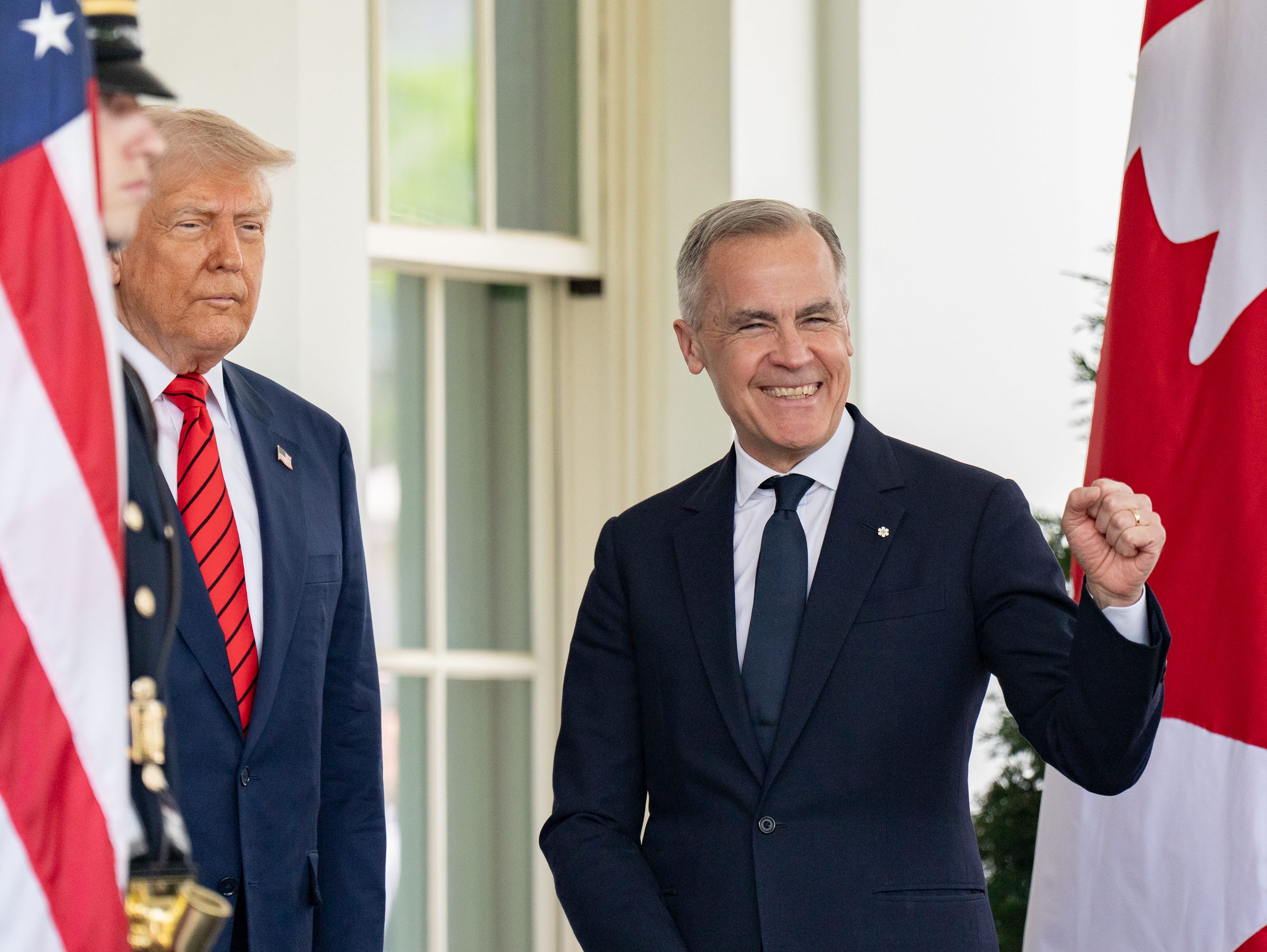
Why Containment?
In 1924, Senator Raoul Dandurand remarked that Canadians “live in a fireproof house far from inflammable materials.” A century later that analogy rings increasingly hollow, the fireproofing is wearing off, and there’s smoke on the horizon. In particular, U.S. tariffs, disregard for international law, and musings about turning Canada into a 51st state have had a profound effect on Canadian politics. Indeed, this adversarial turn by Canada’s neighbor and number one trading partner proved decisive in getting Mark Carney’s Liberal Party off life support and catapulted Carney himself to the premiership.
Since Canada’s April 2025 elections, however, Prime Minister Carney has pursued a balancing act approach towards the United States. A week after the election he visited DC and had a frank discussion with Trump on trade irritants on both sides of the border while simultaneously pitching Canada as an ally on homeland defense and the Golden Dome.
To the extend Canada has sought to diversity its partners, it has focused on other erstwhile U.S. allies, especially Europe. In December 2025, Carney negotiated Canada’s entry into the Security action for Europe (SAFE) partnership intended to boost the European defense industry. Canada’s reserves of critical minerals, including elements like Tungsten and Niobium which are crucial for advanced weapons systems means it should be a natural partner in shoring up European supply chain security.
Carney’s recent China visit grabbed headlines as the most visible sign of Canada breaking with the United States. In practice, however, the deal he signed in Beijing seems clearly lopsided in favor of Canada. Canadian sales of new cars totaled 1.9 million in 2025. 49,000 Chinese EVs represent about 2 percent of this total, far from the existential threat to the North American auto industry critics have made it out to be. In return, Ottawa secured beneficial access to the Chinese market for major agricultural exports like canola oil, a multi-billion-dollar opportunity for Canadian producers. Furthermore, top canola-producing provinces poised to benefit the most from this include Alberta, where a burgeoning separatist movement has been an unpredictable element in Ottawa’s dealings with the White House.
Likely China was more than happy to agree to a worse deal on paper in order to get the symbolic benefits from appearing to peel away a U.S. ally. It is also not risk-free for Canada. While it initially seemed like Trump was willing to brush off the deal, he seems to have reversed course and is now threatening 100 percent tariffs on Canada. Hopefully Carney knew this was a possibility going into the China trip, his comments at Davos the following week suggest that he may have also been interested in the optics of the deal as well as the economics.
Even if Canada ultimately reverses course on its China deal under U.S. pressure, it has managed to regain some initiative in dealings with the White House. Instead of reacting to U.S. flights of fancy, Canada moved first to forge a new partnership with China, and should continue to look for complementarities between the Canadian economy and countries in Southeast Asia or Gulf States like Qatar. Future Canadian deals may provoke less resistance from Washington as Carney’s willingness to go directly to China first may have shifted the diplomatic Overton window for the United States.
At the same time, Canada has not given up on engagement with the United States over areas of shared interest, nor should it. Canada can build all the pipelines, ports, roads, and railways it wants for export diversification, but having the world’s largest economy next door is simply too tantalizing a market to abandon. For this reason, Canadian officials continue to engage their U.S. counterparts on issues ranging from critical minerals, to crime, to defense modernization.
The latter of these issues is of particular interest to me. Canada and the United States cooperate closely on a daily basis through institutions like NATO and NORAD, but U.S. threats have prompted some to argue Canada should view the United States as a national security threat. Practically, this has translated into increased scrutiny over U.S.-supplied weapons and equipment, including an ongoing review of Canada’s F-35 purchase. Personally, I think Canada should avoid trying to put up a fence around U.S. systems, and instead focus future procurement decisions based on what best meets Canada’s requirements and which proposals offer the most for domestic Canadian defense industry. Completely extirpating U.S. kit from the Canadian armed forces is both impractical and a recipe for another fight with Washington, but Canada should seek to have a diversity of suppliers in case future arms sales end up a political football.
Canadian Patrol Submarine Project (CPSP) could be a good test of this approach. A while ago, I along with some colleagues, argued Canada should join the AUKUS agreement to gain a nuclear-powered submarine capability. That ship has sailed, and to be honest at this point I think that’s probably a good thing, letting Canada diversify its defense industrial partnerships through the CPSP. The South Korean firm Hanwha has put forward an interesting proposal well worth consideration.2
In brief, I think this amount to a Canadian strategy of containment vis-à-vis the United States. Faced with an increasingly unpredictable neighbor to the south, Canada is seeking to plug up vulnerabilities while still cooperating on areas of mutual interest. The end game for this strategy is the same regardless of whether Trumpism continues to characterize bilateral relations, or if Washington’s line on Ottawa reverts back to the mean of partnership and cooperation. Either way, Canada hopes to limit as much as possible the United States ability to coerce it through economic or even military means.
Walking the Tightrope
No amount of international partnerships or diplomatic maneuvering can substitute for boosting the health and dynamism of Canada’s economy. On this metric, I am somewhat concerned that Carney is falling into the Sheinbaum trap wherein his success fending off existential economic and security threats from the Trump administration obscures a more lackluster track record on domestic issues.
To be sure, Carney has had his policy wins. One of Prime Minister Carney’s first acts even before the April election was to eliminate his predecessor’s consumer carbon tax, showing a willingness to break with previous orthodoxy in the name of spurring growth. His government also launched a new Major Projects Office in the fall of 2025 aiming to fast-track new infrastructure investments, including a liquified natural gas export terminal, mining efforts, and a new nuclear power plant. In 2025 Canada spent 2 percent of GDP on defense for the first time since the end of the Cold War.
But Canada is climbing out of a lost decade where economic growth consistently fell below 2 percent. 2025 was no different in this regard, with Canadian GDP growing by just 1.7 percent amid macroeconomic headwinds and uncertainty caused by U.S. tariffs. Much like repeated jokes about Europe’s sluggish reaction to its umpteenth wake-up call, the question remains whether policy is really meeting the moment. While Canada has announced important government-led investments in defense, mining, and energy, but the real measure of success for these efforts will be when private companies start making their own big plays.
Canada’s inter-provincial trade barriers have also proven thorny challenges to remove. During his campaign Carney pledged to eliminate, and some progress has been made since. These efforts even garnered a shout-out in the Prime Minister’s Davos speech, but liberalization has been uneven across the provinces. Recently, an IMF report found that Canada could reap a windfall equivalent to 7 percent of real GDP by removing remaining barriers.
Of course some slack is owed to Carney and his government. There are powerful interest groups with vested stakes in maintaining internal trade barriers, and dealing with provincial governments takes time and tact (mind you Carney’s party doesn’t have a majority!). Still, I do think electorates have cottoned on to the fact that you don’t get to claim existential stakes only to decline to acting with the urgency those stakes demand.
Perhaps the greatest test of Canada’s strategy will come this summer with the July joint review of the USMCA free trade agreement. It seems as though policymakers in both Canada and Mexico have priced in the fact that the review will not be the simple reauthorization they had once hoped for, and will likely involve more substantial efforts by the U.S. to renegotiate key provisions of the deal itself. But what those asks from Washington will be still seems nebulous, likely the White House itself doesn’t know at this point exactly what they will ask.
We also shouldn’t rule out either the possibility of an eleventh-hour Trump demand. Trump likely knows that the July review will be a moment of maximum leverage for the United States when it comes to economic relations with its neighbors and seek to exploit that to the fullest. Part of the test for Canada will therefore be managing its relationship with Mexico to present a united front, rather than succumbing to the desire to cut a separate deal with the United States that could be more convenient, but also costly in the long-term.
Looking South-North
Returning for a moment to Latin America and the Caribbean, I am more pessimistic about this region’s ability to implement an equivalent “Carney Doctrine” containment strategy. For all that the region embraces multilateralism, its institutions are facing unprecedented pressure and struggling to meet the moment.
It is hard to envision any grouping of countries in the region today successfully coordinating economic policy in response to U.S. tariffs. Even the Community of Latin American and Caribbean States, meant to be a counterweight to the U.S. influence in regional institutions, failed to sign a statement condemning U.S. strikes on alleged drug boats last fall. The recent ascendancy of a number of Trump-aligned governments in Ecuador, Argentina, Honduras, and Chile further suggests these countries are more likely going to seek accommodation with Washington than unite to oppose U.S. overreach.
Had Denmark stood alone against the United States in the most recent row over Greenland, it seems reasonable to say the outcome may have been different. But Copenhagen had the European Union, as well as Canada and European NATO members to back it up, turning an opportunistic U.S. land-grab into a flashpoint with the entire transatlantic defense and security relationship on the line. In the end, spiraling tensions rattled the markets enough to trigger another about-face from Trump.
But should the White House turn its attentions back to the Panama Canal, the Panamanian government would not have such allies to call upon. Indeed, Gustavo Petro is busy putting forward his own, admittedly fanciful, attempt at reincorporating Panama into the territory of a new Gran Colombia. It is a testament perhaps to the deft diplomacy of the Mulino administration that the matter of the canal seems to have been put to bed for now, but a stray tweet could see the issue rear its ugly head once more.
I could still be wrong on this. Last week’s post discussed how the gap between U.S. military capabilities and Latin American air defenses could lead to the region boosting its military spending. Ever-mounting tariff threats could similarly prompt some countries in Latin America and the Caribbean to forge genuine economic partnerships between themselves and with extra-hemispheric partners to provide a counterweight. Especially if Canada’s containment strategy proves successful, it could make this more likely by providing a model for others in the hemisphere to replicate.
I commend you to subscribe to Christopher Sands’ US Canada Observer here on Substack for excellent regular coverage of the bilateral relationship.
The True North Strategic Review is the best source around for more on Canadian defense procurement.