My friends all know that I’m a big fan of the Dutch rapper Eves Laurent. In particular, I’m a fan of his 2021 song De Ploff! which outlines, in impressive detail, the process for executing a “plofkraak” – blowing up an ATM – which Mr. Laurent was jailed for in 2018.
The attacks eventually became so common that most Dutch ATMs today include countermeasures to ensure any cash is destroyed if thieves attempt to blow them up. This has not deterred criminals, who have merely turned their attentions across the border to Germany where fewer machines are adequately shielded.
Why has this tactic become so popular? Mr. Laurent explains:
Voor bananendozen die van Ecuador komen / Daarom ga ik papier uit deze automaat blowen
[For banana boxes from Ecuador / That’s why I’m going to blow paper out of this machine]
The “bananendozen” are, of course, cocaine shipments, much of which now flow from Ecuador through Dutch ports on their way to the rest of Europe. While I’m well acquainted with the Ecuadorian side of things, what happens after the cocaine is dropped off in Europe, and the effect that has had on countries like the Netherlands, sadly escapes my remit as an Americas researcher.
For this reason, I was grateful for the chance to visit the Netherlands for the first time last week when I traveled to Amsterdam for the Future of War Conference.
Today’s Caballeros will offer some reflections on conversations I had there about the country’s increasingly pivotal role in the transatlantic drug trade, as well as some admittedly disjointed thoughts on European economic competitiveness discourse. For those of you who want me to stay in my lane of Western Hemisphere analysis, we’ll be back to our regular programming in next week’s post.
The Most Functional Narco-State
The Netherlands is, by almost any metric, a highly functional state. Even among other rich countries, polling shows higher than average trust in government and satisfaction with the quality of services. Dutch ports are first-in-class while the country has been able to rise above the economic malaise that has afflicted many of its neighbors with strong economic growth and the presence of world-renowned advanced technology firms including ASML.
On the security front as well, the Netherlands does remarkably well by Western Hemisphere standards. In 2025 for instance the Netherlands reported just 103 murders for a total homicide rate of 0.54 per 100,000, numbers that would make even Bukele green with envy.
Why, then, did the Dutch police get into a shootout with a gang of more than 30 armed men in an otherwise sleepy village?
According to Chris Dalby, the men were likely pursuing retaliation after a shipment of cocaine connected to Dutch kingpin Jos Leijdekkers was stolen by a rival gang in France. “Bolle Jos” (Fat Jos) as he is commonly referred to, fled the Netherlands some years ago after a warrant was issued for his arrest. He then decamped to Sierra Leone, where he found his way into President Julius Maada Bio’s inner circle and recently welcomed a child with the Bio’s daughter Agnes.
Bolle Jos is but one of a number of drug lords who have made their fortunes exploiting the Netherlands’ legitimate logistics advantages to help move narcotics across Europe. Indeed, for years Dutch politicians and analysts have warned the country could be on the precipice of becoming a “narco-state” characterized by extreme levels of criminal embeddedness and impunity for major crimes. One 2019 BBC article put the country’s appeal to traffickers succinctly: “With its extensive transport network, its lenient drug laws and penalties, and its proximity to a number of lucrative markets, it is an obvious hub for the global narcotics flow.”
In some of my conversations, people shared stories that matched or exceeded the dramas associated with Latin American cartel kingpins. Most of these accounts related in one way or another to Ridouan Taghi, leader in the so-called “Mocro Mafia.”
The Dutch Moroccan Taghi was arrested in Dubai in 2019, before eventually being deported to the Netherlands, an impressive feat given the fact that the United Arab Emirates lack an extradition treaty with the Netherlands that would ordinarily govern such a transfer.
Then in July 2021, journalist Peter R. de Vries was shot in the head in Amsterdam in an assassination linked to the Mocro Mafia. Between 2022 and 2023 Crown Princess Catharina-Amalia was secretly relocated to Spain for her own safety amid kidnapping and death threats from organized crime in the Netherlands. Meanwhile the Dutch military was called upon to prevent an attempted prison break involving a helicopter and foreign mercenaries seeking to spring Taghi from his supermax cell.
In this respect, the Netherlands may be the final form of the Pax Mafioso dynamic I wrote about in a previous post. Street crime is far below what is observed in the Western Hemisphere or even the United States for that matter. At the same time, powerful transnational criminal networks retain the ability to challenge the state in important ways, whether through targeted assassinations, blackmail, bribery, or even more extreme plots like the abortive scheme to free Taghi.
The ability of criminal bosses to operate outside the Netherlands seems to be a key factor in the resiliency of their networks. It also impressed upon me the benefits that come from being on the distribution side of the drug trafficking supply chain. Whereas the Ecuadorian gangs that vie for control of the cocaine smuggling routes along the Colombian and Peruvian borders are at times not even paid in cash, European drug distributors have been able to amass personal fortunes in the millions if not billions.
Has Europe Fallen?
Related to the question of Dutch state capacity is the swirling debate over the future of Europe’s economic competitiveness. I’ve been privy to a number of discussions both on and offline that seem to essentially revolve around the same basic questions: Is Europe falling behind the United States, if so, how much, and what can the Europeans do to reverse it?
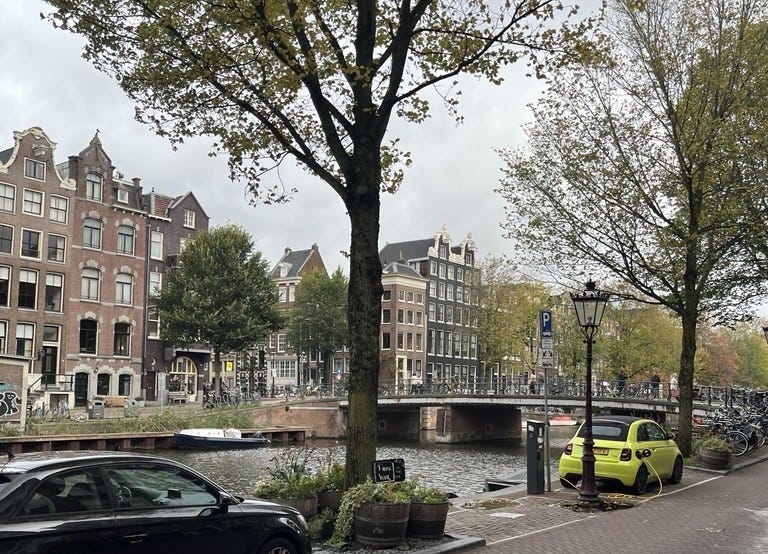
To grossly oversimplify, this debate basically boils down to some variation of the following conversation: In 2025 the Netherlands’ GDP per capita was the fourth-highest in the European Union, at about 74,000. If they were a U.S. state however, the Netherlands would be one of the poorest, falling just below Missouri. If that is true, why does walking the canals of Amsterdam feel so much nicer than wandering around Jefferson City?
There’s any number of permutations of this argument and the explanations are well-trod ground at this point. Europe’s wealth is embodied in its built environment, the beautiful ancient cathedrals, palaces, and old cities that tourists flock to by the millions. European countries also boast more robust social safety nets and wealth inequality less acute than in the United States. I have no interest in retreading this territory too much, but would direct your attentions to the exchange between Paul Krugman and my friends over at Silicon Continent for an illustrative summation of two major factions in this debate.
Ultimately, I do believe European stagnation is real, but also that if any region should have the easiest time shaking off the cobwebs and restarting its growth engine, it’s Europe. The continent’s institutions are still high quality, its human capital is strong, and basic infrastructure is solid. If slow European growth is accordingly the result of bad policies, the solution should be simply to fix the policies.
That being said, I sense that as I’ve become more of a regionalist, my theory of mind for politics in other parts of the world has weakened. I can understand Latin America’s dysfunctions, even if they frustrate me. By contrast, when I read stories about the Dutch filling their gas wells with cement, or the Germans torpedoing a housing development for the sake of a sub species of toad, I want to pull my hair out. It doesn’t help that my social circle tends to intersect with the European progress crowd, meaning I have no shortage of seemingly hairbrained de-growth schemes to stew over.
For the sake of rectifying this lacuna in my theory of political economy, I’ll take a stab at my own theory of Europe’s relative stagnation here. In short, I think there is a sense among many that Europe has won the development game. People live in beautiful, safe cities with functioning public transit, easy access to arts, culture, and fine dining. They enjoy free healthcare, a robust social safety net, and log off from work at 3pm to enjoy coffee and cigarettes. This is the kind of lifestyle the rest of the world aspires towards, and the Europeans have already figured it out. Under this model, the priority should not be scraping and scrounging for a few more measly points of GDP growth, but rather redistributing what these countries already have to ensure that absolutely everyone can enjoy the European good life.
The problem, of course, is that without higher growth you can’t redistribute in a way that makes everyone happy. Subsidized housing is great, but only if there’s enough housing to go around in the first place. Making it harder to fire employees is nice if you’re employed, but in countries like Spain where a quarter of all young people aren’t, it hardly makes a difference.
Circling back to the Americas makes all these debates sound a bit silly, first-world problems and whatnot. Still there are some parallels worth exploring.
At the extremely broad level I see similar debates going on in Europe and the Americas about the redistribution of economic gains. The problem is that the Americas’ commodity-dependent economies have less room for miscalculation. When prices are good and demand is hot, you can afford to redistribute, when the cycle turns against you there’s no net and a long way down.
The other takeaway was not to rest on your laurels. It is a clichéd example at this point, but bears repeating that at the turn of the 20th century Argentina ranked among the richest countries in the world, only for its economy to lurch from crisis to crisis that has left the country firmly stuck in an upper-middle income trap. In the early 1970s Guatemala’s GDP per capita was higher than that of South Korea’s, but middling growth in the former and explosive takeoff in the latter means their current relative positions could not be more different.
With the world potentially entering a period of unprecedented economic disruption fueled by accelerating progress on artificial intelligence, we could see the fortunes of countries shift radically over the next decade. Even if this does not yield the truly transformative change boosters claim, it is surely a bad time for any country to be complacent.