

I was in Manila last week where I had the chance to speak on the implications of U.S. Venezuela policy for Southeast Asia. After the event I ended up striking up a conversation with some folks about Myanmar, where synthetic drug production has exploded with the backing of that country’s military junta. The conversation reminded me of how dangerous genuine “narco-states” can be. It’s hard enough for states to suppress illicit activity, and all but impossible to make a difference when the government is wholly or partially captured by criminal interests.
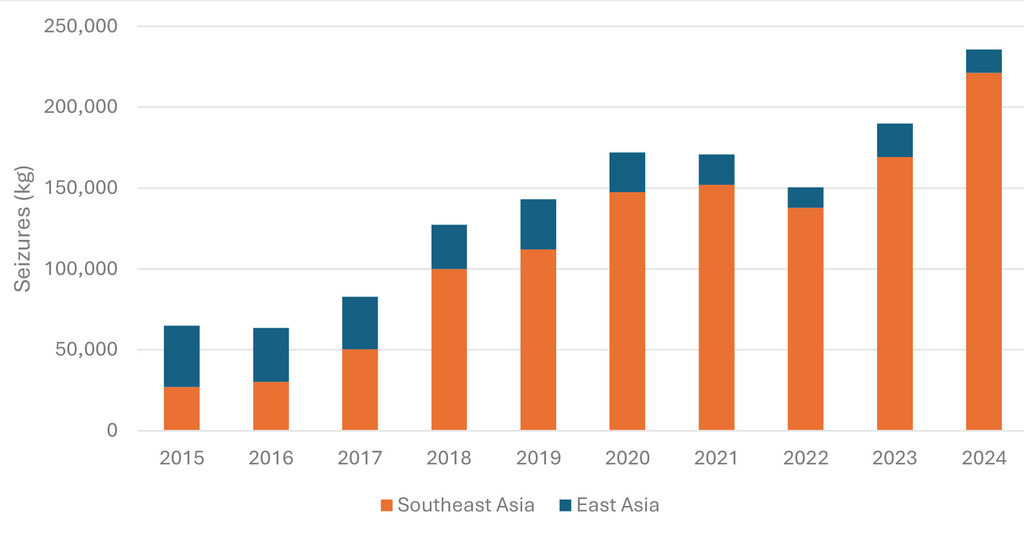
It also got me thinking about a topic that I’ve wanted to write about for some time. While from the U.S. perspective the drug trade is largely a self-contained ecosystem within the Western Hemisphere, criminal groups are global operations. The burgeoning cocaine trade with Europe has alerted many to the transatlantic nexus, but this is hardly the only region where Latin American criminal outfits are looking to expand into.
In the past months alone we’ve seen representatives of Mexican cartels turn up in connection to Nigerian and South African meth labs, while kilograms of cocaine wash ashore on remote Pacific beaches. As the United States looks to squeeze more traditional trafficking routes through the Caribbean and Eastern Pacific, it seems likely that criminal groups will face pressure to identify new opportunities and markets for their illicit wares.
There are still good reasons why globally Europe and North America are likely to remain the primary markets for illicit narcotics in particular. Most fundamentally, these are the places with the wealthiest consumers, meaning that drug cartels can turn a tidy profit from even comparatively small shipments. Nowhere else on the planet enjoys such a large concentration of high-income earners.
That being said, just as transnational criminal outfits have sought to diversify their revenue sources, it make sense that they would also see benefits accruing from at least trying to broaden their consumer base. Even if geographic expansion doesn’t automatically beget greater revenues
Today’s post accordingly is going to take a look at what efforts by Latin American criminal groups to expand into Africa and the Asia-Pacific, why these areas present especially fruitful opportunities for criminal diversification, as well as some of the obstacles the cartels can expect to face here.
Asia-Pacific
After North America and Europe, the Commonwealth countries of Australia and New Zealand probably represent the third-most appealing market for illicit narcotics. Both countries have wealthy consumer bases, while the vastness of the Pacific Ocean creates logistical complexities meaning that traffickers can charge massive markups for their product. Cocaine reportedly goes for up to $350 AUD ($248 USD) a gram in Australia compared to around $95 in Europe and $60-110 in the United States.
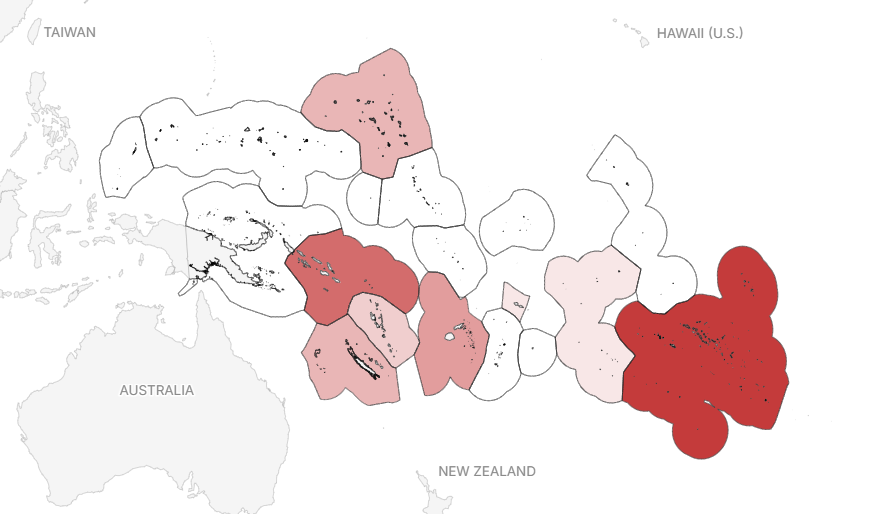
In 2024, the first ever sighting of a narco-submarine in the southern Pacific was reported when a vessel was found abandoned in the Solomon Islands. In 2025, two vessels were recovered, and as of February 2026 a total of seven have been reported in the south Pacific, suggesting that traffickers have adapted the tried-and-true strategy of using low-profile artisanal vessels to make long oceanic trips.
My friend and colleague John Augé recently put out an interesting dataset showing the spread of drug trafficking throughout the Pacific since 2024. The data shows a clear pattern of increasing trafficking activity in the Pacific, with French Polynesia emerging as a key route for Australia-bound trafficking. In 2025 authorities seized a “historic” shipment of 3,600 pounds of cocaine and 512 pounds of methamphetamine, reportedly bound for Australia. This was quickly surpassed in the first months of 2026 when the volume of cocaine seized in the territory grew to 11.5 metric tons.
The problem has gotten so bad that now-Prime Minister of the Solomon Islands, Matthew Wale, endorsed the U.S. campaign against alleged drug boats in the Caribbean and Eastern Pacific, calling for “killing them all to smithereens.”
Still, Australia and New Zealand count a little over 32 million inhabitants, while the lengthy logistical tail required to move cocaine and other drugs through the Pacific likely means that these countries are unlikely to overtake North American and European drug markets in the future.
Turning north, Southeast and East Asia boast much larger and increasingly wealthy consumer bases. Southeast Asia in particular is home to large states with difficult-to-access hinterlands and relatively weak state capacity that ought to make the region a prime target for transnational criminal organizations.
A recent report from the UN Office on Drugs and Crime highlighted the Sulu and Celebes Seas Triangle, encompassing maritime regions of Indonesia, Malaysia, and the Philippines as an increasingly important drug trafficking corridor. For the time being this region seems to be important mainly for the transit of drugs, though the report notes: “The growth in transit traffic through the region may have the effect of expanding drug user markets along this route, as has been seen with methamphetamine transit trafficking in other countries in South-East Asia.”
Perhaps the exception of the Middle East, Southeast and East Asia have some of the harshest penalties for drug trafficking and consumption in the world. Singapore is of course (in)famous for its longstanding hardline approach to drugs, while according to Harm Reduction International, 8 of the 11 members of the Association of Southeast Asian Nations have some form of death penalty for drug crimes on their books. In 2025 Indonesia and Vietnam alone sentenced more than 200 people to death on drug-related charges.
In the Philippines, which abolished capital punishment, former President Rodrigo Duterte nevertheless unleashed a brutal counternarcotics campaign upon taking office in 2016. Duterte’s war on drugs is alleged to have killed up to 30,000 people, complete with stories of rampant abuse by the Filipino National Police and ultimately helped land the former president in the Hague where he is on trial for crimes against humanity.
Harsh penalties for drug trafficking have not stopped individuals from trying to move narcotics into these countries. In addition, new trafficking modalities and technological innovations may be providing criminals with an advantage over state authorities.
Liquid cocaine and methamphetamine allows traffickers to conceal narcotics in textiles, food and beverage imports, and even coal and other minerals. This method of adulteration renders the substances invisible to traditional cargo scanning methods, and difficult to detect even by specialized drug-sniffing dogs. After passing inspection, criminals can extract the pure narcotics from their associated cargoes, a process which is becoming increasingly efficient.
In 2024 Korean authorities busted a trafficking ring moving liquid cocaine from Colombia to Australia. The outfit had reportedly brough on Colombian experts to assist with their operations. Advances in the liquified narcotics trade could give criminals a leg up even in the face of harsh drug enforcement regimes across the Asia-Pacific.
Africa
In 2008, the United Nations declared the small West African country of Guinea Bissau to be Africa’s first “narco-state.” Colombian cocaine and pressure on traditional trafficking routes intersected with weak institutions and rampant corruption in Guinea Bissau to produce an ideal operating environment for organized crime. To this day, Guinea Bissau remains a trafficking hub while political instability remains high following a military coup last November and a recent contentious constitutional referendum.
At a basic level, the appeal of many African countries to Latin American criminal groups is as transshipment hubs for narcotics bound to Europe. But proximity to European markets is only part of the picture.
Nigeria and South Africa are home to growing synthetic drug industries to supply regional and domestic drug demand. In May, the Nigerian National Drug Law Enforcement Agency announced it had uncovered an “industrial-scale” meth lab in Ogun State and seized 2.4 tons of methamphetamine and precursor chemicals. Then on August 20, South Africa announced it had also dismantled a major meth operation near the border with Zimbabwe.
In both operations, Mexican nationals were arrested, hinting at the ongoing export of cartel talent to African drug operations. The meth business in particular seems to lie at the convergence of strong regional demand in populous countries like Nigeria and South Africa, while also being a sector where Mexican criminal groups enjoy a surfeit of talented illicit cooks and chemists.
Geographic diversification also allows criminals to arbitrage regulatory regimes and take advantage of bureaucratic friction. If Mexican port authorities have gotten wise to a particular precursor chemical used in meth production and are stepping up their inspections for it, odds are good Nigerian customs officials are still in the dark.
Beyond the Mexican cartels, Lusophone Africa offers significant opportunities for Brazilian criminal groups, especially the First Capital Command (PCC). Mozambique in particular is becoming an increasingly important route for cocaine, heroin, and methamphetamine trafficking. In 2020, senior PCC leader Gilberto Aparecido Dos Santos was arrested in Maputo as part of an international sting operation. Mozambique’s growing ties to Brazilian organized crime is somewhat unusual given it borders the Indian Ocean rather than the Atlantic, making maritime trafficking from the Americas more complicated.
PCC leaders likely leveraged formal trade and diplomatic ties between Lusophone nations, as well as deeply entrenched elite corruption in Mozambique to gain a foothold in the country’s illicit scene. From there, Mozambique has become a useful logistics hub for traffickers, with cocaine and heroin flowing north to Tanzania and eventually Europe, while methamphetamine moves down to South Africa.
As the United States and its allies look to squeeze the drug trafficking balloon in the Americas, it seems more than likely that Africa will swell in importance for the global narcotics trade.
What’s Next?
It is rarely the case that Latin American criminal groups are creating new drug markets from whole cloth. Rather, the increasingly globalized nature of organized crime is bringing disparate networks into contact with one another, and having a multiplicative effect on existing narcotics challenges.
One area where Latin American groups seem to have carved an especially troubling niche is as technical experts and specialists in drug synthesis. Whether it is refining the kind of amateur chemistry behind most meth labs, or helping boost the recovery rates from t-shirts contaminated by liquid cocaine, Latin American criminals seem to be in high demand.
Another lesson from the ongoing internationalization of drug trafficking is that pressure breeds innovation. Drug cartels do not throw up their hands in despair when one established smuggling route closes, they are usually already searching for another soft underbelly to exploit. While this is hardly a reason to abandon the fight against organized crime, it should chasten our metrics of success, and cause us, as I’ve argued often on this blog, to view illicit narcotics themselves as symptoms of the deeper challenges of corruption, state capacity, and incomplete sovereignty.