

Artificial intelligence (AI) has sparked a renaissance in the weapons of mass destruction community. In particular, the rapid pace of development observed in large language models has led to renewed interest in biological and chemical security expertise. Often somewhat junior partners compared to nuke-watchers, biological and chemical security is back in vogue thanks to AI. Unlike nuclear weapons, where even with the right expertise, it still takes massive amounts of physical infrastructure and resources to construct a usable weapon, biological and chemical weapons fall along a much wider spectrum with some versions being comparatively easy to assemble.
That means one of the biggest moats for a would-be bio/chem villain is technical expertise, where a powerful and morally unscrupulous AI model might be just the thing that’s needed to bring a terrorist’s vision into reality. From the AI side of things, as the cost of energy and compute fall, it can become cheaper and more accessible (other things equal) to harness dangerous AI capabilities. If you buy into the most extreme AI-doomer arguments, synthesizing a world-ending pathogen from even mundane ingredients would be trivially easy for the artificial superintelligences that are potentially just around the corner.
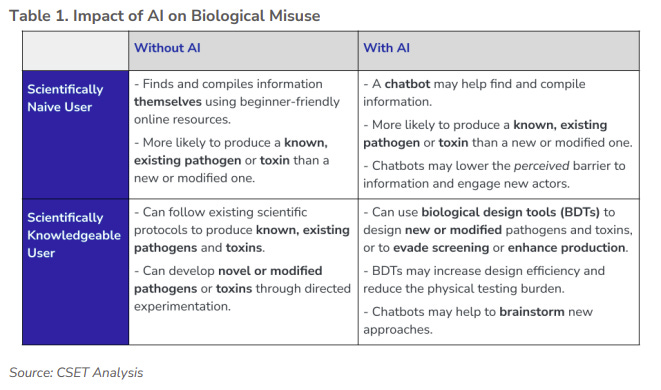
But even without a digital godhead, existing AI models have already proven their utility for biological and chemical uplift in skilled hands. Google’s DeepMind contributed to the Nobel Prize-winning effort to crack protein folding. OpenAI is collaborating with bioscience firms to try and predict the results of clinical trials with a goal of fast-tracking new drugs. If the applications of AI in the life sciences are even half as broad as their proponents claim, it stands to reason that the technology could be a serious risk in the wrong hands.
However, these arguments might be overlooking another important actor that stands to gain from illicit AI: the cartels. Today, thousands of people spread across dozens of countries are engaged in the manufacturing and trafficking of illegal drugs at the behest of sprawling transnational criminal networks. Increasingly these groups deal in drugs that aren’t grown, but synthesized from precursor chemicals. A sufficiently competent Artificial Intelligence could be a boon to this billion-dollar industry by upskilling amateur chemists, advising on lab design, or even aiding in the discovery of new narcotics.
My argument is not that we should neglect higher-order bio/chem weapons risks from AI, but rather that cartel adoption of AI for synthetic drug production is an important, and underappreciated, indicator of potential real harms from AI in the wrong hands.
The underlying logic for this is relatively straightforward: you can sell drugs for a respectable profit, and there is a fairly robust illicit economy wired to support you doing so. This is borne out by the fact that, sans-AI, the number of people who are working on making synthetic drugs like meth and fentanyl right now is much larger than the number of people trying to develop a chemical or biological superweapon. Making drugs pays, perhaps terrorism less so. If AI lowers the barriers to access for illicit science, it seems likely that more people may be incentivized to join the drug game than the terrorism game.
The synthetic drug revolution
Synthetic drugs are not new. Chemical stimulants like methamphetamine have been around since the late 1800s, but they are ascendant in the current global drug market. In the United States especially, the rise of fentanyl, a highly potent synthetic opioid, casts a long shadow over popular culture and political life. While fentanyl overdose deaths have declined from their previous record highs, the drug remains a fixture in American political discourse. Ending the fentanyl trade is ostensibly the rationale for tariffs on Mexico, Canada, and China, as well as the semi-official casus belli for the ongoing U.S. military campaign in the Caribbean.
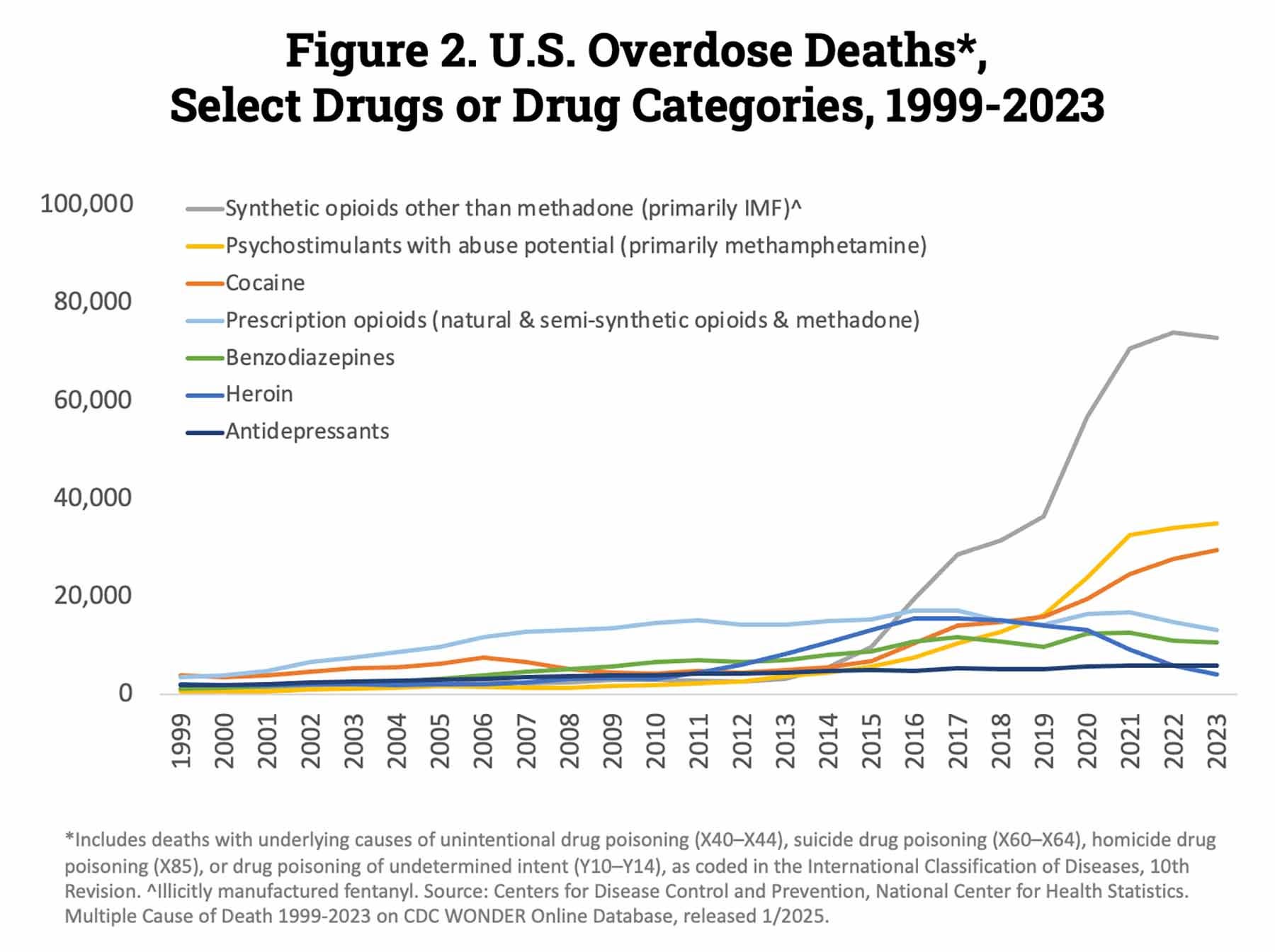
While fentanyl is perhaps the most notorious, it is but one of a host of synthetic drugs that are flooding global markets. This includes meth, which by some accounts is even more important for lining cartel pockets in Mexico and the United States, as well as more potent fentanyl analogues like carfentanil. Today, it is safe to say there are only two types of countries, those with synthetic drug problems, and those about to have synthetic drug problems.
Current trends point to synthetics becoming more, not less, of a problem in the coming years. Synthetic drugs have a number of advantages over more traditional plant-based narcotics. They are largely climate agnostic, require less space to produce, and can be more potent, allowing traffickers and users to get more bang for their buck. These factors are especially important as the United States steps up its military campaign against narcotraffickers, allowing synthetic drug operations to be much more resilient than previous drug operations. Coca fields can be spotted from outer space; fentanyl labs can fit inside a house.
Analysts have long highlighted the difficulty of supply side (i.e. interdiction-based) counternarcotics strategies. It is simply very difficult to interdict a large enough quantity of drugs to put a meaningful dent in their availability to street users and dealers. Synthetic drugs further skew this calculus in favor of traffickers. Whereas you might need a car or go-fast boat to smuggle an appreciable amount of cocaine into the United States, you can traffic an equivalent dose of fentanyl with a commercial drone, or on the person of a single drug mule. With the United States stepping up its operational tempo of lethal strikes against drug trafficking boats in the Caribbean, cartels will likely face pressures to adopt more distributed networks moving higher-potency narcotics. Fentanyl and its analogues fit the bill nicely.
Fentanyl is also not particularly difficult to make. In kitchens and home labs across Mexico, individuals follow rudimentary instructions to synthesize precursors and pre-precursors into viable product. This process is dangerous, often deadly for the cooks, and results in highly varied compounds that worsen the overdose problem among users.
Of course, user preferences can condition the types of drugs cartels are able to sell.
Europe, for instance, has emerged as the primary global market for cocaine, but fentanyl, which has ravaged the United States, has yet to make a dent across the Atlantic. But this means AI should be an even more compelling tool for drug cartels. If fentanyl is not seeing demand in a market, perhaps another synthetic drug might fill the niche. Using AI to synthesize new chemicals is an order of magnitude more complex than getting it to help out with fentanyl or methamphetamine, but it is not beyond the pale for powerful criminal syndicates.
Indeed, drug cartels have strong track records of synthetic drug innovation without AI assistance. The rise of tusi, or “pink cocaine” in South America, ecstasy labs in Paraguay, and the emergence of Chile as a ketamine smuggling hub all speak to this singular brand of illicit innovation and market adaptation.
Even a fairly limited chatbot capable of advising these artisanal chemists on their process could probably drive gains for cartels in the form of better product, higher yields, and fewer accidents. AI could provide step-by-step guidance on methamphetamine or fentanyl synthesis, avoiding reliance on artisanal knowledge or hastily scrawled recipes. It might also be queried on relevant safety procedures for setting up a home laboratory, and while the cartels could scarcely care less about the wellbeing of their cooks, avoiding deaths or lab explosions would help keep their illicit business humming.
AI seems like it could supercharge organized crime’s ability to both adapt to government pressure and unlock new markets. However, if the incentives are so strongly aligned, why haven’t we seen cartels turning to AI for drug development yet?
What to look for
Fortunately, getting an AI that can help you manufacture lethal drugs is harder than simply using a clever series of prompts on ChatGPT. For criminal groups seeking to leverage AI to uplift their drug production, there are broadly two options: (a) build your own model and the infrastructure to support it, or (b) buy it from somewhere else.
The first option is the most technically intensive, essentially requiring cartels to stand up their own underground datacenters and associated infrastructure to host customized models optimized for assistance with drug development. The good news is that this physical infrastructure presents a clear target for law enforcement operations. The energy demand of a datacenter, even an improvised one, should be a natural clue for U.S. and Mexican authorities to look for, while standing up an illicit AI infrastructure stack would be a costly investment for criminals.
Another red flag to look for would be cartel efforts to recruit data science and machine learning experts to help stand up their own models. The New York Times has already reported that groups like the Sinaloa Cartel have sought to recruit, by hook or by crook, chemistry students to assist with the manufacturing of synthetic drugs. Getting programmers to build a custom AI could cut out the middleman in this regard. As Mexico looks to boost its domestic AI and tech sector, the opportunities to either pay off or coerce young tech workers are likely to grow in the coming months and years.
Accordingly, while the barriers to criminals developing their own custom AI models are high, if there are any groups that could accomplish this, powerful and internationalized drug cartels like the CJNG are probably near the top of the list. These groups have sufficient access to money, control over territory, and co-option of state security forces to make a real play at setting up their own narco-datacenters. This approach also has the benefits of customizability and scalability. As compute becomes cheaper and cheaper, the cost for a criminal organization to build more and more capable models will likely continue to decline. A good general-purpose AI resembling the current state of the art might also be turned to objectives other than drug development, simultaneously running financial fraud schemes, developing hacking tools, and acting as personal assistants for cartel bosses.
Nevertheless, narco-datacenters are likely still a ways away. It seems more probable instead that at first criminal AI use would center on running local instances of open-source models that cannot be monitored by their original developers. Chinese models like Deepseek stand out as falling in the sweet spot for Latin American drug trafficking organizations, bringing a combination of close-to-frontier capabilities while being based in a country that has proven willing to snub U.S. requests for closer counternarcotics cooperation in the past.
Another option still would be for criminals to rely on a malicious AI built and hosted by third parties. There is a template for this already with the proliferation of subscription-based “no limits” chatbots like FraudGPT and WormGPT, designed to help users craft customized phishing schemes and cyberattacks. The developers of a hypothetical future DrugGPT would need to be insulated from U.S. and international law enforcement efforts. Perhaps they could be sheltered by an adversarial state with an interest in destabilizing the United States and its allies (China, Russia, or North Korea come to mind). Alternatively, they could simply have a network resilient and distributed enough to evade easy detection.
I’ve not included the potential that bad actors could jailbreak or otherwise evade the safeguards embedded in commercially available, proprietary frontier AI models. Anthropic’s recent detection of a China-based cyber espionage effort that used Claude Code to carry out autonomous hacking is an instructive case study. On the one hand, the incident underscores the level of threat from emerging frontier AI agents. On the other hand, the fact that Anthropic was able to identify the campaign and cut off the attackers’ access to Claude Code shows how quickly leading AI companies can pull the plug on nefarious uses of their proprietary systems. For criminal groups, relying on commercial, proprietary AI for their operations would be like building on quicksand.
Concluding thoughts
We shouldn’t doubt the industriousness of organized crime in the Americas. Cartels have built clandestine submarines, armored vehicles, and even oil refineries in the pursuit of illicit gains. In Mexico especially, criminal groups have the right combination of financial resources, state penetration, and territorial control that could conceivably make this a reality. AI adoption by these groups is likely a matter of “when” not “if” that is, if they haven’t begun already.
That being said, the fact that we haven’t yet seen widespread evidence of criminal use of AI to uplift synthetic drug production is a good sign. If you buy my argument that international drug cartels are the potential first movers in using AI for illicit bio-chem purposes, if they aren’t employing it at scale, that itself may suggest that we have time before a smaller and less well-resourced outfit tries to use AI to pull off a bioterrorism attack.
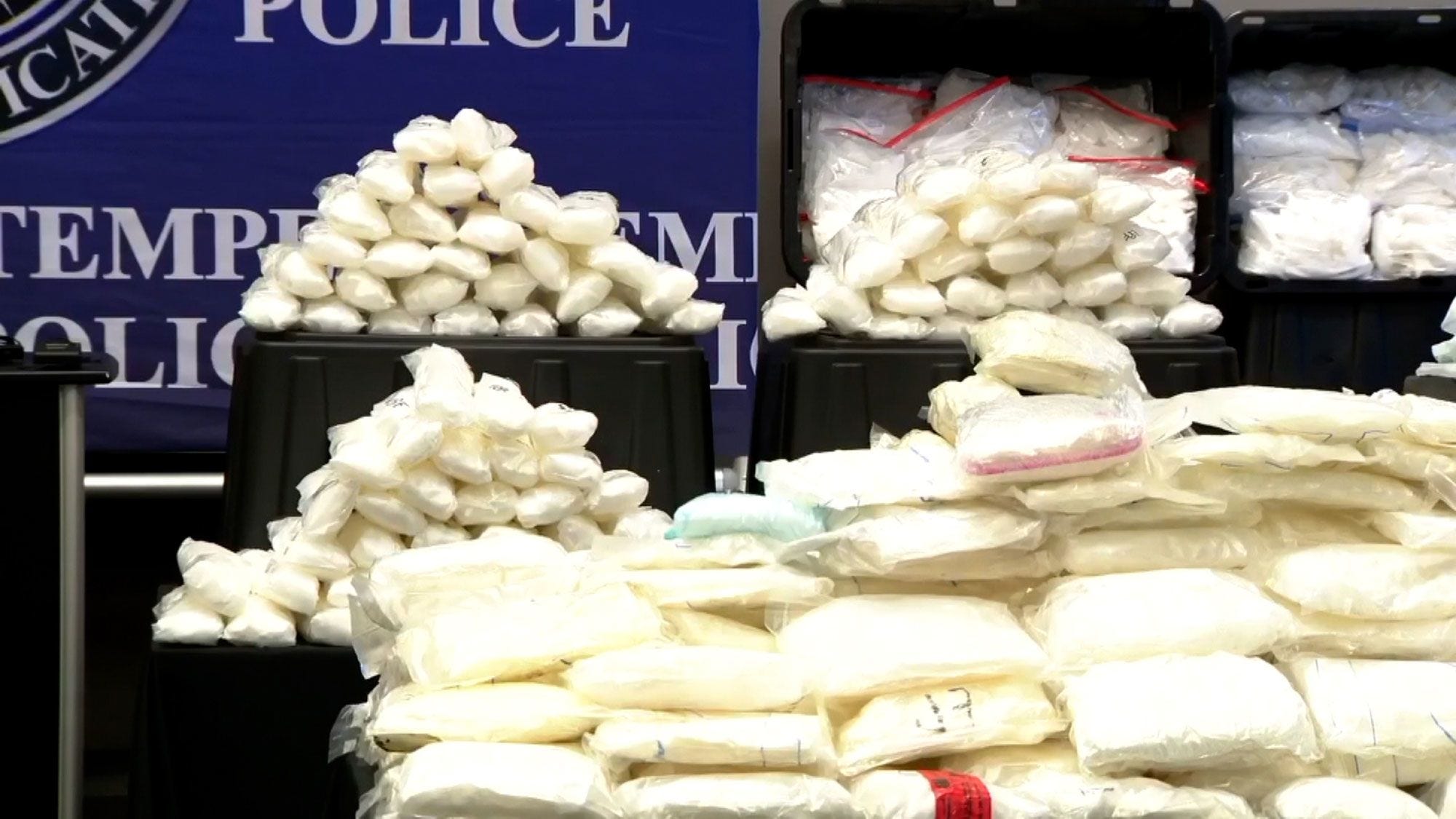
We should use this time to prepare. Agencies like the Drug Enforcement Administration should develop procedures for testing the presence of AI in narcotrafficking operations. In particular, the United States and its allies should remain attentive to new synthetic compounds whenever they crop up on global markets to determine whether artificial intelligence might have played a role in their design. Ironically, good AI might be able to help these efforts. Analysis from the National Institute of Justice has argued that data and sample mining of new synthetic drugs can help forensic labs to better trace the evolution of these substances. The pattern recognition and data analysis capabilities of artificial intelligence might be of use in these efforts.
We can also learn lessons from past efforts to combat AI chip smuggling in order to prevent organized crime from getting ahold of the tech needed to build their own models. The United States in recent years has gotten better at spotting chip smuggling operations seeking to divert export-controlled equipment to China. The United States could look into exports of AI chips bound for datacenters in Mexico to ensure the ledgers match up. The U.S. Bureau of Industry and Security would be a key partner in these efforts, while the upcoming 2026 review of the U.S.-Mexico-Canada free trade agreement provides a useful forum to raise such concerns.
Finally, though it might cause some eyes to roll at the present moment, this is an issue ripe for international cooperation. AI is a digital tool that relies on physical infrastructure. Being able to access, and potentially pull the plug on this infrastructure when it is being used for nefarious purposes will be crucial. While some countries might welcome the establishment of illicit datacenters if they can help destabilize the United States, Washington and its partners should do their best to ensure that their access to the frontier of AI tech remains out of reach.
This piece owes a debt of gratitude to Iskandar Haykel for his thoughtful advice and review. All errors of fact, analysis, or omission are solely my own.
I think one key use case would be using AI to identify alternative precursor chemicals to circumvent export controls