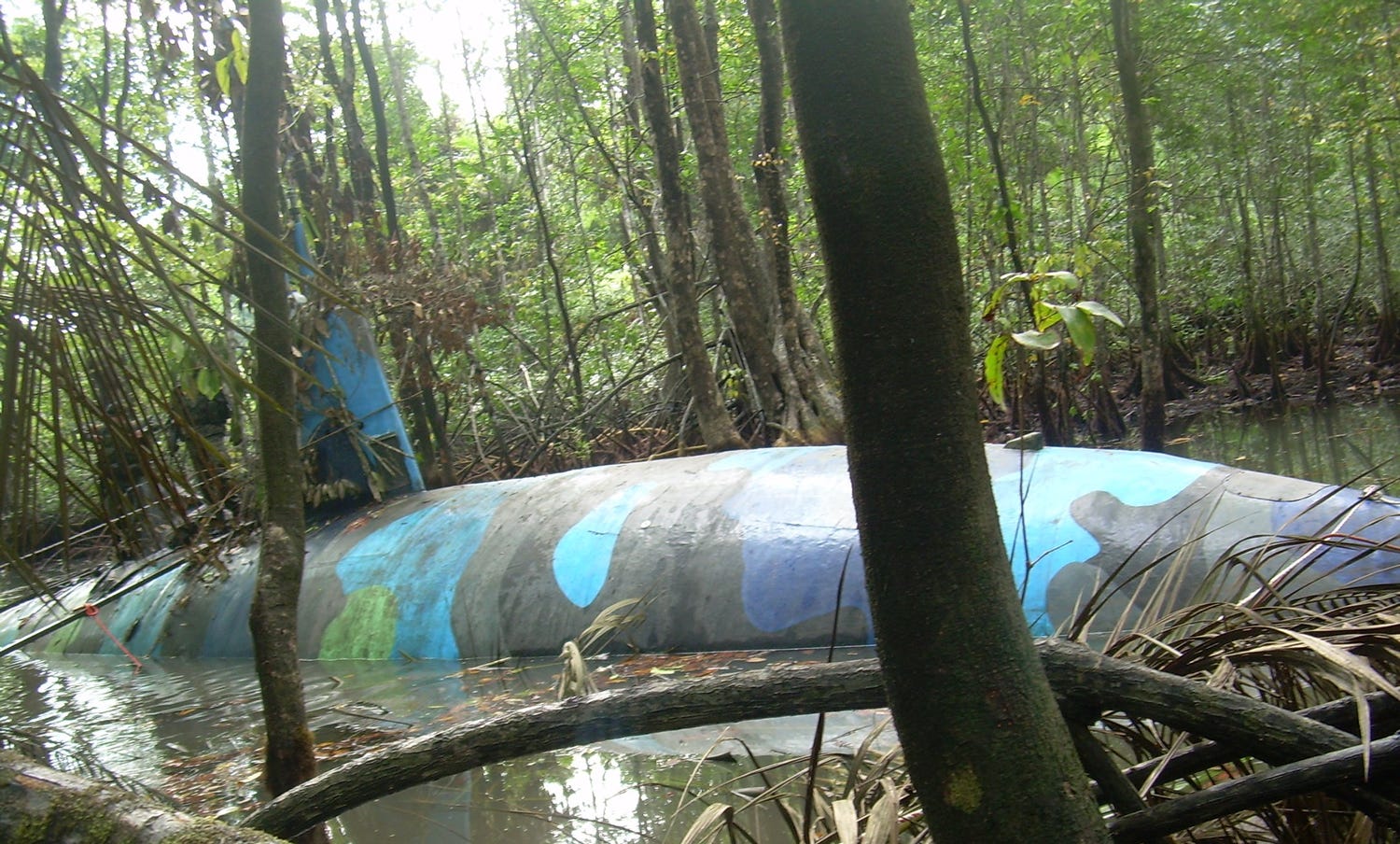
This March, Ecuadorian forces seized a 35-meter long narcosubmarine hidden in the Cayapas–Mataje nature preserve. In April, Mexican authorities showcased a slate of up-armored cartel trucks slated for destruction. That same month back in Ecuador, authorities seized an artisanal firearm patterned after the “Carlo” submachine gun. Similar designs have featured in the arsenals of non-state armed groups around the world, particularly in the Middle East.
These disparate incidents all have their own causal logics, but taken together they point to a broad, decentralized supply chain that sustains and enables illicit activity in the Americas. This criminal industrial base is one of the most important, but ill-understood factors explaining the strength of criminal networks in this region.
We are reminded of criminal industrial base when we hear about its outputs, seizures of explosives, armored vehicles, and artisanal firearms that catch headlines. But more concerning to me is the diffusion of knowledge that is happening constantly between and within illicit networks.
Industries, whether licit or illicit, benefit tremendously from clustering. The more people within a particular sector are sharing information and working together on processes, best practices, tools, and technologies, the more innovation you expect to see. In the legitimate economy, this explains why Detroit is an automotive hub, why Boston leads in bioscience, or why the tech industry took root in Silicon Valley.
Looking to the criminal industrial base, I think the same or similar factors help us explain the pace of technological advance by illicit groups in recent years. We’ve seen narcosubmarines for instance go from crude and scarcely seaworthy vessels to standardized and quasi-mass-produced trafficking mainstays. Weaponized drones have undergone a rapid period of innovation, going from unguided bombers, to one-way attack platforms that now increasingly mount fiber-optic spools to avoid electronic countermeasures.
The criminal industrial base is not new, but it is understudied. Governments tend to treat its various components as isolated problems, and in doing so continue to find themselves on the losing end of the adaptation battle. There needs to be a more systematic effort to reckon with this criminal industrial base, and understand how it manifests across countries and criminal groups in the Americas.
Bombs and Drones
Several analysts (myself included) have documented the revolutionary impact that unmanned aerial systems (UASs), or drones, are having on the fight against organized crime in the Americas. Whereas previously states ruled the air, that dominance is now being tested. Commercial, off-the-shelf drones from brands like DJI offer illicit actors the ability to surveil targets at a distance, deliver contraband without exposing members to risk, and launch precision strikes.
But the use of weaponized drones in particular is constrained by another factor, the ability of criminal groups to rig models designed for civilian hobbyists with weapons of war. Non-state armed groups either employ existing munitions like black market fragmentation grenades, or build their own contact-detonating explosives from scratch. In either case, the group must also figure out how to mount these to a civilian drone.
The skill floor for this isn’t particularly high, Mexican cartels have been known to affix explosives with duct tape and other haphazard measures. But to ensure consistent detonation groups must typically invest a considerable amount of time and expertise in fusing, explosive design, and drone tactics. Trevor Ball outlines some key considerations in an excellent article last year:
“If integrated or semi-permanently fixed to a UAV, for example, a munition’s safety, arming, and/or fuzing mechanisms may need to be modified to ensure it will detonate upon impact at a (relatively) low velocity. If a conventional munition is modified to serve as a small air-delivered bomb, it may benefit from the addition of craft-produced components, such as fins or stabilisers. Munitions normally fitted with time-delay fuzes, such as hand grenades, are sometimes modified to accept impact fuzes. If not correctly modified, UAV-delivered munitions may function prematurely, partially, or not at all.”
A major bottleneck to criminal drone employment therefore seems to be the availability and sophistication of explosives. This is borne out in the case of Colombian armed groups where the dissident FARC faction known as the Estado Mayor Central (EMC) were early adopters of armed drone technology. Drones were as new to the EMC as any other actor in Colombia’s decades-long internal armed conflict, but the group did possess significant expertise when it came to explosive design which allowed them to better exploit their potential in combat.
Indeed, the long history of bombings in Colombia means that many of the groups still active today have a wealth of expertise when it comes to explosive design. Recently Colombian security forces reported the arrest of two men each with around 7 years of experience as bombmakers and drone operators for a FARC dissident faction.
This may also help explain why Colombia has seen such an explosive growth in illicit drone use. The country recorded its first lethal drone incident in July 2024, while in 2025 sustained multiple significant drone attacks that injured or killed dozens of civilians and security personnel alike. More, Colombian groups are now adopting fiber-optic drones that have come to characterize the battlefields in Ukraine. Colombian groups’ familiarity with bombmaking seems to have allowed them to quickly scale up the deployment of weaponized drones in combat.
By contrast, in Mexico it seems as though there may be more of a parallel evolution in drone use and explosive manufacturing. While improvised explosive devices (IEDs) have been used by Mexican criminal groups for decades, the rise in drone incidents has coincided with a dramatic increase in the employment of more conventional explosives and mines.
In comparison to early examples of weaponized drones like the 2017 seizure of a “papa bomba” explosive equipped UAS widely regarded as the first public instance of this technology appearing in Mexico, today cartel drone munitions feature innovations like fragmentation liners, and 3D-printed stabilizer fins. Large seizures of drone-dropped munitions also show a significant degree of design standardization (though variation persists).
Conventional explosives have also become more sophisticated, as evidenced in June of 2023 when a Mexican army patrol vehicle was targeted by two bounding mines set by the CJNG, killing three soldiers. The mines, fashioned from commercial fire extinguishers, were designed to “jump” up when triggered and then explode outward, maximizing damage to passengers in the truck bed. One analysis of the incident notes how drone tactics and IED design feed into one another stating that, “CJNG bomb-making cells are also involved in weaponized aerial drone attached IED (single use drone strike) and IED bomblet design and manufacturing, with cross overs seen with general IED / IED land mine and weaponized drone IED designs.”
Technical insights gleaned by one group seem to diffuse rapidly to rivals who must adapt or die in the Hobbesian world of criminal armed conflict. While the CJNG are widely reported to have adopted armed drones the fastest, a recent report from the National Counterterrorism Innovation, Technology, and Education Center found that their regional competitor, La Familia Michoacana, came in a close second.
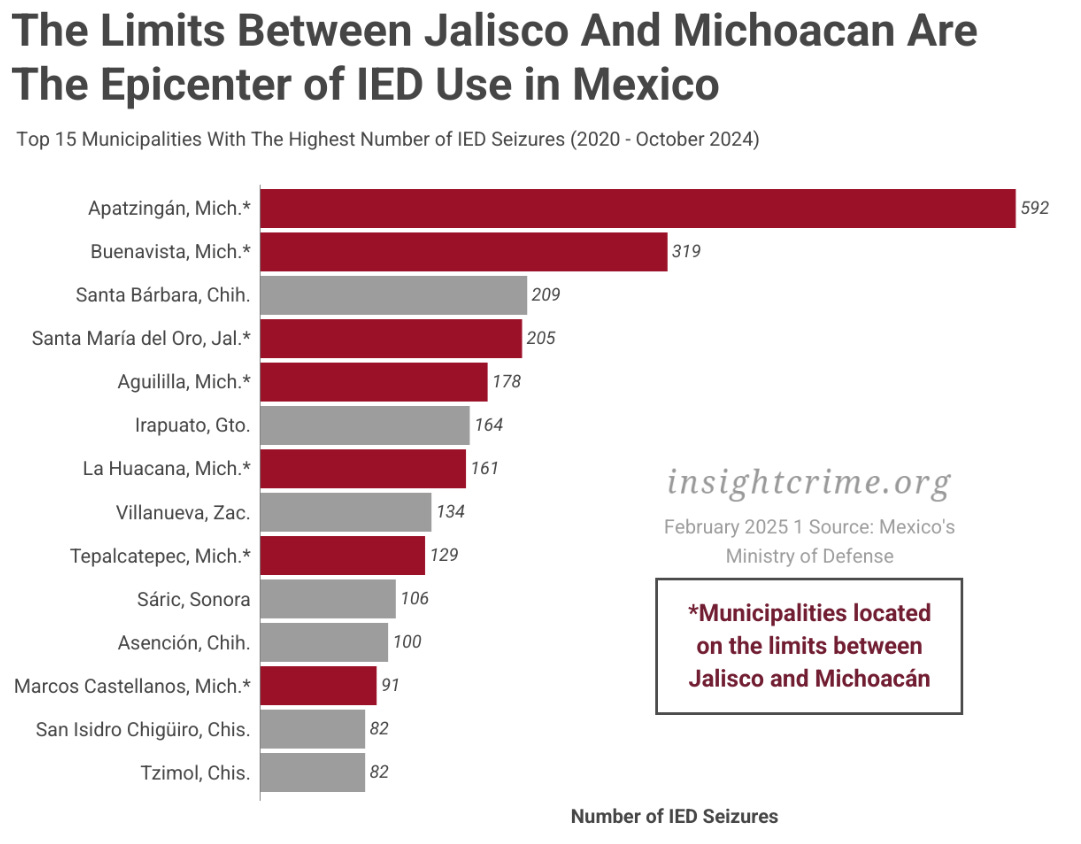
Similarly, according to an analysis by InSight Crime, IED seizures by the Mexican government have skyrocketed since 2020, with 40 percent of all seizures taking place along the border between Jalisco and Michoacán, where conflict between the CJNG and its rivals is fierce.
The threat posed by criminal drones has led governments in the Americas to take steps towards regulating their sale on the civilian market. While these efforts have seemingly failed to put a dent in criminals’ ability to acquire UASs, if they bear fruit in the future it seems likely that these groups will not simply relinquish this capability but instead potentially turn to manufacturing their own drones, or at least drone components. Demand for 3D printed components for these artisanal UASs is likely to grow significantly under this scenario.
(Narco) Subs and Tanks
Perhaps nothing captures the idea of criminal innovation better than the sleek, low-profile hull of a narcosubmarine.
This catch-all term for a host of semi- and even wholly submersible artisanal boats regularly captures media attention, giving the impression at times that these are bespoke, even rare, vessels. In reality, while narcosubmarines indeed a represent a small fraction of the total number of drug-running ships, they are produced on an impressive scale.
The first documented appearance of such a vessel was in 1988 when an empty hull washed up on the Florida coast. Since then, criminal groups have had decades to refine their craft. Between 2020 and 2024 at least 93 of these vessels have been seized, mostly in the Pacific. At least four of the 54 strikes conducted by U.S. forces in the Caribbean and Eastern Pacific since September 2025 have targeted semisubmersible craft.
H I Sutton with Covert Shores, in 2021 noted that narcosubmarine production appeared to be entering a new epoch. Whereas previously production had converged on a set number of designs built largely to the same specifications which suggested relative stability among manufacturers, the emergence of new nonstandard designs suggested a period of flux in the illicit shipbuilding industry. Often these appeared as inferior copies of existing designs, suggesting that workers who may have previously been operating under the guidance of more seasoned builders were striking out on their own.
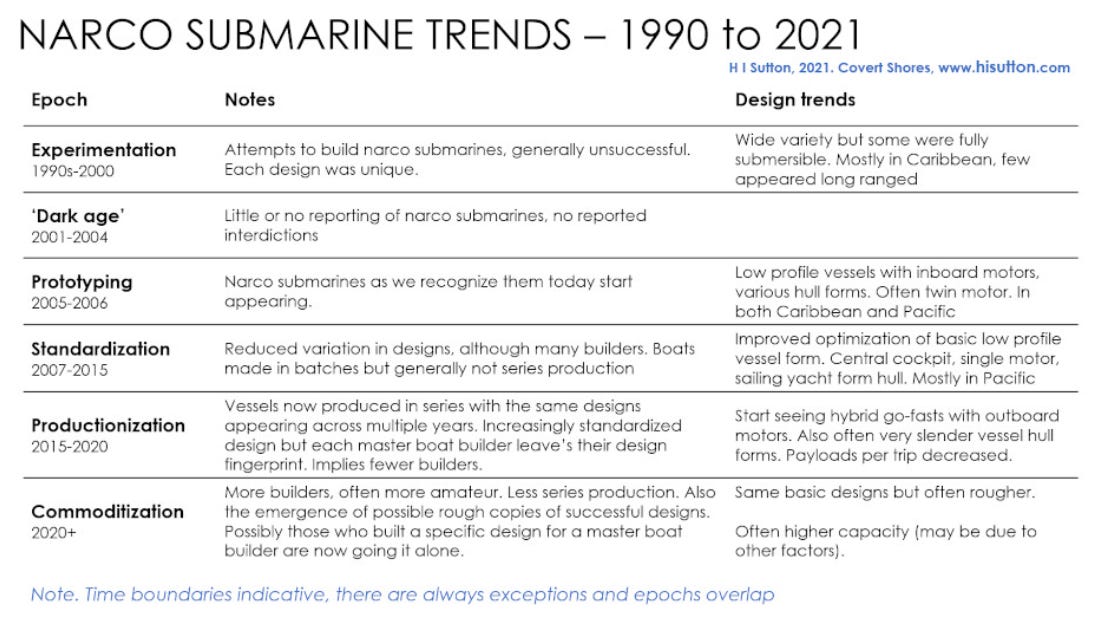
Sutton deemed this a new epoch of narcosubmarine design, where the technology and processes required to build these vessels has itself become commoditized. This also makes halting their construction far more difficult. A decentralized network with more actors participating in the industry not only means more clandestine shipyards, it could allow builders to experiment with new and stealthier designs.
The natural next front for narcosubmarine development is almost certainly transitioning these platforms from crewed to uncrewed designs. Roberto Uchôa has written an excellent article for Small Wars Journal outlining why this is the case. The absence of a human crew can greatly reduce the signature of these vessels, and allows them to loiter for extended periods of time off the coast waiting for patrols to pass. Notably, it also directly undermines the deterrent mechanism the United States is relying on to reduce seaborne drug flows through lethal airstrikes.
The first reported instance of an uncrewed narcosub came in July 2025 when Colombian forces seized one such vessel in the Caribbean. Last week, a small uncrewed surface vehicle (USV) fitted with a camera and antenna, was found by Spanish authorities off the coast of Gibraltar. The drone was empty upon capture, suggesting that its cargo had already been offloaded, or potentially that this was another trial run of the technology.
This latest innovation is made possible thanks to the long history of crewed narcosubmarine production. From an engineering perspective, building the hull is largely a solved problem, the main limitation to narco-USV (or even UUV) deployment instead is how to configure remote navigation, which at the moment seems to lean heavily on Starlink terminals to ensure connectivity on long transoceanic voyages.
While narcosubmarines slink through the seas, on land improvised armored fighting vehicles (IAFVs) otherwise known as narcotanks or “monsters,” have become a mainstay in Mexico’s criminal armed conflict. Like narcosubs, these vehicles have a long history of their manufacture, with sources widely crediting the Zetas for popularizing the vehicles in the early 2010s.
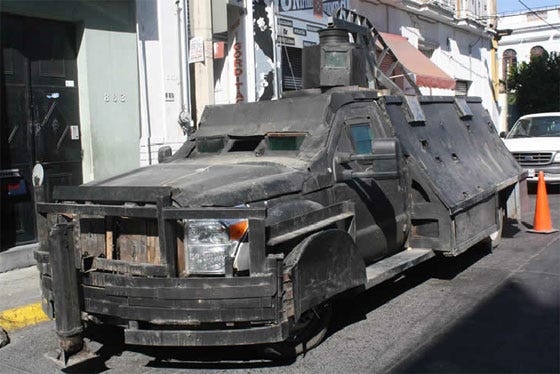
As with drones today, the Zetas’ use of narcotanks spurred rival groups to build their own IAFVs to fight back. However, many early monster designs are more useful for propaganda purposes than combat operations. Groups would compete to possess the largest, or most intimidating combat vehicle, repurposing dump trucks and fitting them with heavy slabs of metal. The results were weapons that, while impressive and difficult to answer with small arms, were vulnerable to becoming immobilized and seized, either by rival groups or Mexican security forces.
But the utility of mobile, protected, firepower remained, and so too did demand for new and improved narcotanks. Cartel armorers began using lighter steel armor to improve maneuverability, and repurposed SUVs and pickup trucks with mounts for light machine guns or .50 caliber rifles. Some modern designs even sport anti-drone “cope cages” or electromagnetic jamming equipment.
There is less open source data on narcotank seizures than there is on narcosubmarines, but the Zetas’ early adoption seems to have created a geographic production cluster around Mexico’s northeast, particularly Tamaulipas state. While narcotanks have by now made their way into virtually every major cartel’s arsenal, from January 2018 to June 2022, authorities in Tamaulipas decommissioned 153 IAFVs, the most of any Mexican state. Michoacán and Jalisco were distant second and third, with 33 and 25 seizures each.
More recently Mexico’s attorney general reported the destruction of 18 such vehicles between December 2025 and February 2026 alone. Videos and images from recent seizures show remarkable similarities in the design of these vehicles. It seems likely that Tamaulipas mechanics and craftsmen in the employ of criminal groups have converged on a common set of designs. Proximity to the U.S. border and the massive flow of automobiles and car parts that cross this every day almost certainly helps fuel these illicit factories.
Contested Logistics and Criminal Innovation
There are clearly many more facets to the phenomenon I’m describing. Illicit fuel refineries, artisanal firearms assembly lines, and of course drug production labs themselves all constitute aspects of the criminal industrial base in my view.
Dismantling this complex clandestine ecosystem is harder than it looks. In many cases it is nigh impossible to expect governments to be able to track down the inputs that feed the criminal industrial base. It is fairly easy for a mechanic to misreport the quantity of auto parts he or she orders and divert some of those to narcotank manufacturing. Similarly, a fisherman might order a replacement motor for their boat, only to install that on a narcosub instead, and that’s assuming authorities are even looking at these kinds of transactions in the first place.
Emerging technologies like 3D printing further complicate matters by allowing criminal groups to fabricate components that are virtually untraceable. Artificial intelligence may further aid artisans in their ability to refine designs and produce more complex vehicles, equipment, and weapons.
If there is a first step to take against the criminal industrial base, it should be recognizing that it exists, not as a set of discrete behaviors or pathologies, but as part of the logistical apparatus that sustains violent illicit actors. Governments should seek to better understand how the presence of certain kinds of covert industrial activity in their territory fuels further innovation and information dissemination.
Another key action would be to sever the recruitment pipeline for organized crime. Illicit actors depend on a range of skilled and unskilled labor to maintain their industrial activities. In Mexico, cartels have kidnapped engineers in the past and forced them to design clandestine radio networks, and continue to recruit chemistry students to aid in the synthesis of illicit drugs. In Colombia, non-state groups increasingly target children for recruitment as drone operators and maintainers. Depending on the level of skill required, cutting off the supply of labor could have a major impact on criminals’ ability to innovate and fabricate advanced systems.
What the Criminals Can Teach Us
At the risk of ending on a digression, I feel the ongoing war with Iran also carries relevant lessons for our understanding of the criminal industrial base. The United States and Israel rapidly achieved air superiority in the opening hours and days of that conflict, and proved far more adept at hunting down Iran’s road-mobile air defenses and missile launchers than one might have expected.
But even after weathering weeks of sorties, Iranian ballistic missile and drone launches never petered out, and appeared to stabilize at low (but nonzero) rate of daily attacks. Iran, of course, had been hardening its missile infrastructure for decades against a potential U.S. attack, nevertheless it seems that even with vast military overmatch, eliminating an adversary’s defense industrial base remains a dangerous dream.
Even if U.S. forces dramatically increase their strikes against nacrosubmarines in the hemisphere, or expands a land campaign to go after manufacturing hubs for IAFVs, it is likely that the institutional know-how and industrial capacity to continue building will persist.
In fact, there’s probably a lot criminal networks can teach our own armed forces about logistics in contested domains. Maybe this is all the more reason for the United States to pay more attention to the criminal industrial base as a case study in preserving supply chains under fire, as well as understanding how adversaries are likely to respond under similar conditions.