The United States just carried out its first (public) airstrike against a drug trafficking organization-turned foreign terrorist organization. It wasn’t against a Mexican outfit, as one might have expected earlier this year, nor was it against the Venezuelan state, as many had hoped (and more are undoubtedly still hoping). Instead, it was against a small boat, in international waters, allegedly trafficking drugs on behalf of the Tren de Aragua. Details are still coming out about the strike, and the alleged 11 “terrorists” killed, but it signals a dramatic step change in how the United States plans to deal with countering organized crime in the Western Hemisphere.
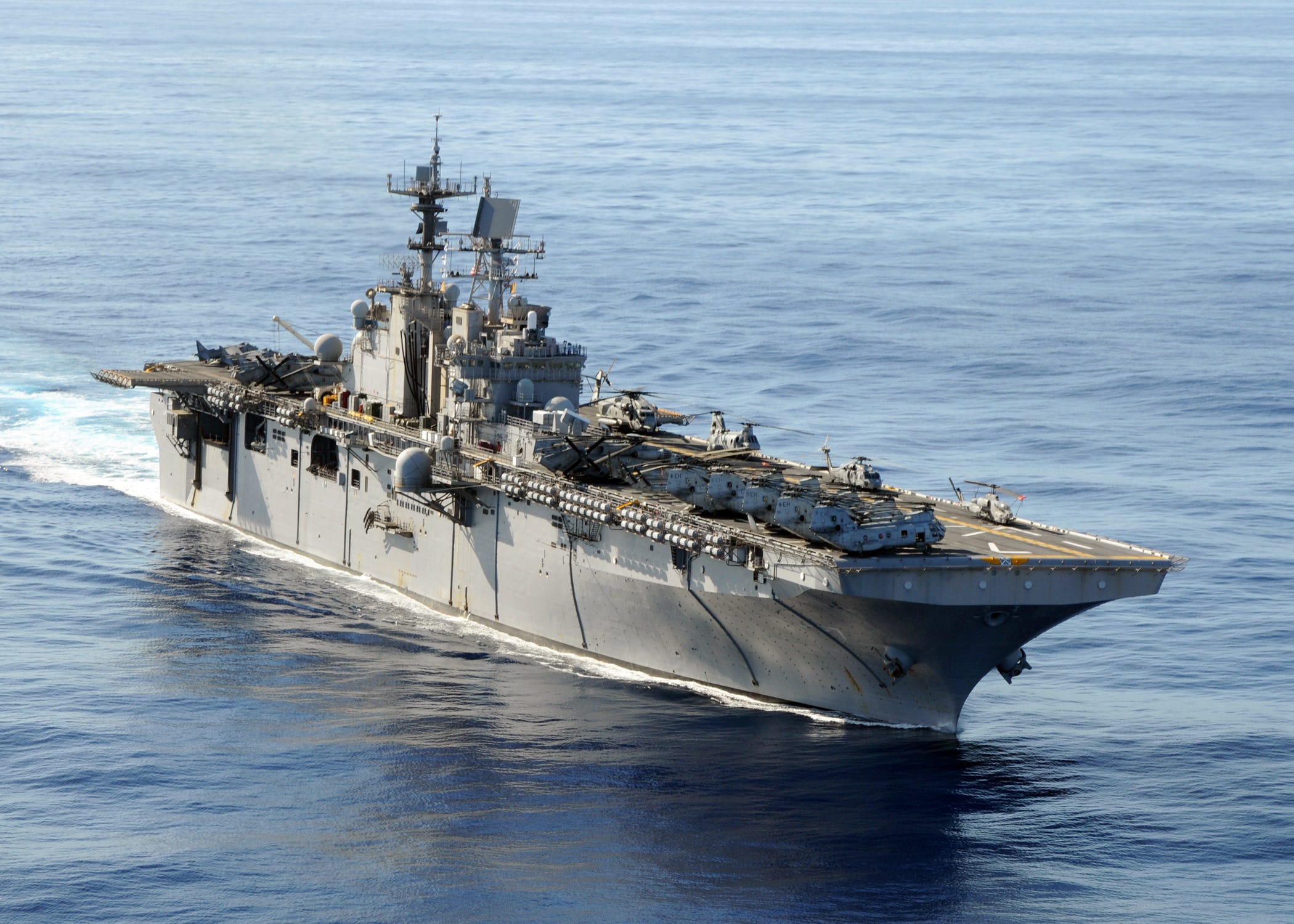
This comes as the United States is engaged in an unprecedented concentration of forces in the Caribbean. In total, three Arleigh Burke-class guided missile destroyers, a Ticonderoga-class cruiser, two amphibious transport docks, the Wasp-class amphibious assault ship USS Iwo Jima, a littoral combat ship, and the nuclear-powered attack submarine USS Newport News alongside various air and sea enablers are currently arrayed in the region. Ostensibly, these are tasked with supporting counter-narcotics efforts, however the magnitude of the force is plainly overkill for such a mission. Indeed, it is quite likely overkill even if the United States intended a sustained air campaign against drug trafficking boats, leaving many speculating what Washington really intends to accomplish.
today’s post, I lay out three theories of U.S. objectives in the southern Caribbean at three different levels of analysis: individually, as a project spearheaded by Secretary of State Marco Rubio, institutionally, as a reflection of Trump administration priorities to tackle drug trafficking, and internationally, as a reassertion of the Roosevelt Corollary to the Monroe Doctrine. My guess is that the truth is probably somewhere in the middle, though where exactly is messy, leading me to theorize that the United States’ current approach can be described as a “kitchen sink” policy, that seeks to leverage a wide range of tools to solve immediate problems, but without an overarching strategic vision.
Interpersonal: Marco Rubio’s Proconsul Moment
Venezuela watchers have so far been perplexed by this administration’s approach to the Maduro regime. On the one hand, early signs pointed to a potential détente with Caracas, exchanging political recognition for cooperation on deportations. Then came the internal clashes over the future of the Biden-era oil licenses granted to U.S. companies with equities in Venezuela. Indeed, as the first warships steamed towards the southern Caribbean, shipments of Venezuelan crude departed on their way to gulf coast refineries.
At the individual level of analysis, current naval operations are an effort spearheaded by Venezuela hardliners within the Trump administration, and Secretary of State Marco Rubio in particular. Rubio, ascendent in his quadruple-hatted role as Secretary of State, acting National Security Advisor, USAID Administrator, and National Archivist, is pushing to raise the salience of Maduro’s narco-trafficking connections as a way of turning up the pressure on the regime.
This would not be the first time an empowered cabinet official under Trump has sought to take the reins of police into their own hands. Indeed, current U.S. foreign policy bears the hallmarks of a top-down decision-making process. The president sets the key agenda items and expects his subordinates to figure out the specifics, while in areas that aren’t priorities, cabinet-level officials and below have more-or-less freedom to maneuver as they wish. The hollowing-out of institutions like the National Security Council further devolves authority to individual agency heads to set U.S. policy largely independently.
But seeking to steer the foreign policy of the United States is not without risks. Director of National Intelligence Tulsi Gabbard landed in hot water over intelligence assessments that Iran was not close to developing a nuclear weapon at the time of Operation Midnight Hammer (she has since reversed course). Secretary of Defense Pete Hegseth was also pressed this summer when revelations emerged that his office had unilaterally paused arms shipments to Ukraine without the president’s knowledge.
In this regard, so far U.S. activity in the Caribbean seems to be a master class in politicking by Secretary Rubio, who has managed to tie Nicolás Maduro directly to one of Trump’s core priorities, stopping the flow of drugs and violent criminals into the United States. Indeed, it is telling that Trump’s Truth Social post announcing the Tuesday strike claimed that the Tren de Aragua was “operating under the control of Nicolas Maduro.” Alleged links between Maduro and the Tren de Aragua have been the subject of fierce debate, including within the Trump administration itself, while organizations like InSight Crime have done admirably work parsing fact from sensationalism.
Nevertheless, the precise relationship between Maduro and Venezuelan criminal groups matters less now that Trump has given his imprimatur to yesterday’s strikes. Accordingly, at the individual level of analysis, it seems highly likely that U.S. military activity in the region will escalate before it cools down.
Institutional: The ‘Try Harder’ Theory of Counter-Narcotics
Looking to how the recent strikes square with what we know of the Trump administration’s anti-narcotics policy, there appears to be a clear through line. From an early stage, Trump has signaled his desire to recalibrate U.S. defense and intelligence institutions to better counter organized crime. “The drug cartels are waging war on America—and it’s now time for America to wage war on the cartels” Trump posted in 2023, and reiterated at his 2025 State of the Union address.
In theory, stunts like these shouldn’t work, or at least the effects should be muted. Drug trafficking is an inherently risky business, but the potential of massive profits is enough to convince plenty of people to take the risk. Until now, however, the possibility of being killed from a distance and with no possibility of recourse by a technologically superior opponent was not in the calculus of most criminal enterprises.
High-visibility actions like the U.S. strike tend to have an outsize effect on criminal behavior. Footage of the strike is likely to be circulating widely throughout the region and among traffickers. Taking a gamble on arrest is one thing, but potentially being struck down by a (literal) bolt from the blue with every drug run might give even hardened criminals pause. The United States does not necessarily need to maintain a sustained campaign of airstrikes on trafficking boats to have effect, it merely needs to convince would-be traffickers that there is a chance they could be targeted.
All of this points to what I call the “try harder” school of politics, which holds that seemingly complex problems are solvable if you are simply willing to focus enough resources on them, and of course bend the law a bit when it gets in your way. U.S. border policy has seemingly been a vindication of this approach, with crossings falling to historic lows due to a combination of fierce rhetoric and draconian immigration enforcement.
“Try harder” approaches generally work when the actor implementing them has both a demonstrated their credibility on the issue at hand, and there are few avenues for recourse by those negatively affected by the policy. In the case of immigration for instance, Trump has demonstrated his credibility on the issue for more than a decade. Meanwhile, the massive deployment of CBP agents and U.S. military personnel along the southwest land border, coupled with a Republican trifecta at the federal level means effectively opposing the administration’s border policies is all but impossible for individual migrants.
A similar story could play out when it comes to drug trafficking in the Caribbean. The United States has demonstrated its resolve to carry out what are in effect extrajudicial killings of suspected drug traffickers, and these groups lack any kinds of air defenses or other means of opposing the U.S. military. Accordingly, I think it is entirely possible that we do observe a dramatic decline in narcotics flows through the region over the coming weeks and months. But drug cartels are nothing if not adaptable and will find other ways to get their contraband to consumers. “Try harder” works wonders in the short term, but so long as the financial and organizational backbone of the cartels remains intact, organized crime will remain resilient. This is not to mention the myriad human rights, legal, and moral implications of removing safeguards against executive power. Tackling those elements requires a more strategic view, and putting in more work with allies in the region, efforts that seldom yield splashy headlines.
International: Prelude to Regime Change?
At the final level of analysis considered here, the presence of warships in the southern Caribbean is intended to signal the United States is looking to assert itself more aggressively as regional hegemon in the Western Hemisphere. Under this reading, anti-U.S. regimes like Venezuela should consider their days numbered as the hegemon will brook no challengers in its backyard.
James Bosworth has done an excellent job outlining why a U.S. invasion of Venezuela would be catastrophic, not just regionally, but for the United States itself. Indeed, if there is one consistent refrain when it comes to Trump’s foreign policy, it is opposition to foreign military adventures that risk sucking U.S. boots into another “forever war” like Iraq or Afghanistan. Nevertheless, a number of analysts have speculated that the United States could conduct more limited operations, like airstrikes or special forces raids to destabilize and hasten the collapse of the Maduro regime.
Where I diverge from those analyses however is that I don’t believe even a light footprint approach to regime change is a core objective of the U.S. mission. My working theory is that the United States is using the concentration of naval power off the coast to stir up domestic opposition in the hopes that a revolution or coup will oust Maduro organically. The United States is in a sense trying to have its cake and eat it too, reaping the benefits of Maduro’s fall, but not getting directly involved in a way that could place U.S. military assets at risk even tangentially.
Accordingly, I don’t think there is serious appetite for even limited military action against Venezuela without a domestic uprising or military mutiny first. By placing a $50 million bounty on Maduro’s head and parking warships off the coast, I believe the United States is hoping that anti-Maduro elements within the Venezuelan military will take it upon themselves to depose the regime and normalize relations with Washington.
The Kitchen Sink and the Future of American Power
To answer the question in the title of this post, each level of analysis suggests the United States wants something different from the current naval deployment. At the individual level, it is about favorable news cycles and signaling, at the institutional, it’s about driving down narcotics trafficking, at the international, it’s about flexing muscles and hoping for the best in Venezuela. Overall, I see the United States approaching this through the lens of trial and error, testing out an assortment of military, intelligence, and diplomatic tools to figure out what works and what doesn’t.
This approach is perhaps best characterized by White House Press Secretary Karoline Leavitt’s statements that the United States will use "every element of American power" to stop drugs from coming over its borders. Of course, the United States is not actually using every single lever of power, but a grab-bag of predominately hard power tools intended to get quick and highly visible results.
I believe there is a role for hard power in the fight against organized crime, but I worry the strategy of throwing everything but the kitchen sink at the problem risks burning long-term stability for the sake of short-term gains. It is easy to become addicted to military action as one-size fits all solutions to organized criminal challenges. But much like the current tariff threats being issues by Washington, the more you rely on a hammer, the harder it becomes to adapt when the thing in front of you isn’t a nail. If the United States neglects capacity-building and partnerships with fellow Western Hemisphere governments, it risks being blindsided by future criminal innovation.
Secretary Rubio is traveling to Mexico and Ecuador this week to discuss security. I hope these visits are productive and yield new security cooperation agreements. As the news cycle churns onwards however, one thing does appear certain, yesterday’s strike was not the end of the U.S. experiment in military action against criminal groups, it was the opening salvo.