Last week the National Security Council released the much-anticipated National Security Strategy. Today’s post parses the good, the bad, and the ugly from this document.
#1 This is a good Western Hemisphere strategy
“Careful what you wish for” has been my mantra as a Latin America watcher this past year. After spending most of my time in this space crying from the rooftops for policymakers to pay more attention to the Western Hemisphere, we now have the most Latin America-focused presidential administration in decades. In particular, acting National Security Advisor Marco Rubio’s fingerprints seem all over the Western Hemisphere section of the NSS.
The Western Hemisphere section is, for the most part, blissfully free of culture war rhetoric that pervades other sections of the document. In fact, the two pillars of this strategy, dubbed “Enlist” and “Expand” would not be out of place in a DC think tank report (that’s a compliment), and center cooperation with allies and partners in the region. Many of their recommendations are pure common sense, like calls for increased coast guard and naval presence to deter drug trafficking, forging mutually beneficial economic ties, and facilitating technology transfer and arms sales to regional allies.
In particular, there is a remarkably cogent analysis of how the United States can compete with China. The NSS repeats common language about the hidden costs and risks to countries of relying on Chinese tech and infrastructure, but recognizes that the United States must do more than scold countries in the Americas.
While the United States government cannot compete with China on a raw dollar-for-dollar basis, it has the benefit of the world’s most dynamic economy and vast capital markets. These can be leveraged in ways that benefit Latin American partners and also box out Beijing’s ability to access critical raw materials, creating a self-sustaining hemispheric ecosystem that could be a major source of strength. The NSS gets these factors right, and it is honestly refreshing to see this argument being made at the highest levels of U.S. national security policymaking.
Also notable is the line that “we must not overlook governments with different outlooks with whom we nonetheless share interests and who want to work with us.” That could be taken as an olive branch to countries like Colombia or Brazil if they can successfully squash their beefs with Washington.
But writing the strategy is the easy part, and I’m still not totally convinced that we are setting ourselves up for success along the lines that the NSS articulates.
So far this year, the United States has had trouble taking full advantage of its wins. Pressure on Panama early on in the Trump administration resulted in a landmark deal between CK Hutchison and BlackRock to sell 43 overseas ports operated by the Hong Kong-based company. But the U.S. has taken its eye off the ball on the deal, opening the door for a Chinese state-owned shipping company to potentially secure a minority stake in 41 of these ports, including strategic holdings in Mexico and the Bahamas. China is also bidding on two new port concessions along the Panama Canal, while U.S. companies are seemingly nowhere to be found.
In Brazil as well, tariffs could have paved the way for a landmark critical minerals agreement that would lock China out of strategic reserves of REEs and niobium vital for defense production. Instead, the United States focused on trying to free Jair Bolsonaro, and may be losing interest in the fight now that it has become evident that such a demand is a complete non-starter for Lula. The United States might lose out on a potential opportunity in Brazil simply for lack of imagination.
There is still reason for optimism. The above examples prove that the U.S. still wields significant influence in the Americas, it is a question of how we use it and to what ends. Argentina, for instance, is a good case study of how positive engagement between the United States and the region could look. Hopefully the NSS, with its mandate to “identify strategic acquisition and investment opportunities for American companies in the region and present these opportunities for assessment by every U.S. Government financing program” can help course-correct, but my prognosis is mixed at the moment.
#2 I still don’t know what the “Trump Corollary” is
Perhaps the single most relevant statement in the NSS is its commitment to articulate and enforce a “Trump Corollary” to the Monroe Doctrine. This is a punchy and evocative statement, sure to capture headlines, but when reading I found myself with more questions than answers in terms of what that actually means for U.S. foreign policy.
The most relevant text from the NSS reads: “We want to ensure that the Western Hemisphere remains reasonably stable and well-governed enough to prevent and discourage mass migration to the United States; we want a Hemisphere whose governments cooperate with us against narco-terrorists, cartels, and other transnational criminal organizations; we want a Hemisphere that remains free of hostile foreign incursion or ownership of key assets, and that supports critical supply chains; and we want to ensure our continued access to key strategic locations. In other words, we will assert and enforce a “Trump Corollary” to the Monroe Doctrine.”
According to this framing the Trump Corollary covers a broad range of topics, from quality of governance to public safety to great power competition and command of the commons in the Americas. For a strategy that professes to offer a more triaged, focused vision of America’s available means and desired ends, this misses the mark.
Let’s consider first the strategic tradition the Trump Corollary is attempting to situate itself within.
Regardless of how you might feel about their contents, both the original Monroe Doctrine and Teddy Roosevelt’s original corollary articulate a remarkably elegant and cohesive strategy. Monroe’s articulation in December 1823 provided a clear objective, no new European interference in the Americas. Of course, at the time the United States had no means of enforcement, but fortunately Britain was willing to shoulder the thankless job of keeping the rest of Europe out while its former colony claimed the credit.
By the time Teddy Roosevelt came to office the United States was finally able to shoulder the full burden of the Monroe Doctrine, but with that power came a perceived responsibility for enforcing good conduct within Washington’s zone of influence. Accordingly, Roosevelt stated that, “in the Western Hemisphere the adherence of the United States to the Monroe Doctrine may force the United States, however reluctantly, in flagrant cases of such wrongdoing or impotence, to the exercise of an international police power.” In this way the Monroe Doctrine as we know it today was conceived as a two-part policy (1) No intervention in the Americas by extra-hemispheric powers, (2) within the Americas, the United States reserves the right to intervene in its neighbors’ affairs as a policeman of last resort.
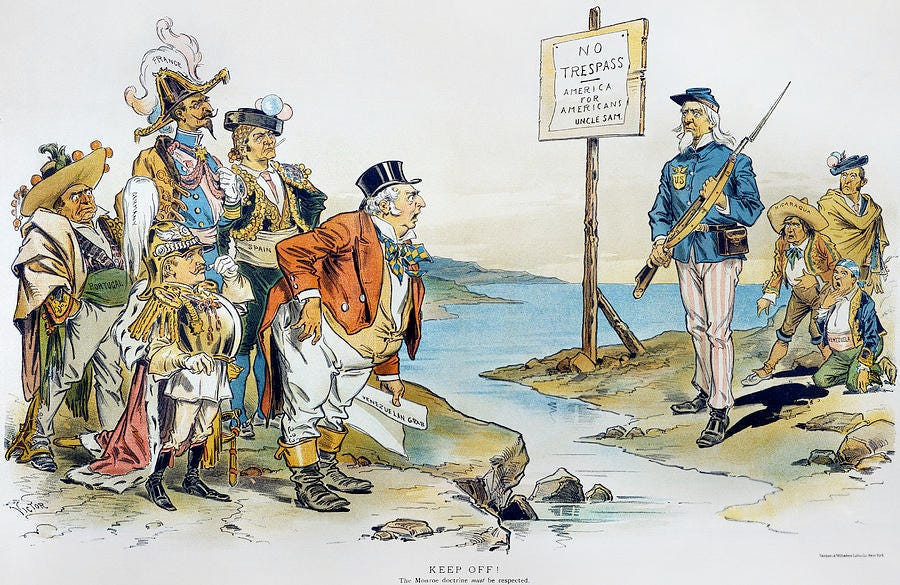
Again, regardless of how you feel about that framing, it seems profoundly unclear what new dimension the Trump Corollary brings to the table. Instead, the NSS lays out a grab bag of things it doesn’t want to have happen in the Americas. We don’t want countries trafficking drugs, or migrants, we don’t want China controlling critical infrastructure, we don’t want to lose access to the Panama Canal. But are those things preconditions for the use of military force? Or does a country need to check several of those boxes (like Venezuela) before bombs start dropping? If countries work with the United States to stop those things from happening, will it be rewarded, and if so, in what way? These are fundamental questions about how you connect means with ends, the exact thing the NSS promises to do, but I feel myself having to fill in the blanks left in the document.
At best, the Trump Corollary is a modification of Roosevelt, enumerating and updating the list of conditions under which the United States will get involved in its neighborhood. At worst, it is what James Bosworth aptly described yesterday as “a branding exercise for ad hoc decisions driven by the president’s whims and pique.”
#3 First Venezuela, then the world
Venezuela is conspicuously absent from any mention in the NSS. Indeed, the focus on enlisting allies and expanding partnerships seems to imply a rosier picture of U.S. engagement with the region than we are currently observing.
In my view, the absence of Venezuela from the document itself confirms my hunch that overthrowing Maduro is not the primary focus of the current U.S. focus on the region. Instead, I think Venezuela matters mostly insofar as it is bound up with Washington’s broader crusade against drug trafficking and migration.
That’s not to say Venezuela doesn’t matter. To the contrary, I think it is a critical test case for the United States’ ability to expand its campaign against narcotraffickers from the global commons to sovereign territory. Maduro’s regime, illegitimate and unpopular at home and with a dwindling and fickle set of friends abroad, is an appealing target, and potentially a valuable precedent. If the United States succeeds in striking Venezuela with limited repercussions, the Western Hemisphere will get a lot scarier for everyone who isn’t the United States. Mexico in particular will be paying close attention to whether Venezuela sets a precedent for U.S. strikes against land targets in the region.
This can also give us some signs of where things could be headed in the showdown between Washington and Caracas. If the United States’ primary goal is to prove it is able to go after traffickers on land, that raises the probability we could see airstrikes against Venezuela that nevertheless leave Maduro in power. In this scenario, the United States launches a handful of strikes using standoff munitions against narcotrafficking targets including ports or airfields, but doesn’t sustain this campaign for long enough to trigger a domestic uprising. Trump would still be able to declare victory by having targeted FTO-designated cartels on land (his stated objective) without having to reckon with the fallout of regime change.
This of course sounds like the worst of both worlds, constituting a flagrant violation of national sovereignty (which the NSS valorizes) while still leaving the Venezuelan people under the yoke of Maduro. In response, I would argue that such an outcome should be seen as at least plausible, and entirely in keeping with this administration’s core national security goals, namely to usher in a new Global War on Crime where the President’s authority to target cartels is viewed as sacrosanct and impervious to judgement.
#4 Risks and rewards for allies
As mentioned before, in the text itself the Western Hemisphere sections of the NSS are heavily focused on building partnerships with countries in the region. Reading between the lines, it looks like the United States is hoping to apply some of the same burden-sharing expectations on the region that it has asked of partners in Europe and Asia.
At a basic level, it seems that the United States heavy-handed approach to drug trafficking will trickle down through the rest of the region. Politicians who admired Nayib Bukele in El Salvador will be doubly emboldened by U.S. strikes on drug trafficking boats in the Caribbean and Eastern Pacific. In the near future, I would expect to see more countries using their militaries against drug traffickers and gangs, either in an effort to emulate the United States, or for fear of being seen by Washington as insufficiently committed to the cause of counternarcotics.
But taking domestic action won’t be enough, and the NSS seems to imply it will be looking to like-minded countries in the Americas to act as problem-solvers within their neighborhoods. This is in keeping with the Trump administration’s general preference for allies to increase their burden sharing. If countries really want to curry favor with DC, they will have to step up in ways they may have never anticipated.
What this might look like will be up to regional governments to decide, but it opens some interesting possibilities especially in the security domain. Maybe Argentina takes a more muscular approach to interdicting and boarding Chinese illegal fishing vessels in its EEZ. Maybe El Salvador sends a security advisory delegation to help Ecuador secure its prison system. Maybe Colombia launches a joint drone production program with a U.S. defense tech firm.
One of the biggest, and riskiest, challenges that the United States may ask its allies to take on is Haiti. Nobody wants to touch the beleaguered country, least of all the Trump administration, and for good reason. No country wants to commit their own soldiers to fight in punishing urban terrain against heavily armed gangs just to prop up an interim government that is hanging on by a thread. For this reason, the new Gang Suppression Force authorized by the Security Council this September remains in limbo, it exists in theory, but everyone is dragging their feet when it comes time to commit actual forces.
To me this is an overly cautious way of thinking about things. A country that is willing to accept responsibility and fully commit to leading the charge against Haiti’s gangs would likely get a warm reception in Washington. They could in turn leverage this goodwill to secure foreign military financing, security cooperation agreements, and even strike a more favorable trade deal. It will also behoove countries to take the initiative on this themselves, rather than wait for the United States to decide enough is enough an browbeat a coalition of countries into taking on the Haiti file.
#5 The foreign policy establishment has yet to notice the vibe shift
While I’ve focused this article on what the NSS has to say about U.S. strategy in the Americas, that has not been the primary headline around the document. Instead, most observers in the national security world have focused on what it means for Europe, or how it views the confrontation with China.
The fact that the Western Hemisphere appeared first among the list of regions is analyzed only insofar as it is proof that the document has its priorities all wrong. To be sure, there has been much ink spilled over the Trump Corollary, but this analysis is largely circulating within the same Latin America-watcher circles, struggling to break out into the larger national security conversation.
Perhaps this is just me feeling sore that after all this time the region I love still doesn’t have sufficient pride. But I do sense that for many of the pundits and analysts in DC’s foreign policy world, this focus on the Western Hemisphere is regarded as something of a distraction we must entertain before the focus reverts to the more relevant theaters of Europe, the Middle East, and Indo-Pacific.
I think this mindset is incorrect for a couple of reasons. First, at a very basic level the Americas will be relevant for at least the remainder of the Trump administration. Even if conflict with Venezuela is not imminent, the United States is reopening and expanding bases throughout the Caribbean and stocking up for a multi-year presence in the region. It seems likely that a larger U.S. force posture in the hemisphere is going to be a reality, and with a bigger hammer the United States is liable to go looking for nails to pound down.
Second, and more personally, I think the Western Hemisphere has much to teach us about the way geopolitics will play out in the coming decades. Whether you care about the future of democracy or the energy transition and the minerals that power it, urban combat or the demographic crisis, the Americas are an understudied and undervalued region. Indeed, part of my goal with this blog is to hopefully convince you that studying Latin America and the Caribbean is crucial to a well-rounded understanding of politics in the 21st century.
We might not all be Latin Americanists just yet, but it can’t hurt to brush up.