

Cuba is embroiled in the worst crisis since the fall of the Soviet Union. In fact, between the vice grip imposed by the United States on oil imports, compounding crumbling infrastructure, and decades of mismanagement, the island’s economic situation is perhaps the worst it has been at any time since the revolution. However, this has failed to catalyze revolutionary sentiment. Protests on the island have been sporadic, isolated, and short-lived. At the moment, any theory that suggests economic deprivation could catalyze a revolution against the Cuban Communist Party appears sorely misguided.
There are several reasons for this, from the continued coercive power of the Cuban security forces to the absence of strong civil society coordinating mechanisms. But I think that the most basic answer is that everyone who might have joined in a theoretical uprising has left the island already.
Those who have not left tend to be older, sicker, or disproportionately disposed to the ideological program of the Cuban Communist Party. These are not the masses you can count on to take to the streets, certainly not for a sustained period of time.
Cuba is hardly the only country dealing with an aging population and mass migration. Indeed, from Latin America to Europe, East Asia, and beyond, demographic winds are shifting and countries are struggling to get their bearings in uncharted terrain.
In the United States and Europe, demographics and their discontents have led some to decry “Total Boomer Luxury Communism” a concept coined in a 2025 article by Russ Greene for the American Mind. As Greene puts it “The essence of [Total Boomer Luxury Communism] is that it redistributes wealth from younger families and workers to seniors, who are on average much richer.” This generational disparity is exacerbated by falling birthrates and rising average life expectancies, meaning a shrinking working-age population is now supporting a growing class of retirees. We see this cropping up in debates over social security in the United States, the notorious “Triple Lock” in the UK, and welfare spending as a whole in Germany.
In Latin America, I would argue, similar demographic trends are making popular protest movements increasingly difficult, while further entrenching authoritarian regimes.
Birthrates alone do not explain these dynamics. Migration in particular offers an escape valve for dictatorships to rid themselves of the young, high-agency individuals who might otherwise press for change within their home countries. Going forward, I believe we could see a rise in “Total Boomer Poverty Authoritarianism” in the Americas. This system is characterized by spiraling economic crises, corruption, and autocratic governance that nevertheless meets with little to no domestic pushback as migration hollows out protest movements before they can become genuine threats to the regime.
How We Got Here
Falling birthrates across the globe have attracted substantial coverage from all corners of academia, media, and political leadership. Latin America has not been spared from this trend and indeed, the region has experienced a precipitous decline in its total fertility rate (TFR) despite remaining firmly ensconced in the middle-income trap. In 2024 Chile’s TFR hit 1.14, ever-so-slightly lower Japan’s. Recent data from Mexico’s national statistical institute reported the country’s TFR was lower than Germany’s despite Mexico boasting a GDP per capita more than four times lower.
The cause (or causes) of these declining birthrates continues to attract significant attention. Of particular interest is how uniform the trend has been. Birthrates are falling in rich and poor countries alike, while political programs championed by both the left and right have struggled to nudge these back up.
I remain fairly skeptical of the maximalist arguments waxing poetic over the disappearance of nations, or that falling fertility is an extinction-level risk for humanity (as far as extinctions go, that’s one of the more agreeable options). What I do believe is that shrinking and ageing populations will be a source of substantial disruption within the next 2-3 decades. The severity of these disruptions will be unevenly distributed, and particularly bad for countries with already weak economic models and high levels of net migration.
In this regard, Cuba is perhaps the hemisphere’s most striking case of demographic collapse under authoritarian conditions. When Fidel Castro and his band of revolutionaries washed ashore from the Granma in 1956 the median age on the island was 21.3. Today, it has nearly doubled to around 42 while Cuba has the highest old age dependency ratio of any Latin American country. For every four Cubans of working age, there is one person aged 65 or older.
Elderly individuals vastly are more likely to depend on others for basic necessities food, water, and healthcare. Even when those services are severely degraded as they are in Cuba, they are unlikely to support rolling the dice on overthrowing the state which could result in even more severe deprivation.
Fellow Latin American autocracies Nicaragua and Venezuela are younger, but have gotten older steadily over the past two decades. Meanwhile mass migration adds pressure since working-age people are disproportionately likely to leave compared to children or the elderly.
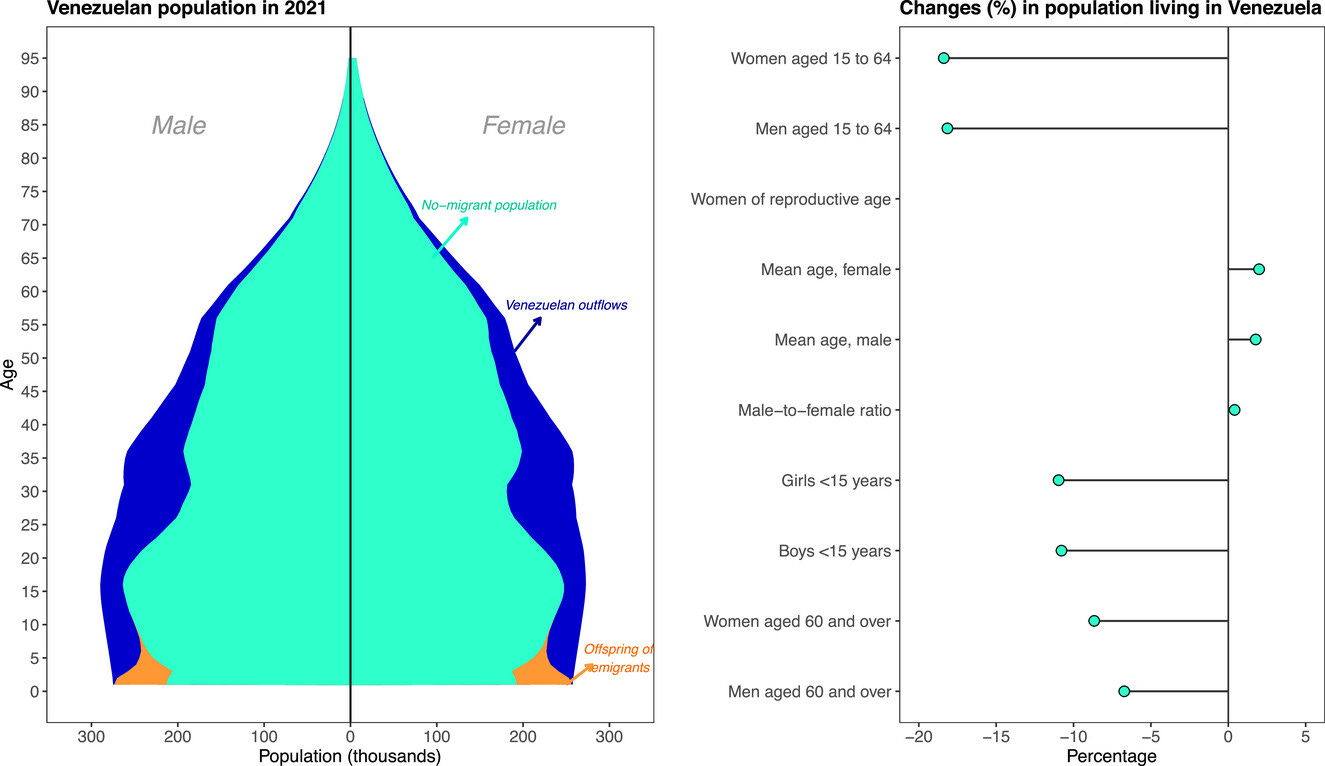
Jenny Garcia Arias illustrates this in a 2024 article in the Population and Development Review which estimates Venezuela’s working-age population dropped by nearly 18 percent, while the share of elderly people increased by about 10 percent more than it would have absent large-scale outmigration. The disproportionate representation of young women in migration flows from 2018-2020 further depressed birthrates within Venezuela.
In Nicaragua, the story is similar, some 800,000 people, approximately 13 percent of the population, have reportedly fled the country since 2019.
Beyond raw numbers, who chooses to migrate or flee also matters significantly.
While each individual decision to leave one’s home is justified, and often made under conditions of extreme uncertainty and duress, the cumulative effect of such departures can hollow out popular movements. Revolutions are human capital-intensive. They require dedicated organizers and strategists who can steer popular sentiment towards realistic political goals. There are a limited number of people in any country who possess such skills and are also willing to put their lives on the line for a cause, and when those people leave, the task becomes exponentially harder.
Take the Venezuelan opposition for example. I cheered the news that María Corina Machado had successfully escaped the clutches of the Maduro regime and would be able to receive her Nobel Prize in person. I was relieved that after more than a year of occultation she would be able to receive medical treatment, and reunite with family also outside the country. But her departure also seriously diminished her ability to influence conditions on the ground within Venezuela, while her attempts to return have thus far been stymied.
In other cases, exile has become a preferred tactic of authoritarians to defang domestic opposition movements. No regime in the Americas has been so prolific in this as the Ortega-Murillo dictatorship in Nicaragua, which has systematically exiled and denaturalized hundreds of opposition figures.
In El Salvador as well, government pressure prompted the news outlet El Faro to relocate its operations to Costa Rica. Again, I understand the rationale for such moves, but it is undeniable that they also make it harder for opposition actors to understand the situation on the ground in their former homes.
This brings us all the way around to demographics again. Young people tend to have fewer attachments that can be leveraged against them by the state to compel their silence or exile. They also typically have more energy to confront riot police and tear gas day in and day out. Not for nothing have students historically comprised the red-hot core of protest movements throughout the Western Hemisphere.
Where We’re Headed
None of the above factors mean that mass movements are impossible in Latin America anymore, but they do make them harder to build and sustain.
Venezuela seems like an instructive case study in this regard. Since the Hugo Chávez era the country had experienced protests along with migration. However, both of these kicked into high gear beginning in 2014 and accelerating through the 2018 presidential elections.
When Juan Guaidó declared himself president in January 2019, the country exploded into protests that for a time seemed to pose a genuine threat to the regime of Nicolás Maduro. However, as the street protests were effectively quashed, they gave way to a surge in migration driven by a potent cocktail of economic, security, and political push factors. Eventually, the number of Venezuelans living abroad came to total some 8 million, the largest migration crisis not associated with an active armed conflict.
In July 2024, when Maduro engaged in an even more brazen electoral theft, the country once again erupted into protests. By some accounts, these demonstrations were even more widespread than they had been in 2019. However, the shelf-life of this movement seemed shorter than it was before, with the total number of demonstrations rapidly declining through August and September.
Of course, it’s difficult to tease out causality from this, the regime’s reaction to protests was more heavy-handed in 2024 than 2019, while the opposition may have chosen to strategically limit its calls to protest to preserve the staying power of the movement. It still seems quite likely that the presence of a few million extra bodies might have caused the 2024 movement to look a bit different.
In Cuba as well, the July 2021 protest movement that rattled the Communist Party leadership gave way to repression and accelerated ongoing mass migration which according to some estimates, has shrunk the island’s population by as much as a quarter.
This is not to say that in a world without migration we would have seen a successful uprising in Cuba. Rather that the island’s current demographic situation makes organizing such a movement even more of an uphill climb. Indeed, it strikes me that the primary mechanism through which Total Boomer Poverty Authoritarianism manifests is by reducing the number of opportunities for change in a country.
National protest movements are often catalyzed by some inciting event, an election, a fuel price hike, or a particularly resonant moment of state brutality. In that moment, people take to the streets and regimes weigh the relative tradeoffs of repression versus accommodation. If repression wins out and the regime stays in power, the cumulative effects of ageing populations and migration means that future movements will have less and less to work with going forward.
I’ve spent most of this article focusing on the autocratic governments of today, but what really worries me about Total Boomer Poverty Authoritarianism is what it means for future assaults on democracy. Latin America is getting older, while increasing global interconnectedness is making the logistics of migration easier.
If Mexico, Chile, or Colombia were to slide into dictatorship at some point in the coming decades, civil society there would likely face similar, and potentially even more acute, challenges associated with mobilizing smaller and grayer populations.
This paints a depressing picture, but I still take heart in the fact that Latin America’s civil society remains one of the most vibrant and dynamic in the world. Certainly it would be laughable for me to suggest that older people cannot drive political change in the region that is home to the Madres de la Plaza de Mayo.
By no means do I believe demography is destiny, but it exerts an undeniable pull. Reversing autocratization is becoming harder, while the window of opportunity to push back against the closing of civic space is narrowing. The sooner we recognize these factors, the more prepared we can be to confront democratic backsliding before it gives way to full-fledged authoritarianism.
From your last paragraphs, feels like Brazil and Peru are especially vulnerable as neither of the main factions is particularly enamored with democracy
Excellent piece! And a great resource with the graphs :)