

Who is the most important political figure of the 21st century? It’s a question that I’ve batted around in recent months. There are some obvious answers (Trump, Putin), but I’d like to make the case for a more quixotic candidate, former Mexican president Andrés Manuel López Obrador.
While AMLO’s direct accomplishments don’t amount to a great deal (more on that later), his political style is, in my opinion, the defining template for successful mass politics in this century. What I mean by this is first, that AMLO’s approach to politics, characterized by an intense focus on forming personal connections to voters and the agenda-setting power of the bully pulpit is the recipe for success in an electoral political system. I add the caveat about elections because, while unelected dictators may also embrace an AMLO-esque style, they don’t need to rely on it to gain and maintain power. Kim Jong-Un isn’t particularly charismatic, nor savvy with mass-media, but he doesn’t need to be. This argument applies more to the Nayib Bukeles of the world, who despite autocratic tendencies, still rely on winning elections to achieve a popular mandate.
It is also unquestionably conditioned by my own affinity for the Americas. My response to this would be I think most people don’t have enough affinity for the Americas (hence this blog). The region is a laboratory of democracy where you find just about any political meta-narrative playing out in real time, from enlightened technocracy to ascendant populism to democratic backsliding and even state collapse. It is also a mirror to the United States, which I’ve become increasingly convinced better resembles a Latin American country than any European government. With that in mind, I firmly believe AMLO tells those of us in the U.S. far more about our current political moment that we recognize.
AMLO, in brief
Before moving much further, it’s worth spending time on a brief overview of our protagonist. Like any good story, ours begins with a stolen election. Well, not exactly, the 2006 Mexican presidential race saw Felipe Calderón elected with 35.89% of the vote to López Obrador’s 35.33%. Both candidates declared victory, and while the Federal Electoral Tribunal subsequently found evidence of irregularities, it did not deem these sufficient to overturn the official results. AMLO subsequently took to referring to himself as the “legitimate president” and briefly formed a parallel protest government to Calderón’s. In 2012 he ran, lost (by a wider margin), and cried foul again in a presidential election against Enrique Peña Nieto. With two lost races under his belt, AMLO ditched his former political party and launched National Regeneration Movement, or (in Spanish, Movimiento de regeneración nacional or Morena). A hodgepodge of left-wing groups, Morena was largely held together, and served as a vehicle for AMLO’s presidential ambitions.
In 2018, Peña Nieto’s presidency came to a close riddled with scandal, tormented with an economic crisis that saw fuel prices spike, and facing a metastasizing organized crime challenge. The conditions were ripe of AMLO at last to come to power, wining more than twice as many votes as the next-closest competitor.
Once in office, AMLO wasted little time in sketching an ambitious vision for his presidency, which he dubbed the “Fourth Transformation” placing it in the same lineage as the Mexican War of Independence, Reform War of 1858-1861, and Mexican Revolution that ended the Porfirio Díaz dictatorship. Originally hailing from the southeast state of Tabasco, AMLO branded himself as a champion for Mexico’s unheard, as well as an opponent of foreign business interests and their cronies within Mexico. He slashed NGO funds and curtailed the independence of government agencies under the auspices of slashing waste and rooting out corruption. He also brought about the single greatest increase in Mexico’s minimum wage, implemented a host of federal assistance programs, and invested in major infrastructure projects intended to help underserved communities.
All of the above would be roughly par for the course for a left-leaning, populist leader, but AMLO’s signature innovation was the manner in which he communicated this agenda. He quickly became famous for his signature press conference, dubbed the mañanera, which he hosted almost without fail every morning of his presidency. These sessions regularly ran for several hours, featuring not just AMLO but a cavalcade of advisors, ministers, and functionaries opining on matters from rural broadband deployment to the creation of a new statistic to measure happiness. The mañanera was at once the primary means for journalists to get access to AMLO, and the soapbox from which he addressed the country.
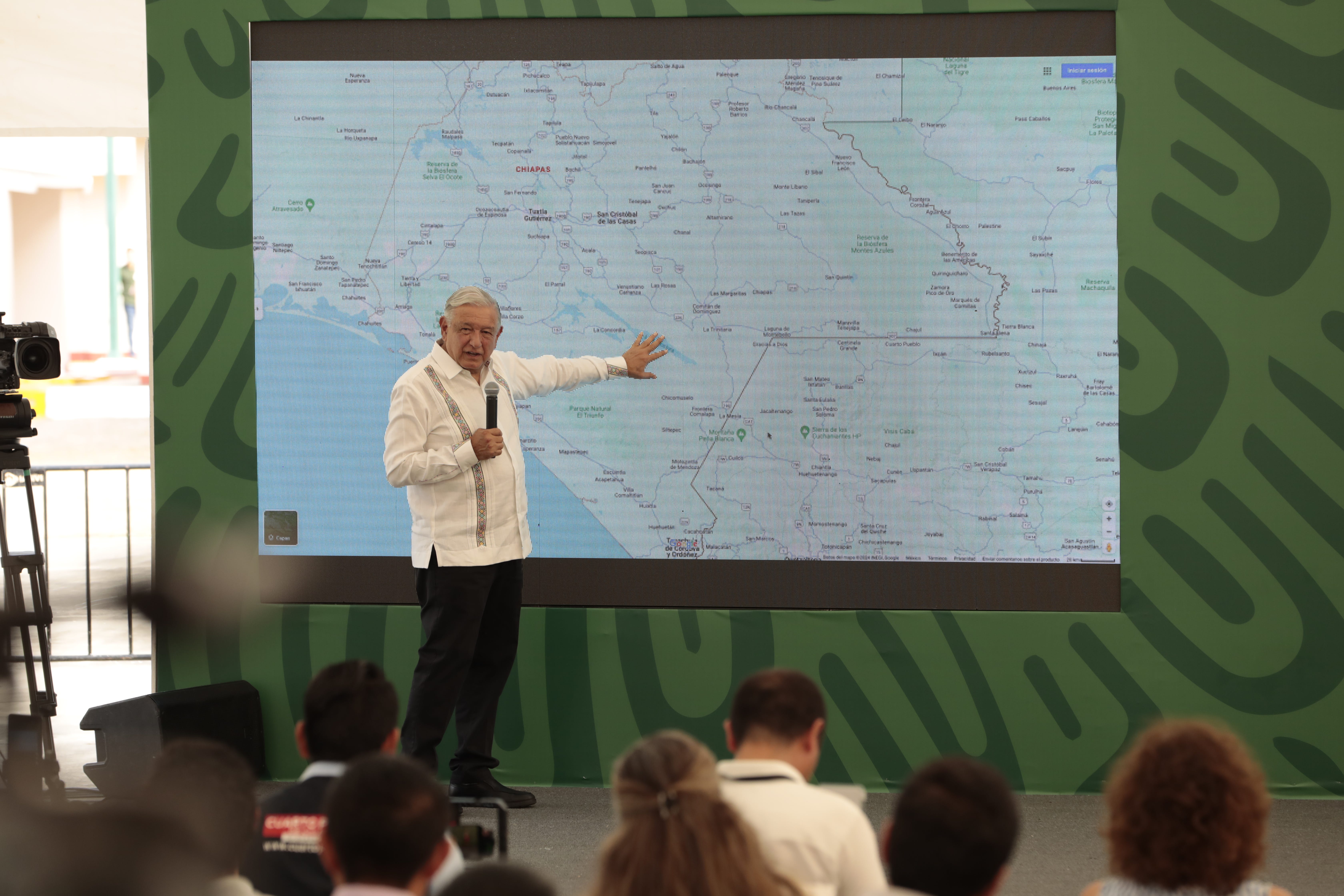
As a tool for communication, the mañanera typically set the tone for the day’s political discourse. It was also a primary source of controversy, such as when AMLO shared the personal phone number of a New York Times reporter whose coverage he disagreed with. But scandal in some ways was the point, it helped keep AMLO at the center of any national discourse. For instance, 2024 opposition presidential candidate Xóchitl Gálvez forged her reputation trading blows with AMLO over his mañanera comments, which in turn elevated her status as seemingly the chief thorn in AMLO’s side. But this fame was won only in relation to AMLO himself, not necessarily on her own mass appeal, a fact that made Gálvez appear a stronger candidate on paper that in reality.
The Bully Pulpit and Political OODA Loops
Coined by John Boyd, OODA loop stands for “Observe, Orient, Decide, Act” and models the process by which fighter pilots take in and react to new information. With each change to the situation, your OODA loop resets, in a dogfight, being able to get inside an opponent’s OODA loop, acting while they are still orienting to the situation, offers a decisive advantage. Recently, commentators have applied this concept to our ability to rationalize the news cycle. In a world where stories can be updated on a minute-by-minute basis, keeping up with the flow of information is an increasingly daunting task. Politicians face an even greater hurdle, translating this firehose of information into concrete action.
Populists tend to thrive in tight OODA loops. Keeping the media cycle churning at a frantic pace over time wears down the ability of political rivals to keep up. When populists ascend to high office this capability is empowered even more. The presidency drives the national news cycle, and leaders who recognize this find it easy to turn this power to their advantage. Today my colleagues bemoan feeling they are “outworked by a septuagenarian” as they struggle to keep up with the perpetual motion media machine the White House has become. The reality that Trump and AMLO both grasped is that relatively little effort is needed to set a thousand pens flying working on op-eds, think pieces, and Twitter posts.
Controversy is the point of this strategy, throwing up a smokescreen of a dozen scandals muddles the salience of any one issue, and serves to dissipate both public outrage and media scrutiny. For instance, in 2023 more than 2,500 women were murdered in Mexico, of those 830 were classed as femicides, killings based specifically on the victim’s gender. When Xóchitl Gálvez pressured AMLO on his failure to combat gender-based violence, the president responded by having a song titled “All Women go to Heaven” performed at his mañanera. When I look at Trump’s oval office press conferences, with his off-the-cuff remarks that almost instantly go viral for good or for ill, it is hard not to see echoes of the mañanera at work. Spectacle over substance is the name of the game in this style of politics.
None of this is particularly novel, FDR famously leveraged the ability of radio to forge a personal connection with voters, but modern media has turbocharged this trend. In particular, spectacle-driven politics and populist appeal are useful for building support among groups who have historically not felt represented by traditional politicians. Morena’s current coalition is evidence of this, featuring a base that includes millions of Mexican citizens who feel represented in a way they have never experienced before.
Successful Successions
If there is one key difference however between AMLO and Trump, it is that AMLO was popular. Trump’s approval rating never once surpassed AMLO’s at any point during his term. This popularity tended to befuddle analysts like me who, from our posts in the states seemed to see Mexico lurching from bad to worse. In July 2023 my colleagues and I speculated about the end of AMLO’s presidency predicting that, “Mexico in 2024 looks economically stagnant despite the once-in-a-generation opportunity presented by nearshoring. The nation is weak and debilitated in its fight against ruthless and expanding cartels and limping more than sprinting as democratic institutions continue to suffer debilitating attacks.”
I would argue this assessment remains more true than false. From a policy standpoint AMLO’s term can be characterized broadly by mediocrity. He delivered genuinely popular and often underappreciated social assistance programs, but did so at the expense of macroeconomic health and fiscal responsibility, particularly later on in his term. A modest decrease in Mexico’s homicide rate towards the end of his term seems more a coincidence than the result of any coherent security strategy. Finally, he had to wait until the 2024 election delivered a legislative supermajority to implement the full extent of his proposals for government reform, ramming through constitutional amendments as a lame duck. His greatest achievement therefore appears to be establishing a personal connection with his supporters that translated into a durable coalition.
This is no mean feat, populist movements quickly lose their dynamism and coherence once the first charismatic leader is out of the spotlight. There is an open question in the United States of what the MAGA movement will be come once Trump is no longer in the standard-bearer. Similar thoughts swirled as AMLO approached the end of his term-limited six years in office. Despite initial flirtations with the cardinal sin of Mexican politics, running for a second term, AMLO ultimately handed the torch and soapbox off to Claudia Sheinbaum.
Sheinbaum entered office the most powerful president in recent Mexican history, winning with a 2:1 vote margin over Gálvez, her closest contender, a legislative supermajority, and her party in control of 23 of Mexico’s 32 governorships. As of June 5, Morena supporters also now pack the Mexican supreme court. Just four other leaders in the Americas, Cuba, El Salvador, Nicaragua, and Venezuela, can lay claim to such authority. Sheinbaum has kept the mañanera in place, though so far her rhetoric has taken a more practical, and less bombastic tone compared to her predecessor.
My personal, unfounded, conviction is that Sheinbaum’s heart isn’t in it the same way AMLO’s was. If true, that’s probably good for Mexico in the long run, as technocratic governance backed by a popular mandate can help the country make some of the difficult choices it needs to break through the current economic and security malaise. AMLO was able to muddle through with a mediocre policy record but sky-high approval because of his charisma and personal connection to his base. Sheinbaum has so far successfully followed in his footsteps, but will likely face pressure to deliver results in a way AMLO never did.
AMLO’s presidency teaches us that when people are insular, politics polarized, and the flow of information moving faster than ever before, the ability to craft compelling narratives beats out policy success. Looking at the politics of my own country with this in mind, I now have no doubt that come 2026 people whose lives have been made measurably worse by the Trump administration will vote up and down the ballot to keep his agenda trundling forward. They will do so because, at the end of the day, they believe Trump speaks for them better than any other candidate. While it’s tempting to ascribe this phenomenon to Trump’s own unique and confounding charisma, for those of you following along I’ll keep making the argument that this really is AMLO’s world, we’re all just living in it.