

On April 19, U.S. Southern Command announced that it had undertaken another lethal airstrike against a boat suspected of trafficking illicit drugs. As of my writing this, the death toll for U.S. airstrikes in the Caribbean and Eastern Pacific stands at 178.
The Trump administration claims these strikes have been wildly successful, reducing the volume of seaborne drug trafficking by more than 90 percent. Analysts have largely dismissed this claim, but it is harder to categorically reject it than one might expect. In February, Politifact queried the White House about this claim and were directed to U.S. Customs and Border Protection (CBP) data showing a 98 percent drop in air and marine drug seizures from July to November 2025. However, maritime drug interdiction is primarily handled by the Coast Guard, which just reported a record volume of cocaine seized during the 2025 fiscal year.
Further complicating the deterrence narrative, Adam Isacson and John Walsh with the Washington Office on Latin America has done more work than most showing that total cocaine seizures by CBP have been largely unchanged since the start of lethal boat strikes.
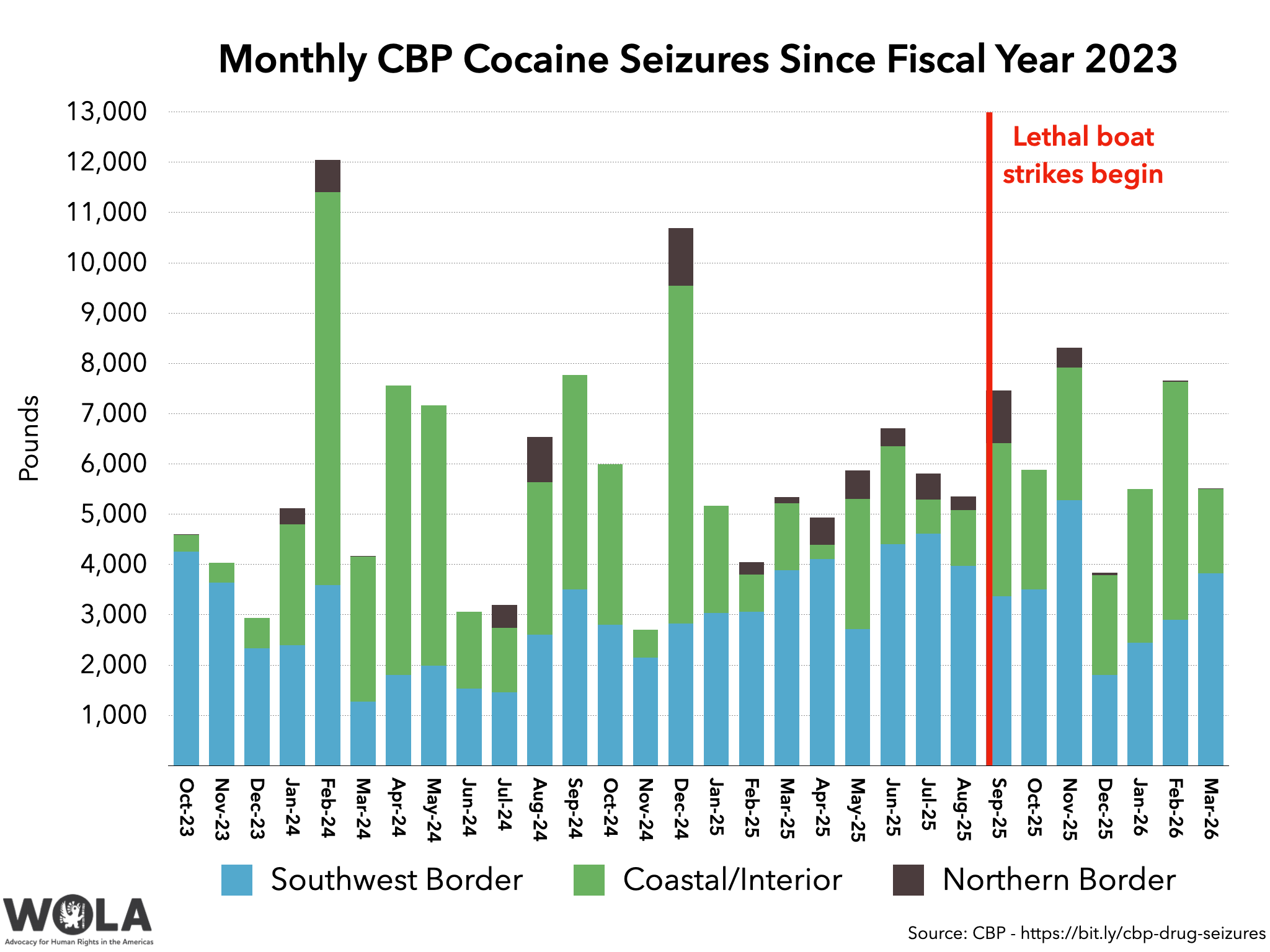
Last month, more than 5,500 pounds of cocaine was seized by CBP. In 2025 that figure was 5,300 pounds, and in 2024 it was about 4,200 pounds. Assuming CBP seizes roughly the same fraction of drugs crossing the border, that suggests the volume of drugs bound for the United States has not decreased in any appreciable way (and may even be increasing). But while this chain of logic makes sense, without knowing the total volume of cocaine being trafficked each month, we can’t definitively say that boat strikes have had no effect.
To illustrate this, let’s say that before the start of lethal boat strikes, 100,000 pounds of cocaine was being trafficked to the United States each month. Now, using one of the more conservative estimates offered by the Trump administration, let’s say the strikes have deterred 90 percent of traffickers who would otherwise be barreling towards the United States. Now traffickers are only trying to move 10,000 pounds of product into the U.S. per month. That would mean in March, CBP intercepted more than half of all cocaine before it entered the United States, a remarkable feat.
My every intuition is telling me that’s not what is happening. Instead, even if seaborne trafficking is down, criminal groups are pivoting to air and overland routes, hiding narcotics in legitimate shipments, or turning to uncrewed systems to keep the cash flowing without relying on human crews. Still, getting good estimates about the size of illicit economies at large seems virtually impossible. In most cases we know the numerator, how much we are seizing, but the denominator, how much is really out there, remains infuriatingly opaque.
How Illicit Economies are Estimated
There are a handful of reports that attempt to figure out the denominator of organized crime. The United Nations Office of Drugs and Crime for instance periodically puts out documents on drugs, trafficking in persons, firearms, environmental plundering, and crime writ large. The NGO Global Financial Integrity (GFI) also provides estimates for the retail value of various transnational criminal activities, with the overall “market for crime” being valued at between $1.6 and $2.2 trillion. Unfortunately, these estimates from GFI are from their 2017 report on Transnational Crime and the Developing World and almost certainly outdated by now. Nevertheless, the $1.6-2.2 trillion figure continues to be cited by virtue of the fact that without it there are precious few hard numbers to benchmark the market for crime against.
I’m not going to attempt a comprehensive review of how all types of illicit activity are (or are not) estimated in a blog post, but want to give some color of how I think about these challenges when it comes to narcotics and arms trafficking in the Americas.
Drugs
Of all the types of illicit commercial activity, drug trafficking probably receives the most attention. However, the sheer variety of illicit substances, and their variable modes of production, makes getting a good estimate difficult. GFI uses two methods to estimate the sum value of cannabis, cocaine, opiates, and amphetamines, giving a range of between $426-$652 billion. Both methods, however rely on older UNODC estimates, in some cases from 2003, and extrapolating out from there.
Value estimates also can’t tell us much about whether the volume of narcotics we’re seizing is making a dent in overall supply. Drug prices fluctuate by region, and street prices are liable to be even more inconsistent as individual dealers are subject to highly uneven levels of overhead, supply chain security, and competition.
Nevertheless, plant-based drugs, and cocaine in particular, may be some of the easier drugs to estimate total production for. Coca leaves, the base ingredient for cocaine, occupy large swathes of territory that can be identified and mapped by land, from the air, or by satellite. The UNODC periodically releases fairly reliable estimates of coca cultivation in the world’s three largest coca producers, Colombia, Peru, and Bolivia. If you know how many acres are under cultivation, you should be able to calculate how much cocaine could be produced if all the coca leaves there were to be harvested.
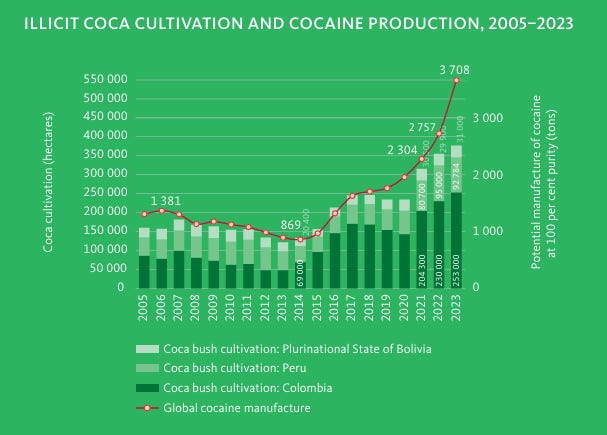
Indeed, the UNODC’s 2025 World Drug Report found that coca cultivation in 2023 hit record highs, with more than 350,000 hectares under cultivation. Meanwhile, cocaine production was estimated at 3,708 tons, a 50 percent increase from the 2022 estimate.
Much of this was driven by Colombia, which not only saw increased cultivation, but higher yields from coca bush under cultivation thanks to the introduction of new and more productive strands as well as more sophisticated processing that allows drug traffickers to get more out of a harvest. The report was not received well in Colombia, where President Gustavo Petro threatened to pause collaboration with the UNODC in favor of an alternative methodology.
So, it seems possible to measure the total volume of cocaine being produced every year, but even with that impressive feat under your belt, obtaining the level of fidelity needed to determine whether certain policy interventions are working to disrupt traffickers remains elusive. InSight Crime illustrated this in an excellent way with their recent investigation into the Brazilian port of Santos. Long the capital for Brazilian cocaine exports to the world, seizures of the drugs at the port have fallen precipitously in recent years, even as global cocaine production exploded.
A recent investigation suggests that a combination of better inspection at ports, and the fact that Brazilian authorities are increasingly seizing cocaine shipments before they get to port is genuinely making a difference at Santos. But as one outlet has closed, others have opened, especially in the northern state of Bahia, and southern port of Paranaguá. Overlaying all of this is the fact that we still don’t really know how much cocaine is passing through Brazil, even if we know how much is being produced in a given year.
Turning to synthetic drugs like methamphetamine and fentanyl the picture gets even fuzzier. While coca fields occupy acres upon acres, meth labs can be crammed into cramped and unsafe houses or even mobile labs making them difficult to track. Notably, while UNODC’s World Drug Report featured production estimates for cocaine, opium, and heroin, it sticks to reporting seizure numbers for most synthetic drugs. The sheer potency of these drugs also means that a much higher percentage of the total volume needs to be interdicted to make a dent on the supply side.
Guns
The conversation around arms trafficking is a good example of how a credible-sounding estimate can end up being propagated well past its useful expiration date.
Last year, the Global Initiative Against Transnational Organized Crime put out a report scoping the various estimates around illegal arms transfers. One of their citations was to the 2017 GFI report, which estimated the value of the arms trade at $1.7-$3.5 billion. This in turn is a back calculation based on the claim that the illicit arms market is about 10-20 percent of the licit arms market. The 10-20 percent figure appears in a number of reports going back years, but to the best of my knowledge has its origins in a 2001 estimate by Small Arms Survey. We could be calculating the size of the modern illicit arms market based on data that’s a quarter of a century old.
Another data challenge comes from government opacity. The Mexican government’s recent lawsuit against U.S. arms manufacturers alleges that “between 342,000 and 597,000” guns are trafficked into Mexico from the United States each year. A 2021 Government Accountability Office report, citing Mexican government estimates, said that 200,000 guns are trafficked per annum. Meanwhile, Project Thor, an ATF-led initiative against gun trafficking, estimated that between a quarter of a million and 1 million guns are trafficked each year. To the best of my knowledge, the statistical methods and estimation strategies used to arrive at these figures have never been released.
In the open source, Topher McDougal and Sean Campbell recently applied a capture-recapture methodology to try and estimate the yearly flow of weapons into Mexico. This is typically used for estimating wildlife populations where the total population is unknown. Researchers capture a sample population instead, tag and release it, and at a later date capture a second independent sample. Based on the proportion of previously tagged individuals in the second sample, it should be possible to get a sense of how large or small the underlying population is (i.e. if there are very few tagged individuals in the second sample, the population is likely much larger).
In the case of illicit firearms, McDougal and Campbell use two datasets of firearms seizures, one consisting of leaked data from the National Center for Planning, Analysis, and Information to Combat Crime (CENAPI) supposedly containing records of firearms seized by Mexican authorities at the federal, state, and local levels, and one consisting of data on only arms seized by the Secretariat of National Defense (SEDENA). In theory, the proportion of guns captured by SEDENA in the CENAPI dataset should be the same as the proportion of guns in the CENAPI dataset to the total “population” of illicit firearms in Mexico.
However, by the authors’ own admission, these data “present an imperfect application opportunity because they are not independent, sequential attempts at the same capture process.” On top of this, while in theory all guns seized by SEDENA should also appear in the CENAPI dataset, just 26.5 percent of the SEDENA records are duplicated, making the SEDENDA dataset larger than the CENAPI dataset and not the other way around. Despite this, McDougal and Campbell argue the data still “represents a relatively independent attempt to capture (a) all illicit guns in circulation in Mexico, or alternatively (b) a sampling of the total guns intercepted by Mexican authorities.”
My goal isn’t to cast aspersion on the researchers, or any of the organizations mentioned above for that matter. The people working in this space are incredibly forthcoming about the limitations of their data, and the challenges associated with measuring black market trade. Notably, the average that McDougal and Campbell arrive at is much more conservative than many of the less methodologically transparent estimates, suggesting to me their research isn’t wildly overestimating the problem.
If anything, I think we need more efforts to apply different estimation methods, and replicate or update existing studies as new data become available. I also think we should be less credulous towards government figures when reported without at least some methodological color. While I am willing to acknowledge states likely possess important non-public information about various illicit economies, the quality of their publicly available data often leaves much to be desired and suggests to me that what’s happening behind the scenes may not be much better.
Drawing Good Lessons from Bad Math
I’m doubtful that we’ll ever be able to produce an estimate of total criminal activity that is unimpeachable, but I still believe there is merit in trying. Being open about your data sources and methods is a useful exercise in thinking through issues in a more structured manner as opposed to relying on intuition alone. Continued advances in commercial satellite imagery and artificial intelligence-assisted data analysis could also help us arrive a better estimates in the near future.
The question remains, however, if we can never know the denominator when it comes to things like narcotics or arms trafficking, how can governments know when they’re making progress against these issues?
Personally, I think part of the answer comes from thinking about outcomes instead of activities. The sheer quantity of narcotics trafficked each year matters only insofar as it correlates with bad outcomes like violence and drug overdoses. Our goal therefore shouldn’t necessarily be to maximize drug seizures, but minimize violence and overdoses. Even the crudest and most corrupt states can pull off “record” drug seizures from time to time, but there isn’t really a substitute for the hard work of building state capacity.
This is also why I’m skeptical that lethal strikes on alleged drug boats are all that effective even if we assume they are having the desired deterrent effect. Looking around the Americas today, it seems as though criminal groups remain firmly ensconced, growing rich and dangerous thanks to increasingly diversified illicit revenue streams that can’t be blown up with a single missile.
To be sure, I think most people working on hemispheric security issues recognize this. SOUTHCOM commander General Francis L. Donovan even acknowledged the need to apply “systemic friction” to criminal organizations, and noted that traffickers have adjusted their routes in response to U.S. strikes as well as increased maritime interdiction. So while I’m still hopeful that the United States renewed focus on the Western Hemisphere represents more opportunity than it does risk, we need to remain humble about what we do, and don’t know, and focused on driving the outcomes that genuinely better the lives of those in our shared neighborhood.
You do a good job outlining the key problem for analysts and policymakers which is its nearly impossible to accurately measure effectiveness when it comes to countering trafficking.
It seems relatively easy to displace illicit activity from one location or TTP to another and observe that but overall numbers and effects are essentially shots in the dark.
Being able to better measure effectiveness is probably one of the best arguments for focusing on demand rather than supply side interventions.