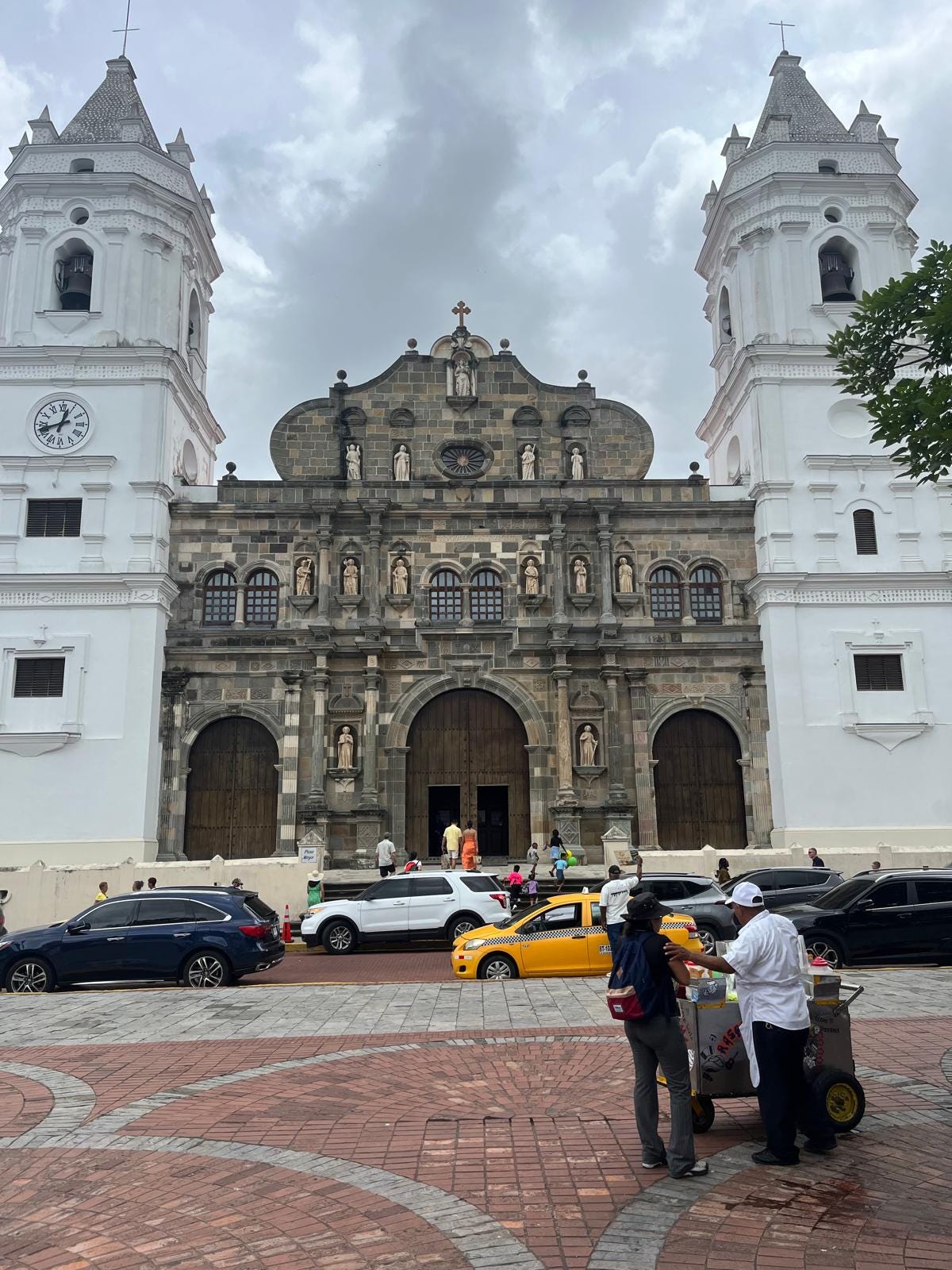
I spent last week in Panama City conducting a series of interviews on the U.S.-China-Panama triangular relationship. While you’ll have to wait for more on the exact findings from those meetings, I wanted to share some quick impressions from the trip as a whole. The following sections will deal with the Panama-U.S. relationship, the domestic agenda of President José Raúl Mulino, and my impressions of Panama City.
50 ways to leave your ally
Panama has found itself in the crosshairs of the Trump administration, which during its first several months was fixated on the idea of “reclaiming the Panama Canal.” Within Trump’s first 100 days Panama was visited by not one, but three cabinet level officials, including Secretary of State Marco Rubio who travelled there on his first international visit. Pete Hegseth’s subsequent March trip also marked the first time in over two decades that a U.S. Secretary of Defense visited Panama.
Latin America analysts (myself included) tend to measure U.S. engagement with the region against an idealized “Goldilocks zone.” We bemoan a lack of U.S. engagement in the region, but recoil from big stick power plays by Washington that smack of Cold War-style meddling. We perpetually strive for a middle ground where the United States prioritizes its Western Hemisphere partners while treading carefully around cultural and historical sensitivities. Panama is an illustrative case, after years of being left out in the cold, it is now feeling the heat of U.S. attention.
This dynamic is not new to Panama, indeed, during my time and meetings there I was captured by two paradoxical realities I feel lie at the heart of the Panama-U.S. relationship:
Panama is the most pro-U.S. country in Latin America.
The United States has historically been the single greatest threat to Panamanian sovereignty and self-determination.
You can trace both of these all the way back to Panama’s independence in the early 20th century. On the one hand, Panama owes its existence to the United States. On November 3, 1903, nationalists arrested a battalion of Colombian troops and proclaimed independence. Further action by Colombia was deterred by the presence of the U.S. warship Nashville, which had arrived in the city of Colón just a day before, quite literal gunboat diplomacy in action. However, just 15 days passed before U.S. Secretary of State John Hay and Philippe Bunau-Varilla, a French national acting as Panamanian ambassador to the United States (though in truth acting more in his own interest), signed a treaty establishing U.S. control over what was to become the Panama Canal. The treaty was presented to the infant Panamanian government as a fait accompli, marking the beginning of more than seven decades of U.S. occupancy of Panamanian territory.
Today, as the country enters another fraught moment with Washington, a similar pattern seems to be playing out. In my conversations there I sensed the betrayal that the United States would turn so suddenly on one of its staunchest supporters. But more than that, I felt a sense of sorrow, at the missed opportunities.
Indeed, when it comes to U.S.-China competition in the Americas, there is perhaps no better partner for Washington than Panama. The country has demonstrated its willingness to distance itself from Beijing time and time again. At the first sign that Trump was serious about his concern over Chinese ports along the canal, Panama announced it would pull out of the Belt and Road Initiative and launched an audit investigating the two sites of concern. Panama has limited its telecommunications cooperation with Huawei and is currently striving to rip and replace as much existing infrastructure as possible.
Alas, while the potential is there, the prospects for getting the level of engagement in Panama right seem as elusive as ever.
An accidental president
Further complicating Panama’s international position is the precarious state of its domestic politics. Originally the running mate to former president Ricardo Martinelli during the 2024 election, now-President José Raúl Mulino was catapulted to center stage after Martinelli was convicted on corruption charges in the middle of his campaign. Martinelli fled to the Nicaraguan embassy in Panama City where he instructed his supporters to vote for Mulino instead. The handoff was successful, and Mulino won in a crowded field with roughly 34 percent of the vote. A triumphant Martinelli now safely enjoying asylum in Colombia, a while later tweeted a shirtless picture of himself with the caption “I need new haters, the old ones have become fans.”
Mulino thus assumed office having won less that half the vote, with his party holding just 14 out of 71 seats in Panama’s legislature, and an ill-defined power base largely resting on Martinelli’s endorsement. Nevertheless, for an accidental president, he has evinced a remarkable strategic outlook. Mulino entered office with three core policy objectives, social security reform, reopening the Cobre Panama mine, and creating a new reservoir to feed the canal. These are all, in my view, the right moves for Panama’s future, though they are unfortunately all hard sells for the electorate.
Social security reform was the first item on Mulino’s agenda to be accomplished. On March 18 this year, the legislature passed a bill establishing a timeline for increasing employer contributions and seeking to incorporate more informal workers in it. While the bill notably did not raise the retirement age, it nevertheless helped fuel major protests as labor unions took to the streets. In this respect, Mulino succeeded where several previous administrations had failed, bolstering the solvency of Panama’s increasingly rickety social security system though at the expense of a significant amount of his own political capital.
Reopening the Cobre Panama mine is a similarly unpopular, yet necessary move. In 2023 protests against the mine shut down the country while the Panamanian Supreme Court ultimately ruled that contract for the mine was unconstitutional. But the mine, which accounted for roughly 5 percent of Panama’s GDP, has remained a national irritant even in its current state. For one, it requires continued maintenance and security to prevent wildcat miners from accessing the property, meaning that movement near the mine remains constrained for neighboring communities.
First Quantum, the Canadian mining company that operated Cobre Panama, previously threatened international arbitration, a potentially costly affair for Panama which could even in a best-case scenario tarnish Panama’s reputation and dim the business environment. Mulino has succeeded in getting these proceedings dropped, and there is likely room for a new deal to be made. First Quantum’s original contract was highly favorable to the mining company, a more realistic agreement could not only see more revenue sharing with the Panamanian government, but include more up-to-date environmental provisions. Nevertheless, the 2023 protests remain raw, and mining a highly salient issue in Panamanian politics. Mulino’s actions have accordingly moved at a snail’s pace, and even still have drawn protest.
The final component of Mulino’s domestic agenda is the construction of a new reservoir to feed the Panama Canal by damming the Rio Indio. The idea for the $1.6 billion project itself predates Mulino’s presidency, deemed necessary by the Panama Canal authority after droughts in 2023 saw canal transits fall to historic lows. But the president has lent vocal support to the initiative, spending still more of his fast-depleting political capital on the project. On paper, the reservoir is a win-win, able to be used for both drinking water and industry, especially as water recycling technology in the canal improves. In practice, it will involve the displacement of thousands, primarily rural, indigenous people, to make room for the reservoir.
Taking on any one of these would dent a leader’s approval, addressing all three in sequence has left Mulino with an approval rating second only perhaps to Peru’s Dina Boluarte. In a recent poll, just 9 percent of Panamanians feel the country is on the right track, while about 68 precent have a negative perception of Mulino’s government. None of this is made any easier either by an increasingly volatile U.S. government (though I must note Mulino has nevertheless outperformed expectations in that respect as well).
Personally, I consider myself something of a Mulino fan. In a region where leaders can swing between wannabe dictators, blatant thieves, and sometimes both at once, I’m willing to give a good amount of credit for those leaders willing to spend their political capital on tough but necessary decisions. But there’s a difference between intentions and outcomes, and the reality is that Panama faces a difficult road ahead. Like so many other countries in the Americas, it has yet to clear the middle income trap, faces high public debt, and endemic corruption that strangles the government’s ability to deliver services. Climate change, particularly water insecurity, is also increasingly creating tradeoffs between key pillars of the economy like the canal, and the needs of Panamanian citizens.
Even if all three items on Mulino’s domestic agenda come to pass, there is no telling they will be enough, or that a future president will not seek to tear them apart for populist gain.
Panama the city
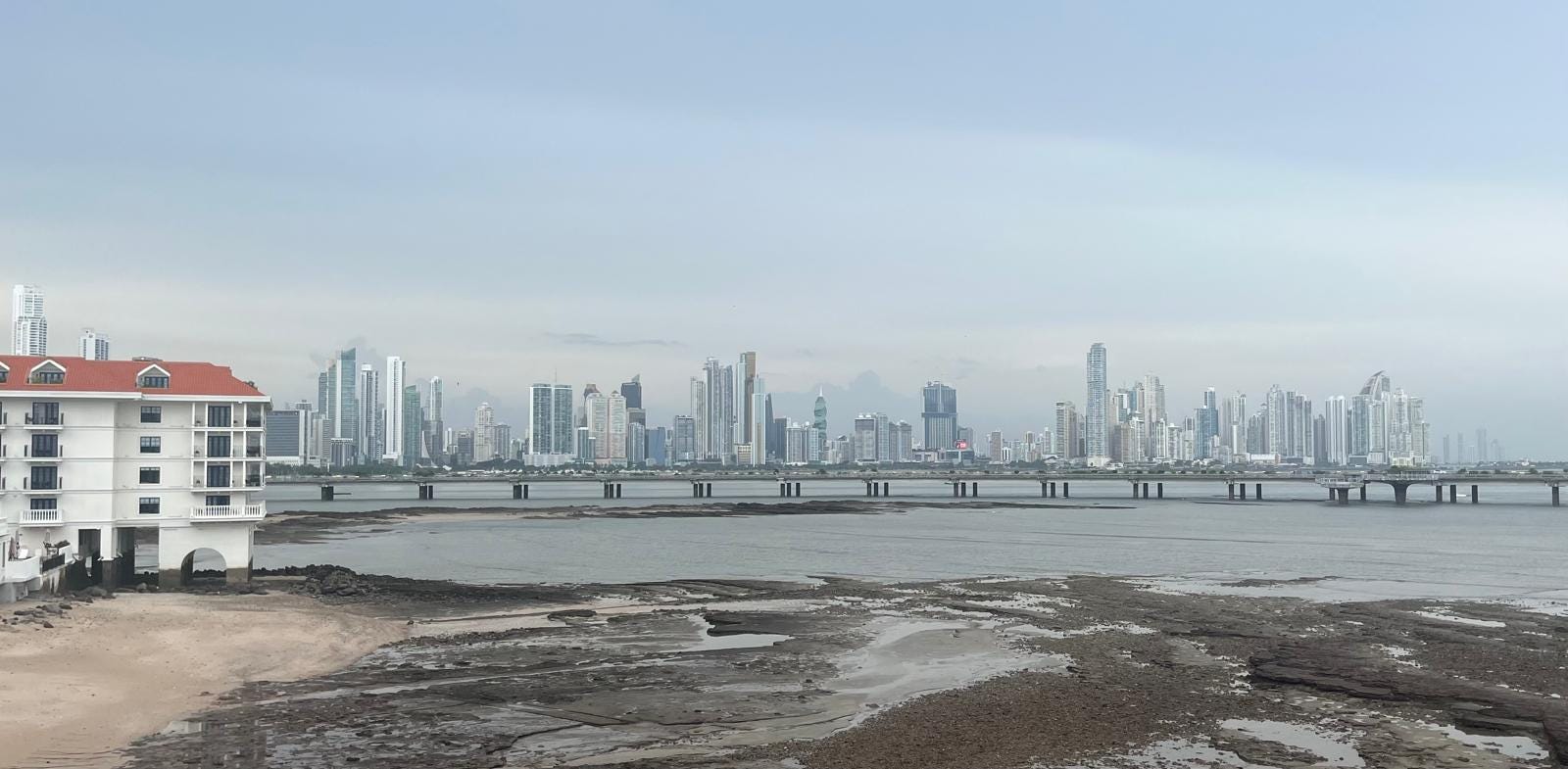
I was perhaps most excited about this trip for the chance to see Panama City. The skyline in particular is worth it if you, like me, prefer the city to the countryside. The cityscape is dotted with high-rise towers. Perhaps that density is helpful, because for being a city of over a million, it does feel surprisingly small.
Like elsewhere in Latin America, it is a city of profound inequality. Sandwiched between the city’s spires are hollowed-out husks of buildings bedecked in razor wire. It’s always tempting, but at times analytically lazy, to go hunting for equivalencies when you aren’t spending any real time in a place, but I still felt the parallels between Panama City and U.S. cities are striking. Major cities in the United States feel absurdly rich and poor at the same time, torn between luxury apartments and potholes, trillion-dollar companies whose employees commute to on crumbling public transit. By contrast, in European cities for instance have less visible poverty, clutter, or decay, and as a result often feel nicer even if the most dynamic of them struggles to match the GDP of Pittsburgh. Panama City, of course, is far from the level of wealth aggregations of U.S. metropoles, but the sensation of a vast discrepancy between the amount of money circulating and the built environment persists.
One interviewee put it best, pointing out how the two most striking aspects of Panama City are in turn symptoms of its own pathologies. First, the public works, which are indeed striking. Spacious highways cutting through the city help reduce the chaotic jumble of traffic that characterizes Latin American cities. But infrastructure projects are also prime targets for rent-seeking and kickbacks. Second, the high-rises that give Panama City its iconic skyline are made possible by a business community which has historically operated in grey areas, enabled by low taxes and even lower tax collection. While Panama has been remarkably successful at managing this environment, it has done so at the expense of building state capacity, leaving the country, much like the canal itself, vulnerable to shifts in global trade winds.
Lest you think I’m being uncharitable to Panama or Panama City, I truly loved my time there. The food, culture, and environment were some of the most pleasant I’ve experienced in the Americas and I think that Panama City is a must-visit for any urbanism-loving travelers to Latin America.