The United States doesn’t have enough military bases in Latin America. No, seriously. According to the Congressional Research Service in 2024, the United States has just “three persistent bases and three other military sites to which DOD has access in the region.” The three permanent facilities in question are, namely, Naval Station Guantánamo in Cuba Soto Cano Air Base in Honduras, and the Atlantic Undersea Test and Evaluation Center in the Bahamas. Contrast this with the Indo-Pacific, where CRS estimates 24 persistent bases along with 20 other sites, or Europe, with a whopping 31 persistent bases and 19 other sites. Notably, the United States has no permanent military bases south of the equator in the Western Hemisphere. If Washington is serious about resurrecting the concept of “Hemispheric Defense” it will quickly confront the fact that the infrastructure to support power projection in this region has atrophied over the past decades.
This is in part a positive story. Washington has underinvested in military infrastructure in Latin America over the past decades in part because it has not considered invading its neighbors as much of a priority since the end of the Cold War. In lieu of Roosevelt and his big stick, the United States has been more of an absentee superpower in the region, turning its gaze southwards momentarily when crises flared up, but otherwise distracted with more pressing matters in the Middle East, Europe, or East Asia. Not so anymore. As the Ford Carrier Strike Group steams towards the Caribbean, many of the Americas analysts I know have been remarking with a certain dark humor that we should have been more careful when we wished for the United States to pay closer attention to the region. But you don’t correct for decades of underinvestment overnight, and as the Trump administration surges forces to the Americas, I think it is increasingly likely that the U.S. will come face-to-face with the lack of basing infrastructure in the region.
U.S. military bases are a controversial topic. Not a week goes by without a graphic purporting to show the number and location of U.S. overseas bases goes viral, often for the lurid claims it makes about the number and location of these sites. I think there are compelling reasons a country may want to host a U.S. military base, and compelling reasons why a local community might want one gone. For the purposes of this post however, I’m more interested in exploring the ways U.S. basing infrastructure shapes and constrains operational reality.
Where Bases Are
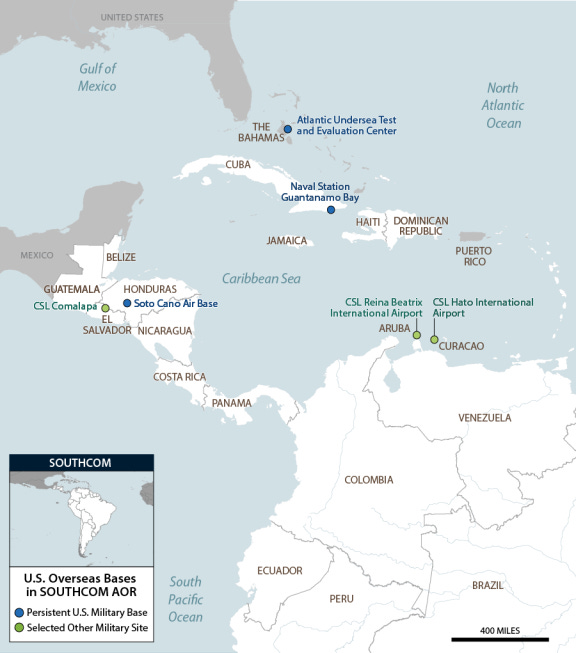
What bases the United States does have in Latin America and the Caribbean face a number of practical and political challenges. Naval Station Guantánamo, the largest and most notorious U.S. military base in the region is also the United States’ oldest overseas base. While it has been the lynchpin of previous deployments, such as humanitarian assistance to Haiti in 2010 and 2021, it will struggle to become the backbone of an expanded U.S. force posture in the hemisphere.
The Cuban government’s active hostility to the Guantánamo naval base is one of the chief obstacles to operations out of this facility. Since supplies cannot be brought in overland from Cuba, the base needs to be supplied by air and sea, meaning cargo ships and planes compete for precious real estate. The greater the military presence at Guantánamo, the more supplies need to be brought in to sustain it, placing a hard upper limit on the base’s capacity. A full carrier strike group, for instance, would likely be well beyond the base’s ability to support and replenish. The base may also find itself facing something of an identity crisis, as the Trump administration pushes to repurpose the detention facilities there to hold migrants, although relatively few people have been held there so far, pushing forward with these plans may divert resources from supporting naval and air operations.
Next on the list is Soto Cano Airfield in Honduras, headquarters of Joint Task Force Bravo and the United States southernmost permanent military facility in the hemisphere. With Cold War roots, its primary role today is for humanitarian assistance operations in Central America such as in the aftermath of Hurricanes Eta and Iota in 2020. As of 2021, it is also the site of Palmerola International Airport, a new civilian airport servicing visitors to Tegucigalpa. The base has confronted further political headwinds this year as President Xiomara Castro threatened to kick the United States out in response to the Trump Administration’s use of it for deportation flights. While Honduran elections in November may see a more pro-U.S. candidate take the reins, the politicization of Soto Cano, as well as the need to share runway with civilian flights limits its potential to become a major regional logistics hub.
Unlike the previous two, the U.S. Navy’s Atlantic Undersea Test and Evaluation Center technically falls under U.S. Northern Command’s Area of Responsibility (AOR). It is also hardly equipped to sustain a major military force by itself. With a shallow harbor and short piers, it would be unable to host an Arleigh Burke-class destroyer, let alone an aircraft carrier. Not that it is likely to be called upon to do so, as its location in the Bahamas is so close to Florida that any force in need of support would almost certainly find it simpler to operate out of the many facilities found there.
None of this is intended to downplay the importance of these existing bases. Indeed, the longstanding U.S. military presence at all of these means they are remarkably well fit for purpose and maintained by soldiers and staff who enjoy a deep familiarity with their inner workings. However, in a hypothetical scenario where the United States is seeking to drastically increase its activity in Latin America and the Caribbean, the lack of basing infrastructure poses real power projection and operational security challenges.
Why a Lack of Bases Matters
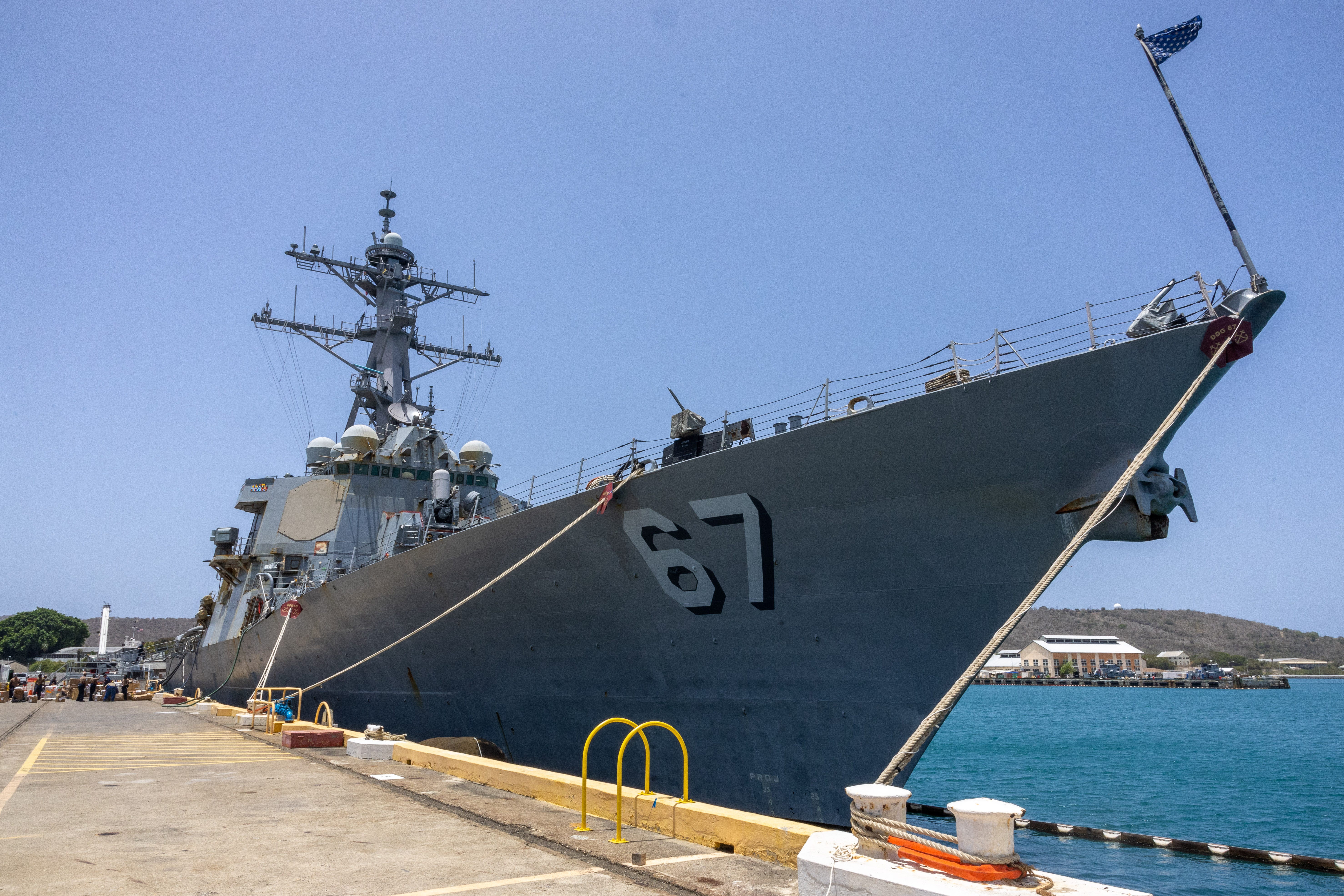
In part, the absence of major military bases in the Americas can be compensated for by the proximity of the United States itself. The continental United States is, after all, right there, while overseas territories like Puerto Rico and the U.S. Virgin Islands offer additional logistical capacity while still being within U.S. borders. But the fact remains that in recent decades the United States has not optimized for power projection in LAC. Take Puerto Rico for instance, which is playing a vital role in the ongoing military deployment in the Caribbean. Naval forces are relying on the erstwhile civilian port of Ponce for resupply needs, while the logistical demands have forced the DoD to dust off the once-shuttered Roosevelt Roads naval air station to house new F-35Bs. The further from the Caribbean you go, the greater the challenges become, to the point where I have serious questions about whether the United States would be able to get a sizeable force to the southern cone with any degree of haste.
By way of illustration, let’s take a look at Soto Cano. The below map shows some range approximations for aerial platforms the United States might want to employ in a world where the Western Hemisphere sees more intensified military activity.
At first blush, this looks like pretty good coverage, but there is considerable variation in the range of various platforms. Generally speaking combat aircraft like the F-35 are most limited, while ISR craft can reach most any point in the hemisphere should they need to (platforms not shown here like the RQ-4 and E-3 have ranges in excess of 4,000 miles, covering the whole region).
Of course, with access to aerial refueling, U.S. forces can reach out and touch virtually any point on the globe if need be, but organizing that takes time. If the United States wants to scramble assets quickly in response to a crisis in the hemisphere, south of the equator, it faces real limitations. Even if all the above platforms were currently based in Soto Cano, it would take hours of flight time for the longest-range systems to get past the equator. Then, once these planes arrive in region, they will need to rely on civilian airfields or agreements with other militaries if they want to land, or else get ready to make the long trek back to base.
But a lack of bases isn’t just a question of how fast U.S. forces can get somewhere, it also matters for how safely and securely forces can get into position.
Without military bases to serve as logistical nodes, the United States presence in Latin America and the Caribbean also faces operational security risks from relying on civilian infrastructure. As previously mentioned, most of the capital ships deployed in the Caribbean have called into the port of Ponce, or else returned to their home bases in the continental United States. South of San Diego there is not a single place on the Pacific coastline of the Americas where a U.S. Navy ship can call in for resupply other than at a civilian port.
While civilian port calls are a standard practice for naval forces around the world, several facilities the United States has relied on for support are subject to concerning levels of influence from geopolitical rivals, especially China. The Arleigh Burke-class destroyer USS Sampson docked at Manzanillo in July where the Hong Kong-based company Hutchison Ports operates a terminal. More recently, the USS Lake Erie, a guided missile cruiser, docked at Hutchison-operated Balboa before transiting the Panama Canal on its way from the Pacific to Caribbean theaters. Port calls provide China with an opportunity to collect data on U.S. standard operating procedures and patterns of life that could be applicable to the Indo-Pacific. Indeed, China has reportedly sought to gather this information on U.S. naval deployments closer to its shores, like in Subic Bay in the Philippines.
There’s also a much greater chance that the United States could lose access to civilian facilities at inopportune moments. In September 2023, Hutchison denied docking authorization to a U.S. ship seeking to unload supplies at the Polish port of Gdynia which the company partially operated. In a crisis scenario where the United States is seeking to rush assets to the region, delays like this could seriously disrupt U.S. logistics even if they are relatively quick to resolve.
New Basing Opportunities and Challenges
There are signs the United States is seeking to expand its access to basing in the Americas. The most noteworthy case in this regard is Ecuador, where President Daniel Noboa has been diligently seeking to pave the way for the reopening of the air base in Manta. Shuttered in 2009 by Rafael Correa, the base’s closure, and concomitant decline in U.S.-Ecuador security cooperation, has been pointed to by analysts as one of the reasons for the surge in drug trafficking through Ecuador. Reopening it would also give the United States access to a military facility in the Americas south of the equator again. Certainly, it would be a coup for the United States to be able to fly aircraft out of Manta again, giving greater visibility into the Pacific drug trafficking routes where the majority of U.S.-bound cocaine travels. Final say on this facility will be left to the Ecuadorian people however, in a referendum to be held later this year on lifting the country’s current constitutional ban on foreign military bases.
Another opportunity comes from Argentina, where the United States has supported Javier Milei’s efforts to build an integrated naval base in Ushuaia. Located in the far south of the country, Ushuaia is regarded as an Antarctic gateway city desired for its relative proximity to the frozen continent as well as the strategic waterways of the Drake Passage and Strait of Magellan. Several successive Argentine administrations have aspired to build a major naval base in Ushuaia, but Milei’s push to revitalize Argentina’s armed forces is helping bring this dream closer to fruition. Whether the United States has provided financial support for this estimated $300+ million project is unknown, and while two successive SOUTHCOM commanders have visited the site, it still seems unlikely this would be a permanently occupied U.S. overseas base. Nevertheless, Milei’s cozy relations with Washington means that if the facility comes online it seems probably the U.S. could strike some agreement for limited access, particularly for Antarctic logistics support.
Finally, there is Panama, where the U.S. negotiated access agreements to three military facilities during Pete Hegseth’s visit in March of this year. Notably, the memorandum of understanding signed between the U.S. and Panamanian governments was explicit that troop presence would be on a rotational, not permanent basis. Still the agreement has drawn fierce criticism in Panama for allegedly opening the door to a soft reoccupation of the Canal Zone. Still, if these tensions cool, some of the facilities could be important assets for an intensified U.S. force posture in the Americas. Access to Naval Station Balboa (formerly Rodman Naval Station) may reduce dependency on Hutchison ports for U.S. vessels transiting the Panama Canal for instance.
These all don’t really qualify as overseas military bases, with the possible exception of Manta. Electorates in the Americas are very cagey about the idea of an overseas military presence in their country, for good reason, so even if momentum to build more bases picks up on the United States’ part, it will remain a delicate dance with regional governments.
What should we take away from all of this? The scenarios I’ve presented above assume the U.S. is interested in conducting large-scale military operations not just against drug traffickers in the Caribbean, but in the south Atlantic, off the coast of the Galapagos, or around Rapa Nui. That may seem far-fetched even now, and I would agree with you on that. But if you told me three months ago that the U.S. would be repositioning a carrier strike group and seriously flirting with toppling Maduro, I would have called that far-fetched too. And rumblings that the National Defense Strategy will prioritize the homeland over China, along with more recent news that the U.S. is unwinding its force posture in Europe point to a focus on the Americas becoming something of a new normal.
Some in the United States have been eager to welcome the return of the Monroe Doctrine, proclaiming that all great powers are masters of their home regions first. I’ve become more skeptical of these claims as of late. While I’ve argued for years that the United States needs to pay more attention to its own neighborhood, I’m not convinced that Washington throwing its military weight around in the Americas is the key to great power revitalization.
China for instance needs to focus on regional hegemony because its neighbors actively limit its power projection abroad. Beijing’s freedom of maneuver in East Asia is constrained by countries like Japan, Korea, Vietnam, and the Philippines who are deeply cautious about China’s rise and have the military power to pose a challenge. The same cannot be said about the Americas, and while drug cartels, authoritarian regimes, and mass migration in the region can have a disruptive effect on the United States, they don’t fundamentally impair its ability to project power globally.
All this means that SOUTHCOM probably doesn’t need INDOPACOM-levels of basing infrastructure in the Americas (and probably shouldn’t try to do so). But the United States should consider how the paucity of existing infrastructure constrains its hemispheric ambitions and think about where strategic investments in allied countries can correct some of these vulnerabilities.