

On Tuesday, Human Rights Watch published a report on the use of weaponized drones in Haiti which opens with an alarming report that, “at least 1,243 people were killed by drone strikes in 141 operations between March 1, 2025, and January 21, 2026.”
The document does an excellent job dissecting the multitude of humanitarian and legal concerns that flow from this statistic, and I recommend you read it before continuing with this post as I’m going to focus less on those aspects, and more on why drones have proven so deadly in Haiti.
It’s hard to find good granular data on drone use, especially by nonstate actors. Nevertheless, a new research report by the National Counterterrorism Innovation, Technology, and Education Center (NCITE) sheds some light on how uncrewed aerial systems (UASs) have been employed in Mexico. Drawing on data from the Armed Conflict Location and Event Data Project (ACLED), the NCITE researchers identified a total of 221 drone incidents in Mexico between 2021 and 2025, resulting in 77 recorded fatalities. In other words, on average one person ends up dead for every three drone attacks in Mexico. In Haiti, each drone operation on average results in close to nine fatalities.
In Colombia as well, data on drone attacks is hard to come by, but the New York Times, citing Defense Minister Pedro Sánchez, reported that the country had sustained the “equivalent to 333 successful attacks” in 2025, resulting in over 100 police and military “casualties.” These figures are fuzzier, but they also come out to about a three-to-one drone attack-to-casualty ratio.
I’m sure that total number of attacks and casualties in both Mexico and Colombia is much larger than what’s been picked up in the open source, but I’m not sure the number an order of magnitude larger, which it would have to be to stack up against Haiti. Now add to that the fact that the population of Haiti is roughly a tenth of Mexico’s and you start to get a feel for just how extensive this campaign has been.
But why have drone attacks in Haiti been so much more lethal than what we’re seeing elsewhere in the hemisphere?
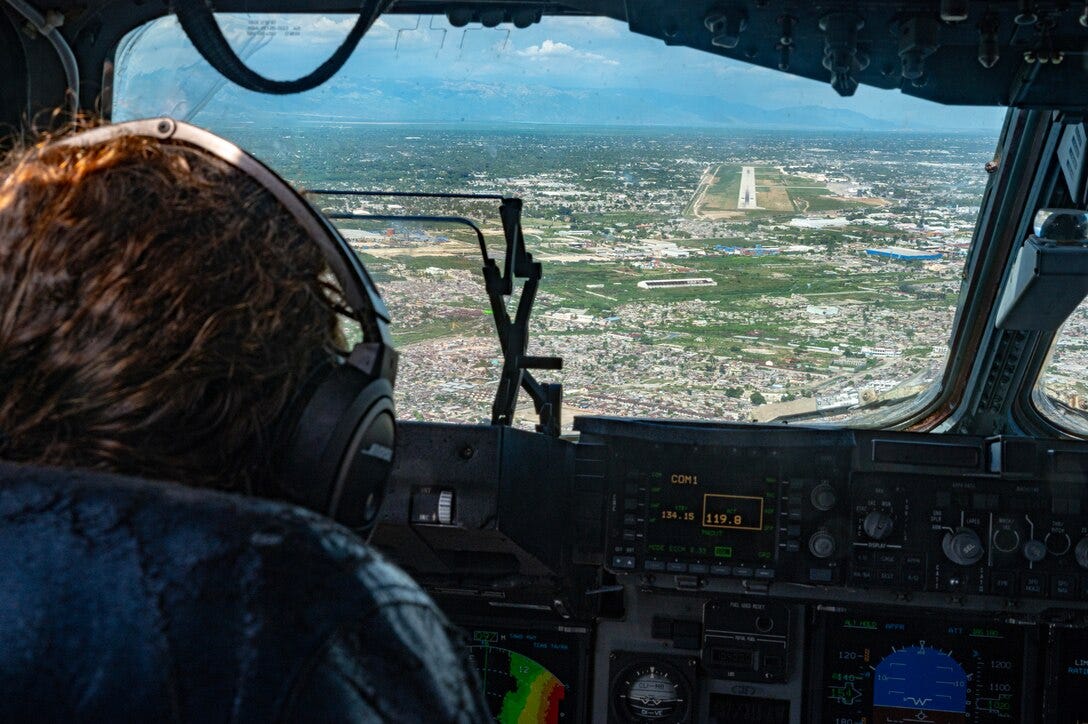
One explanation is that this is a function of the high population density and urban terrain of Port-au-Prince and its surroundings. This means errors in targeting can be much more deadly if explosive-armed drones end up detonating on crowded streets, in residential buildings, or near schoolyards.
But I think even more important is the fact that, in Haiti, weaponized drones are the purview of a specialized “Task Force” exclusively dedicated to their use. This Task Force was announced in March 2025 by Prime Minister Alix Didier Fils-Aimé and would operate as an arm of the Haitian government, but was supported by a team of private military contractors supplied by Erik Prince’s latest venture known as Vectus Global. These forces are focused almost exclusively on drone operations, allowing them to build up lethal expertise in the use of these weapons.
One lesson from the past five years of combat UAS history seems to be that, while it’s relatively easy to get started using drones, it’s hard to use drones effectively. That seems to be the case in Ukraine especially, where both Moscow and Kyiv have concentrated UAS expertise in a number of specialized units. It turns out that while your average infantryman may benefit from having a spare drone or two around, becoming a true master of drone tactics takes time.
We see this happening in Mexico too with groups like the CJNG employing custom “Droneros” units and actively recruiting Colombian veterans of the war in Ukraine to gain their expertise. This trend is borne out to an extent in the NCITE report, where CJNG-attributed drone attacks average one fatality per every two incidents, making them 42 percent more lethal than the overall trend.
Video of a drone strike on an evangelical seminary in Haiti.
My hypothesis therefore is that the presence of dedicated drone operators, lack of accountability for civilian casualties, and complex human and urban terrain in Port-au-Prince and its environs have produced a lethal mixture in Haiti. Drones have in this way introduced a new vector for civilian victimization, but without necessarily promising an end to the country’s cascading security and political crises.
Is Unrestricted Drone Warfare Working?
Whether its quadcopters in Haiti or Tomahawks in Iran, the Trump Administration and its backers seem enchanted with the idea of bombing to win. Setting aside the major ethical and rights considerations Human Rights Watch lays out with respect to this strategy in Haiti, it’s worth interrogating whether the drone campaign has actually broken the power of Haitian gangs.
In theory, drones offer a convenient way for security forces to strike at gangs without exposing their own personnel to retaliation. The ability of quadcopters to maneuver between buildings also allows for precision-guided strikes previously the sole purview of more advanced militaries.
Furthermore, unlike in Mexico and Colombia, it also seems as though Haiti’s gangs have been slow to acquire and use drones themselves. Despite claims by gang leader Jimmy “Barbecue” Cherizier that he could “kill anyone in the country” with an explosive UAV, criminals have either struggled to access significant numbers of drones, or are bottlenecked when it comes to expertise. This makes the air war even more lopsided in favor of the government, even as the state remains on the back foot when it comes to territorial control.
The chart below maps the total number of events coded as political violence by the ACLED. While there does appear to be a drop in total events following the introduction of armed drones in March 2025, the trend hasn’t been particularly consistent.
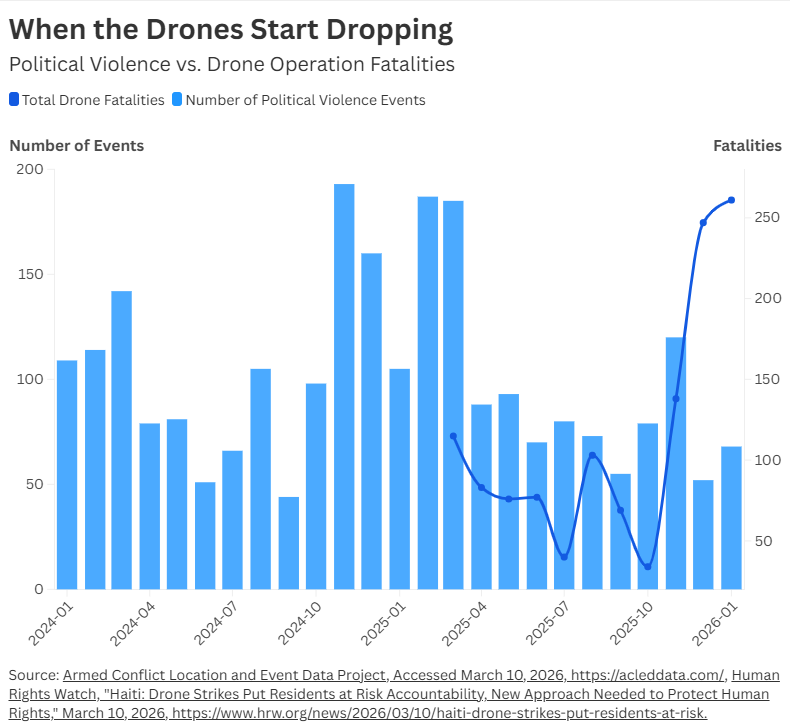
Digging into the data a bit more and the total number of political violence events has declined across the board since the drone campaign was launched. The sole exception to this trend was the “Explosions/Remote Violence” category, which spiked from zero events in the March 2024-February 2025 period, to 93 in the subsequent 12 months, mainly because the drone attacks themselves are recorded in the data.
These data are borne out by reports that security in and around Port-au-Prince is slowly but surely improving. Without reliable countermeasures to drones, gangs have been forced to retreat from neighborhoods, allowing the Haitian National Police to move in. Early on in the drone campaign, The Guardian interviewed a number of people who seemed willing to give the benefit of the doubt if it meant a reprieve from escalating gang violence, one particularly evocative example for me was the following: ““For us … drones are entirely proportionate to the level of weaponry the gangs possess,” said Rosy Auguste Ducéna, a respected human rights advocate who works for RNDDH [the National Human Rights Defense Network] in Port-au-Prince.”
However, this early optimism has almost certainly been tarnished as the collateral damage continues to mount. This included an attack on a gang leader’s birthday party on September 20, 2025, that caught multiple civilians in the blast, including young children who were promised gifts if they attended the celebration. Abuses committed in the name of security and stabilization are not new for Haiti, but the seeming lack of any effort by the government to reckon with civilian casualties is a deeply worrying trend nonetheless.
It’s also worth noting that reports of battles and civilian victimization episodes still number in the hundreds. The news coming out of Haiti remains pessimistic about the government’s ability to combat gangs, and according to the latest data from InSight Crime, Haiti’s homicide rate in 2025 was about 10 percent higher than in 2024. If drones were the silver bullet to Haiti’s violence problem, we would hope to see more conclusive results a year in.
It turns out however, that as with conventional war, you cannot assassinate your way to stability. While the drone task force has excelled at raining death from above, the central problem continues to be that the Haitian state lacks to ability to take and hold territory. Drones can clear out gangs from a region, but without boots on the ground to stabilize and restore order, other armed actors will rush to fill the vacuum.
This all suggests that the drone task force has failed to deliver the kind of transformative security gains Haiti needs and has come with the side effect of exposing civilians to yet another form of extrajudicial violence. Relief may be on the way, with the impending deployment of the multinational Gang Suppression Force (GSF) that may be able to actually lock in territorial gains, but how this new entity will interact with existing security forces, especially the drone operators, remains to be seen.
Tenth Time’s The Charm
Haiti is currently waiting with a mix of trepidation and hope for the arrival of the 5,500-strong UN-authorized but operationally independent GSF. The force will pick up where the beleaguered and perennially understaffed and under resourced Multinational Security Support Mission left off. In doing so, it will also join the ranks of several international missions like it that have came and left Haiti over the past decades.
The GSF could provide Haiti with the physical presence it currently lacks. While the total number of personnel is still far below what would be necessary to secure the whole country, it can put a meaningful dent in gang controlled neighborhoods in Port-au-Prince and buy much needed breathing room for the country’s beleaguered interim government.
However, the GSF will not be the only show in town, as the continued presence of private military and security contractors adds to an already dizzyingly complex strategic picture.
According to public reports, the Haitian government signed two agreements with Vectus Global, the first a one-year contract for training and technical assistance standing up an armed drone task force. The second agreement allegedly grants Prince’s group a 10-year contract to collect customs and tax revenue in exchange for assisting the Haitian government with border and infrastructure security.
I’ve yet to hear a satisfying answer as to how the GSF will work with either Vectus Global or the government’s drone task force. When it comes to the use of armed drones, in a worst-case scenario, the existence of parallel chains of command could result in green on blue friendly fire episodes. Continued drone strikes that result in civilian casualties might also degrade the legitimacy of the GSF in the eyes of the Haitian populace, who have much cause for skepticism towards even the best-intentioned international forces.
In the case of Prince’s contractors, I will be curious to see how they interact with the company of GSF troops that is to be deployed to the Haiti-Dominican Republic border. If both forces are able to work together on joint security, it could be a meaningful boon to curb the flow of weapons that crosses the border on land. However, the two forces may well find themselves clashing over methods and jurisdictional questions, with no clear authority to adjudicate these questions.
As a final reflection, I wonder what the nature of the conflict in Haiti portends for other countries pursuing a more militarized strategy towards gangs in the Western Hemisphere.
Military analyst Jack Watling has argued that the future of conventional war will increasingly feature grinding urban sieges like those we have seen in eastern Ukraine. I wonder whether the fight against organized crime will similarly become (even more) urban in the coming years. Not only are cities lucrative extortion and logistics hubs, they may end up being one of the few places where non-state armed actors can hide effectively from increasingly pervasive aerial surveillance and strike assets.
When long-endurance UAVs can scour every inch of the Amazon, and satellites can beam high-fidelity real-time video coverage to military targeters, the concrete jungle could be the last, best, sanctuary for criminals and weak irregular combatants. Haiti demonstrates however, that even in the age of cheap precision, urban combat remains lethal for civilians, all the more so when international norms around necessity and proportionality are being systematically stripped away.