

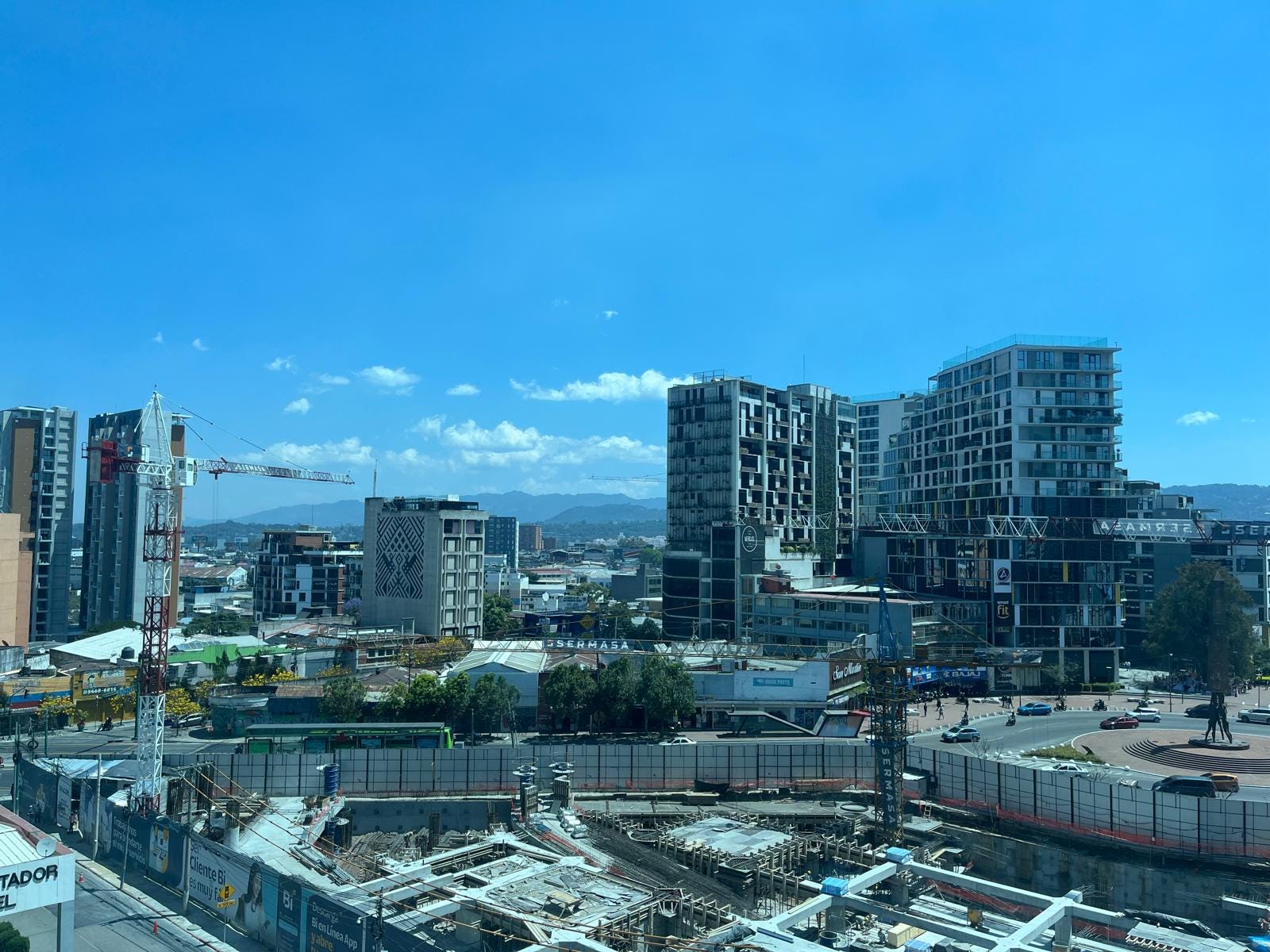
I spent last week in Guatemala City as part of a research trip for my day job. While those findings are coming out later this month, I wanted to take a moment to share a couple of impressions from the trip overall, starting with a heartfelt petition to renovate La Aurora International Airport.
Don’t get me wrong, the airport is fine, but compared to Guatemala’s neighbors, La Aurora feels aged, and together with the traffic getting to and from, reminded me of LaGuardia circa 2015. Landing there you would be hard-pressed to realize you’re in the capital city of Central America’s largest economy.
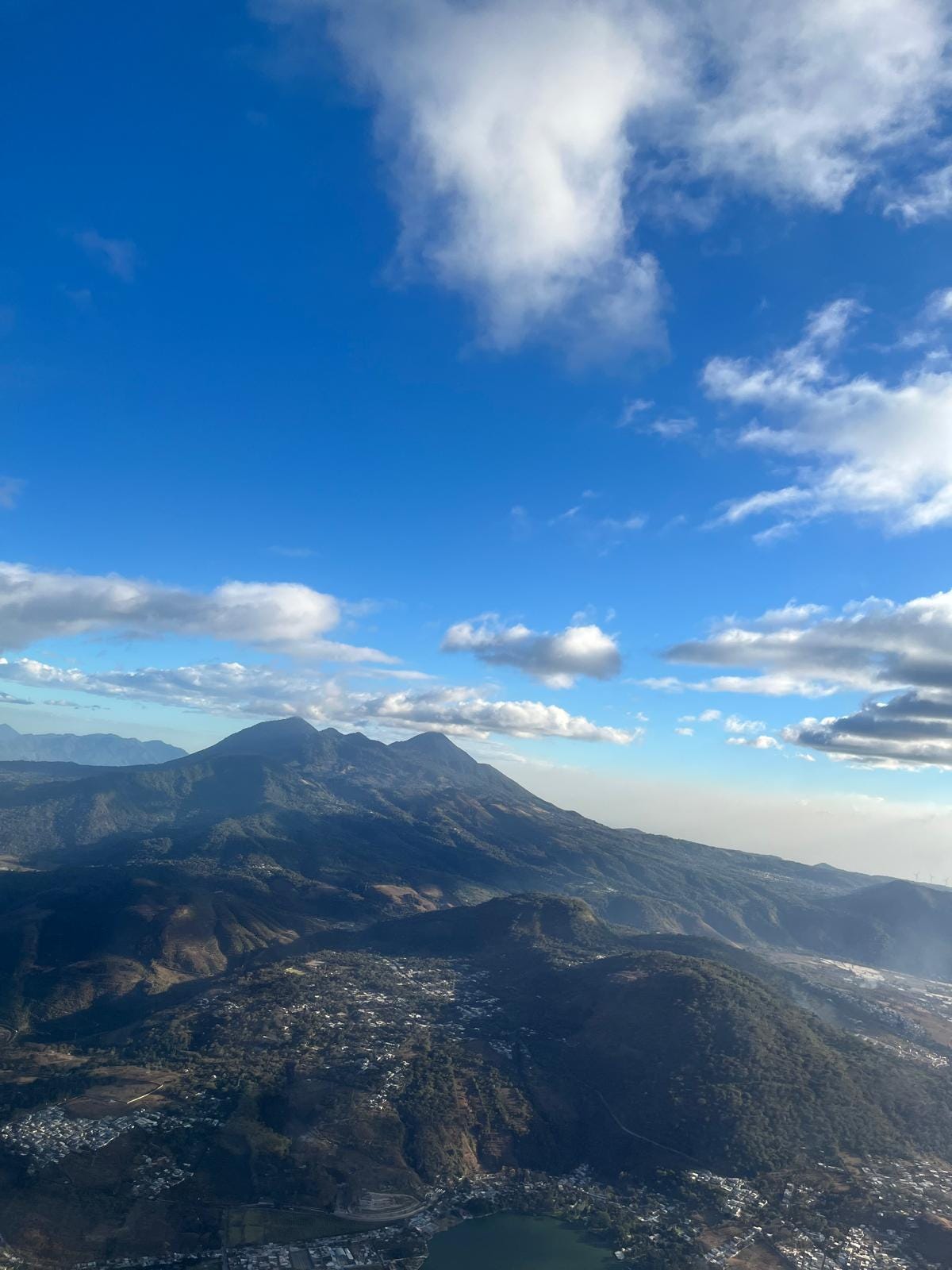
The airport is also too small to be a major transit hub, but from where it is currently nestled in the heart of Guatemala City, there’s no place for it to expand. Meanwhile the surrounding volcanoes and mountains mean transatlantic flights can’t take off fully fueled and need to stop over in San Salvador before continuing.
With La Aurora hemmed in, Guatemala could simply build a new and improved airport outside the city, like Honduras has with its (really nice) Palmerola International Airport. But doing so would require expanding the roads that lead into the city proper, or else accepting that Guatemala City’s congestion problem (the worst in Central America) will become even more intractable.
La Aurora airport embodies Guatemala’s development challenges in miniature. During my time in the country, the sense I got was that, if the country could just get its infrastructure right, the rest would follow.
The country has strong domestic industries, a large and young population by Central American standards, access to both Atlantic and Pacific coasts, and access to U.S. markets thanks to the CAFTA-DR trade agreement. There is a real sense of dynamism, as well as a fair amount of sophistication that came through in my meetings.
Some would say the real thing Guatemala is lacking is governance, and the presence of corrupt, entrenched rentiers is the real reason nothing gets built. To be clear, corruption is clearly a colossal challenge in Guatemala, where current President Bernardo Arévalo had to fend off a slow-moving coup attempt by the so-called “Pacto de Corruptos” that sought to prevent him from taking office.
Unfortunately, it seems like Arévalo’s administration has fixed neither corruption nor infrastructure. While the government has instituted stricter requirements for transparency in contracting, networks of graft remain firmly in place, often run by career bureaucrats who remain firmly ensconced while ministers cycle in and out. In the meantime, new entrants struggle to navigate mounds of paperwork and compliance requirements.
One person I spoke with told the story of how, after heavy rains inundated a stretch of road, it took several months for the government to get the permits sorted to allow a construction company to fix the segment. At that point, most people would have been more interested in getting the road back up and running than ensuring all the contracting was above board.
I’m sympathetic to the challenges Arévalo faces. He was dealt an extremely tough hand and has managed to play it expertly. But the mismatch between expectations and reality was acute while I was in Guatemala, and the demand for real transformative change, or at least the appearance of it, could produce even more political volatility as the country gears up for elections next year.
A Nation of Chambers and Councils
Several of our meetings were with the private sector, and let me tell you, Guatemalans love their industry associations. For any sector you can conceive of, there’s a chamber, council, or association. Most prominent of all is these is the Guatemalan Chamber of Industry, which by my count has at least 50 sub-councils focusing on coffee roasting, mining, candy and chewing gum, and PVC pipe manufacturing.
Guatemala is a relatively small country, and that means the business community is even smaller. Combined with the layers upon layers of industry associations, councils, and chambers, that means it’s fairly easy to get a read on what the private sector is thinking as a whole.
The Guatemalan business community is also fairly introspective about the challenges their industries face. For example, I’ve heard countless countries pitch themselves as potential hubs for semiconductor manufacturing, and was fully prepared to hear something similar in Guatemala from executives hoping to leverage their country’s ties to Taiwan to get in on the chip business. In this regard, I was pleasantly surprised to hear one interviewee remark that Guatemala needed to focus on consumer electronics assembly before it could even begin to think about climbing the lowest rungs of the semiconductor value chain.
Another common theme was that, in the absence of government infrastructure development, private companies are stepping in out of necessity. Especially when it comes to roads, there has been a surge in private road construction in Guatemala. That’s a fine stopgap measure, but the benefits from these efforts are unlikely to be shared widely, and if anything could have the effect of boxing out competitors who can’t afford to set up their own parallel state.
But any construction is better than no construction, especially since Guatemala’s growth potential remains bottlenecked at every turn by infrastructure. Guatemala at the moment has essentially two functional commercial ports, Puerto Quetzal on the Pacific coast, and Puerto Barrios on the Atlantic. With annual throughput capacity of 340,000 and 200,000 containers respectively these ports are not particularly large (in 2025 the port of Cristóbal, Panama alone moved more cargo than both ports combined), and operations at both are controlled by powerful longshoremen’s unions. The average waiting time for a ship to dock at either port is around 90 days.
Linking the Pacific and Atlantic coasts is the CA-9 highway, which is just two lanes wide for most of its length. Even where the road widens to four lanes as it passes through Guatemala City, the increased volume of cars there causes commercial trucks to move at a snail’s pace.
There are a couple of legislative projects that are showing promise for infrastructure rejuvenation. The Priority Road Infrastructure Act established a new directorate under the Ministry of Communications, Infrastructure and Housing entrusted with a mandate to fast-track new roads and maintenance. Unfortunately, that entity is behind schedule in getting up and running owing to uncertainties over lines of authority, composition, and the fact the 2025 budget was approved before the bill was passed, creating uncertainty as to where the 30 million quetzales the bill appropriated would come from.
A new law on ports currently being considered would attempt to reduce the power of longshoremen’s unions and make it easier for private actors to develop new ports. If passed, this could help drive investment in port infrastructure, and open up new export opportunities with more specialized terminals for agricultural goods or bulk minerals.
Still, this approach runs the risk of transforming the country into a world of private ports, connected by private roads to private companies, helping a limited number of firms boost exports, but not necessarily creating conditions for broader-based economic growth.
Our Man Arévalo
Another takeaway for me was the extent to which Guatemala has quietly given the United States everything it could possibly ask for. Guatemala has accepted more deportees than any other country, it eagerly signed an agreement on tariffs and trade and has kept its mouth firmly shut about the United States’ lethal boat strikes or the capture of Maduro. Arévalo has even kept the Guatemalan embassy to Israel in Jerusalem after Jimmy Morales moved it there in 2018.
In some respects, this strategy seems to be working pretty well for Guatemala. Arévalo has avoided any major blowups with Trump that could give his opponents room to further undermine his government. Guatemala has also hung on to a sizeable chunk of the remaining USAID money, according to some people I spoke with, as much as 85 percent of the remaining funds for Latin America and the Caribbean are being directed towards Guatemala. Of course, the overall pie is much smaller, but it’s a pretty impressive feat for Guatemala all things considered.
However, other people I spoke to still felt jilted by the United States. Guatemala has missed out on the love-fest that leaders like Javier Milei and Nayib Bukele have received. Even Gustavo Petro managed to finagle a surprisingly chummy one-on-one with Trump in the Oval Office. Several people were confused as to why Guatemala wasn’t invited to the upcoming “Shield of the Americas” summit in Miami that representatives from Trinidad and Tobago, Guyana, Paraguay, El Salvador, Ecuador, Argentina, Honduras, Costa Rica, the Dominican Republic, Bolivia and Chile will all be attending.
The simple answer is Arévalo doesn’t fit the part. An academic by trade elected on a social-democratic platform simply doesn’t play to the Mar-a-Lago crowd the way El Salvador’s swaggering millennial dictator does. Never mind the fact that Bukele has been far more eager to cozy up to Beijing than Guatemala, which remains a dutiful ally to Taiwan.
Ultimately, I think the status quo is ideal for Arévalo. Guatemala gets to reap the benefits of cooperation with the United States, while the president is neither drawn into a diplomatic feud with Washington nor exposed to attacks from the left for visibly bending the knee to Trump.
However, with elections coming up in 2027, staying out of the limelight may no longer be an option, and Guatemala’s more conservative elites will likely be eager for a candidate who can sweet-talk Trump and win accolades from online MAGA influencers. My hunch therefore is next year’s campaigning season will feature several candidates who are jockeying for the White House’s endorsement. Trump himself may be eager to continue his streak of kingmaking Latin American presidents.
But appealing to partisan politics in the United States is a strategy that at best pays out half the time. A friendlier relationship with the Trump administration does not guarantee new economic opportunities, and by the time the next president is inaugurated in Guatemala, the United States will be gearing up for its own election season.
Security without Mano Dura?
Originally, our visit was scheduled for late January, only to be postponed at the last minute when Guatemala declared a 30-day “state of siege” triggered by violence tied to the Barrio 18 gang in the country’s prisons. In response, criminals rioted and took hostages in the prisons, set up roadblocks in parts of Guatemala City, and killed nearly a dozen police officers.
Coverage of states of exception these days is often colored by the experience of El Salvador, which just extended its one-month state of exception for the 48th consecutive month since 2022. In reality, states of exception often come and go without much in the way of fanfare or results.
In Guatemala’s case, the 30-day state of siege was exactly that, lapsing on February 16 with a declaration by the government that violence had been brought under control and the order restored to the prison system. While the limited state of exception is probably a good example of fighting crime without sacrificing democracy, it seems far too soon to tell whether the limited campaign will have a lasting effect on security.
Guatemala’s homicide rate in 2025 was 16.1 per 100,000 inhabitants, slightly less than Costa Rica, which is confronting a wave of criminal violence, and more nearly 40 percent lower than neighboring Honduras. It has been trending downwards over the past decade, though with a brief post-Covid bump.
Most of the criminal violence is driven by street-level gangs like Barrio 18 and MS-13, who finance themselves mainly through extortion. While both are officially designated foreign terrorist organizations, they are both poor and poorly armed compared to the region’s illicit apex predators like the CJNG and PCC.
Nevertheless, during our time in Guatemala City, the overwhelming impression was that security wasn’t great, but remains “good enough” even during the height of the state of siege. Indeed, some of our interviewees even teased us a bit for our skittishness upon learning we postponed in January. “Nothing has really changed” one person messaged, “but I completely understand.”
Guatemala City features the usual urban security markers, lots of private security, barbed wire and entryways inset from the street. Of course, I was flitting between nicest of the nice parts, but still it felt like the city has a more relaxed and at-ease energy than other spots in Central America.
There’s reason to believe the current equilibrium won’t hold up for long though. Mexican cartels have increasingly penetrated Guatemala to secure trafficking routes. Indeed, after the death of El Mencho, Guatemala deployed military personnel to its border as a precaution against potential CJNG retaliation there. The introduction of new and hardier strands of coca plant has also introduced cocaine production to neighboring Honduras, fueling new criminal dynamics that Central America’s security forces could be ill-prepared to confront.
Another, more structural, challenge arises from the fact that Guatemala is among least-urbanized countries in Latin America, with just 56 percent of the population living in cities compared to a regional average of 81 percent. Coupled with the fact that the median age is around 25 and emigration has slowed dramatically since 2025, internal rural-to-urban migration could still be a big problem.
As urban populations grow and outstrip the ability of the government to provide services or enforce property rights, we tend to see organized crime explode. That’s the case right now in Guatemala City where Zone 18, the most populous and violent of the city’s 22 internal subdivisions.
Beyond Guatemala City, regional centers like Quetzaltenango, Cobán, and Huehuetenango are all poised to experience population booms over the next decade. This is all the more reason for Guatemala to get infrastructure right, if urban populations spike without the accompanying security apparatus or built environment to sustain them, the country could face a wave of violence that will be difficult to staunch.
In the interest of not ending on this pessimistic note, I should end instead by saying that I truly had a wonderful time in Guatemala City, and my one regret is not being able to take in more of the country between meetings. Those of you who know me know that I wrote my undergraduate thesis on Guatemala, and the country has always been my first love as a Latin America analyst. The weather I returned to in DC this week certainly has me missing the Land of Eternal Spring even more.
The claim that “any construction is better than no construction” may sound intuitive, but from the perspective of public economics and infrastructure policy it is conceptually wrong. In fact, a large body of development literature shows the opposite: poorly conceived infrastructure can make problems worse rather than better.
The first issue is economic. Infrastructure is not a neutral good; it competes for scarce fiscal resources. In a country like Guatemala—where fiscal space is limited and state capacity is weak—every project carries a high opportunity cost. If public capital is allocated to projects with low or negative social returns, those resources cannot be used for interventions that would actually improve connectivity or productivity. From an economic evaluation standpoint, the relevant question is not whether to build or not to build, but whether the marginal social return of the project is positive and higher than alternative uses of the same resources. A poorly located or oversized project can easily produce negative net benefits.
The second issue is systemic. Transport infrastructure does not function as isolated projects but as interdependent networks. Building infrastructure without a network logic can actually increase system friction: roads that terminate in bottlenecks, expansions that simply shift congestion downstream, or corridors that generate flows the secondary network cannot absorb. In those cases, “more infrastructure” does not improve mobility; it simply relocates or amplifies the underlying problems.
The third issue is institutional. In countries with limited state capacity and high levels of capture, construction spending can become a mechanism for rent extraction. Unnecessary or oversized projects do not just waste resources; they reinforce the political and business incentives that produce bad infrastructure in the first place. This phenomenon is well known in political economy as the creation of “white elephants”—projects driven by rents rather than by the functional needs of the network.
The fourth issue is strategic. Infrastructure that actually supports economic growth is the infrastructure that removes critical logistical frictions. Achieving that requires prioritization: identifying where the network is failing—bottlenecks, missing links, lack of capillarity—and intervening there. Building without that logic simply confuses construction activity with infrastructure development.
For that reason, the real question is not whether to build or not, but whether the right thing is being built in the right place. A country with Guatemala’s constraints cannot afford improvisation. The difference between infrastructure that supports growth and infrastructure that undermines it is not the amount of concrete poured, but the quality of the public decision that precedes it.
Sorry where are you from? And what’s your “day job”? This is quite an audacious blog-like post lacking nuance. Can you share some advice on how to embrace confidence to share such impartial takes on the internet? I’ve been burdened by ethics and the urge to only share accurate information so have struggled to publish anything on my own country. Oh to be a white man in 2026!