

The Uruguayans probably live in Latin America’s best-governed country.
In 2025 the Economist Intelligence Unit’s democracy index scored Uruguay the highest of any Latin American state, placing it squarely between the Netherlands and Japan. James Bosworth routinely puts Uruguay in a category unto itself in his maps of regional trends. This always gets a good laugh from me, but it is true that Montevideo often stands alone as a bastion of rationality in a region buffeted by the winds of populism. But why has Uruguay diverged so sharply from its neighbors?
According to Luis L. Schenoni’s 2024 book Bringing War Back In: Victory, Defeat, and the State in Nineteenth-Century Latin America, the seldom-studied Siege of Montevideo may hold the key to understanding Uruguayan exceptionalism.
Known in Uruguay as the Great Siege of Montevideo, the eight-year battle for the city from 1843-1851 took place in the context of an internationalized Uruguayan civil war. In order to bolster the Uruguayan government led by Manuel Oribe based in the city of Cerrito de la Victoria, Argentina dispatched a force of 12,000 troops to try and seize or starve out the rival government in Montevideo.
Of a pre-siege population of about 31,000, more than 5,000 Montevideans were conscripted to defend the city, representing one-sixth of the total population and virtually all adult male inhabitants. The struggle, now largely forgotten, was of truly epic proportions, even inspiring Alexandre Dumas to deem the city The New Troy in a 1850 novel.
With the intervention of Brazilian troops in 1851 the siege was finally lifted, Argentina defeated, and the Oribe faction, which had represented the interests of countryside landlords and regional caudillos was smashed in favor of the central government based in Montevideo. In this way, Uruguayan politics quickly consolidated around a belief in central government, allowing the country to increase tax revenues, strengthen infrastructure, and conduct its first national census in 1852, just one year after the siege had ended and a decade or two before Argentina or Brazil.
A stronger state did not mean the end of internal violence, however, and Uruguayan politics in the 1800s still featured the regular drama of coups, plots, and uprisings. But unlike its neighbors, both of Uruguay’s dominant political parties, the blancos and colorados, agreed upon the basic notion of strengthening centralized government authority, their disagreements were instead over who should have access to the levers of state power.
This is one of a host of case studies Bringing War Back In uses as evidence to support its theory of how war makes the state. I can best summarize the book’s argument in brief as follows:
1. Early states are characterized by competition between central elites who want to strengthen the state, and peripheral elites who want to weaken it;
2. Interstate war empowers central elites at the expense of peripheral elites to undertake state-building activity to confront an external threat;
3. Victory in interstate war reifies central elites to lock in the gains from state-building efforts, defeat discredits the center and empowers the periphery, corroding the gains in state capacity that were forged in preparation for war.
This was the kind of book I’ve been wishing someone would write since I started taking an interest in Latin America. It is a deeply-researched look into the history of conflict in a region that is consistently overlooked by military histories and political science studies of war and the state. The theoretical framework is ingenious too, and once you start thinking about the argument the book makes, you start seeing it everywhere.
Schenoni frames his argument in the book as a return to tradition. Whereas modern political science literature has focused on too narrow a set of causal mechanisms, the grandfathers of the “bellicist” theory of state formation were more open-minded in theor theorizing. Indeed, Charles Tilly’s famous quote that “war made the state and the state made war” hints at a deeper complexity in its circularity.
According to the book’s literature review, modern analyses of war and state formation make one of two arguments. The first of these reduces war to a pure selection mechanism wherein stronger states outcompete weaker states, who are either dissolved or absorbed into their conqueror upon defeat. This Darwinian view however struggles in cases where defeat did not result in the total destruction of the loser, as is the case in most all Latin American conflicts. It also neglects the role of contingency in war, which Clausewitz reminds us most resembles a game of cards where chance and friction mean history is replete with examples of upset victories by supposedly weaker states.
The second bellicist tradition looks exclusively at preparation for war as the causal mechanism connecting fighting with state capacity. This makes sense as states who believe themselves about to face an external threat need to raise taxes, recruit armies, and build up their war industries, all activities that require a more powerful central government. Schenoni points out, however, that if preparation for war is the sole variable, we would not see any divergence between victor and vanquished in their state building trajectories.
Indeed, according to this theory we should expect both the Chilean and Peruvian states to strengthen after the War of the Pacific. In fact, Peru should even become stronger after its defeat as it had a higher prewar baseline assuming straight lines go straight. Such predictions are inconsistent with the historical record, however, and accordingly should be dismissed in favor of a better theory.
Schenoni’s begins with a modification of this second bellicist theory. Preparation for war does indeed strengthen the state, but these gains are not locked in until victory is achieved. Furthermore, the policies adopted by states preparing for war tend to alienate peripheral elites, such as rural landowners who see their power in decline relative to the central government.
The outbreak of hostilities accordingly represents a moment of maximum risk for the central elites. Battlefield losses in particular can spark coup attempts and cause resentful peripheral elites to rebel against the government. Should the war end in defeat, the discredited state-builders are often easy pickings for regional power brokers to carve up. Should the state prevail, however, the peripheral elites must usually fall in line or be forced in line by the empowered central government and its victorious army.
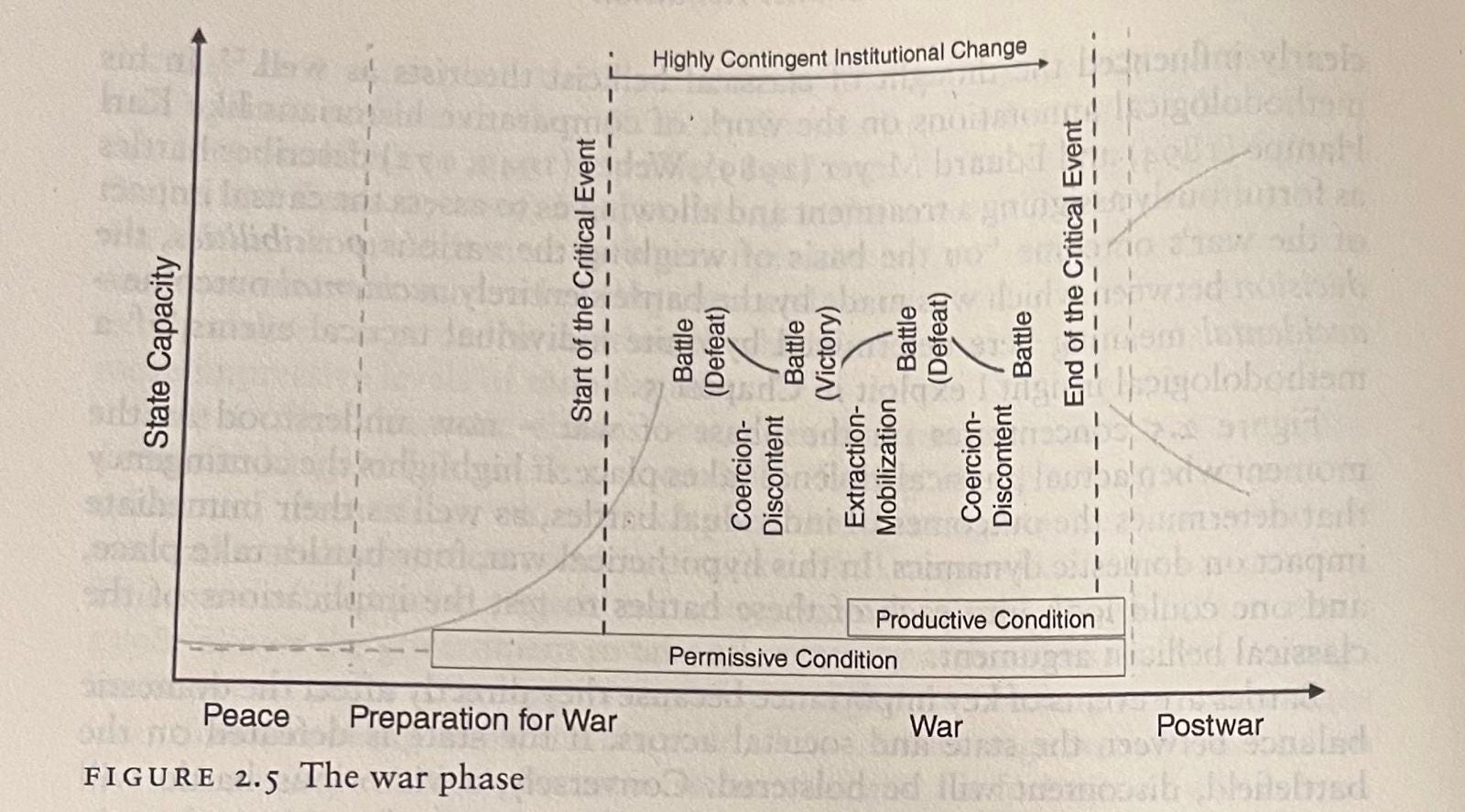
During the War of the Triple Alliance, for instance, Paraguayan successes on the battlefield were often accompanied by uprisings from Argentine provincial warlords which Buenos Aires struggled to tamp down for long. After Argentina’s ultimate victory, however, its larger and battle-hardened military was able to turn inward and put down the restive provinces with little difficulty.
This example comes from one of three chapters devoted to historical case studies Schenoni uses to test his theory. These chapters were definitely the highlight of the book for me, offering truly excellent and concise histories of the War of the Triple Alliance, War of the Pacific, and Mexican-American as well as Second Franco-Mexican wars. If I have one (unfair) criticism of these chapters, it is that I could have used even more military history in the case studies.
Still, I came away with a raft of new historical trivia from these pages, like how Peru started the War of the Pacific boasting four ironclad warships to Chile’s two, only to be forced to scuttle one in an early engagement when it struck a reef, and have the other captured by Chilean forces in a world-historic case of bad luck.
I also appreciated Schenoni’s decision to test this theory in Latin America, which he himself admits at first glance seems like it should be a challenging region for bellicist theory-testing.
Before reading Bringing War Back In this year I finished Greg Grandin’s sweeping treatise on the Western Hemisphere, America, América. While I enjoyed Grandin’s piece on the whole, one of his central arguments, that Latin America’s uniquely pacific nature stems from the early adoption of the doctrine of uti possidetis and the embrace of arbitration, not war, to resolve territorial disputes, didn’t sit well with me.
Certainly, uti possidetis and anti-interventionist norms carried some sway, but early Latin American leaders could hardly take these norms for granted. In fact, some of the bloodiest interstate wars, including the War of the Triple Alliance and War of the Pacific, took place in the latter half of the 19th century, when norms around uti possidetis ought to have had decades to take root.
To the extent the region went to war, Grandin seems to imply this was the product of malicious European and U.S. financial interests corroding the noble Latin American pacifist instinct. This was uncompelling for me, as surely it can’t be the case that Latin American states happened to emerge from their bloody wars of independence magically more enlightened on matters of international peace and diplomacy than their bloodthirsty neighbor to the north or the barbaric Europeans.
Of the War of the Pacific for instance, America, América writes in a brief section that Chile was “goaded on and financed by British mining and financial houses that were invested heavily in nitrate in the country’s northern deserts.” I won’t deny these foreign economic motivations were at play, as they are in virtually any conflict, but Bringing War Back In adds valuable nuance to Grandin’s depiction of war motivations and financing in the Americas. Schenoni writes that, “From 1879 to 1880 the revenue of the Chilean state doubled from 124,406 to 242,126 pesos. Almost all of it came from tax revenue…internal taxes covered the largest share.” This surge in taxation was in turn channeled virtually entirely into building up the country’s armed forces. In other words, Chile pulled its own financial weight on the road to war.
While it is true that in the 20th century Latin America diverges sharply from the rest of the world as a zone of interstate peace, as Schenoni demonstrates, in the 19th century, interstate wars in Latin America were actually more frequent, lasted longer, and killed more people as a proportion of total population than in Europe. The War of the Triple Alliance for instance, caused more battle deaths in absolute terms than the Crimean War, the deadliest European conflict between the Napoleonic Wars and WWI.
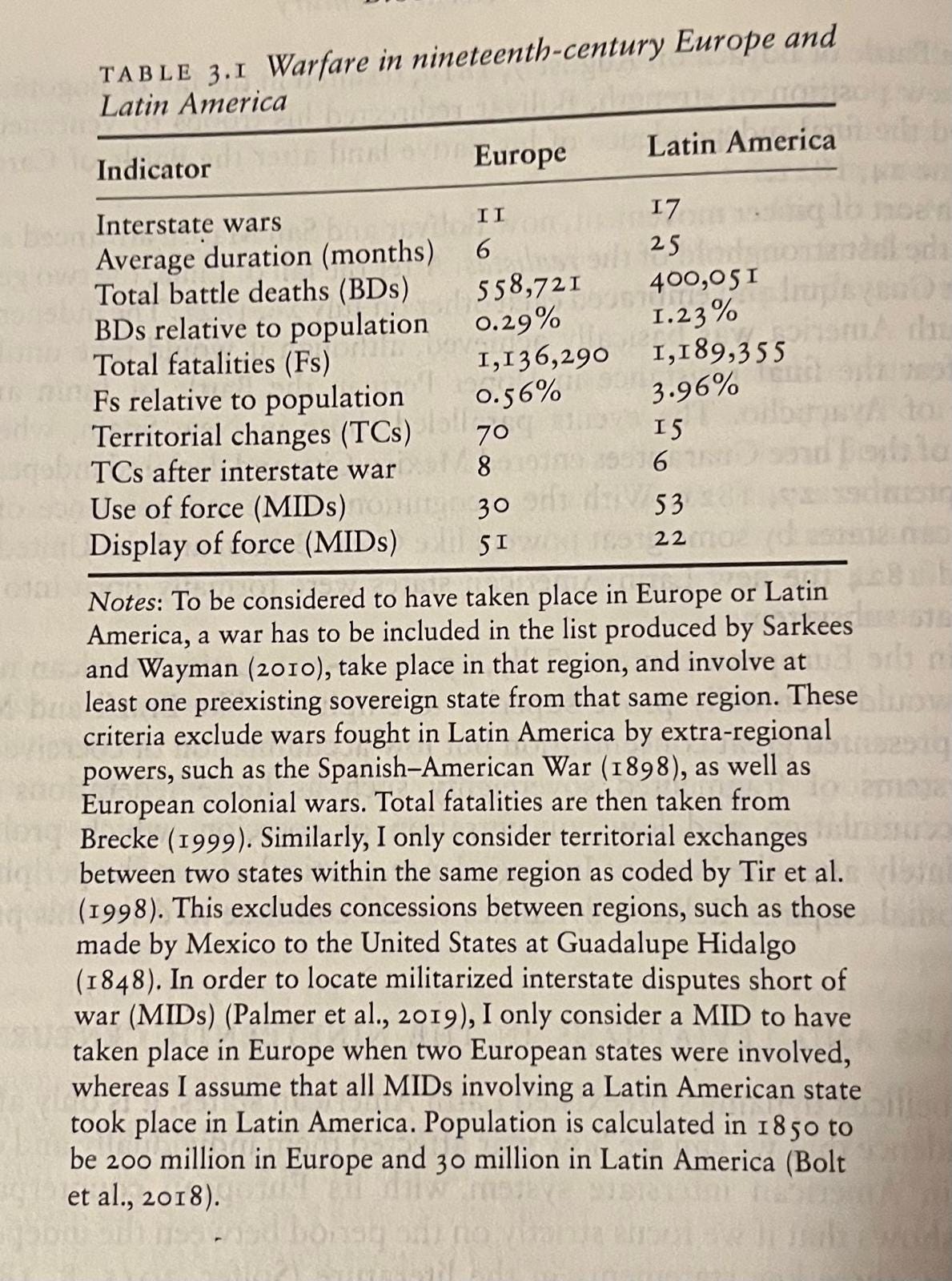
While many of the conflicts that gripped Latin America during the 1800s would be considered small in absolute terms, relative to their populations some remained truly grand in scope. There is the case of Montevideo mobilizing its entire adult male population, while Costa Rica during the 1856-1857 Filibuster War managed to raise a force some 10,000 strong from a population of 100,000, a mobilization feat that rivals the 20th century World Wars.
I wasn’t completely carried away by the book however, and was left wondering whether Schenoni’s theory might overemphasize the effects of victory and defeat on institutional arrangements to the exclusion of more “tangible” aspects of the state. State-builders aren’t just discredited after defeat in battle, the losing state can find itself bereft of strategic or resource-rich territory as well as severely depopulated.
In the case of Paraguay in particular, it seems to me that the loss of between 60 and 69 percent of the country’s population do war, disease, or displacement during a compressed period of war to me should be the single most important contributing factor to the country’s weakened state-creating efforts in the late years of the 19th century. Bringing War Back In cites a cable from the U.S. Ambassador to postwar Asunción who claimed that Paraguay could yet rise from the ashes, but I remain skeptical.
I also found myself wondering whether there’s a point at which the consolidation hits a “good enough” threshold where victory and defeat in interstate war no longer yields large swings in state capacity.
For example, the two most obvious counterexamples to the book’s theory are Germany and Japan post-1945, where comprehensively defeated states rapidly rebuilt their capacity. Schenoni argues this was due to the victorious power taking a vital interest in the rebuilding of the vanquished, historically anomalous behavior, as well as the very real possibility of a new war with the Soviet Union in Europe and communist China in the Pacific supercharging a new round to state capacity-building activity.
However, an alternative explanation advanced by Francis Fukuyama in his 2014 book Political Order and Political Decay is that both countries had sufficiently institutionalized high state capacity that rebuilding could take place at an accelerated timeline. Germany and Japan had sufficient muscle memory of what a high-functioning central government looked like that they could reproduce it even after suffering massive defeat. The effects of victory and defeat seem the strongest when states are either young or weakly-institutionalized, but states that are neither of those things could have some built-in antibodies to the effects of losing a war.
Finishing this book also left me all the more intrigued by the decline of war in 20th century Latin America, and what this meant for states in the region today. My rudimentary application of Schenoni’s theory to a counterfactual Latin America that remained more bellicose would predict we’d see even more stark variation in terms of state capacity within the region. While there is undoubtedly variation in the region today, most Latin American countries fall within the same rough range in terms of capability. Had these countries continued to war with one another with the same intensity seen during the 19th century, we would probably be living in a region of higher highs and lower lows, with some serial winners boasting hyper-competent state institutions while others would still be struggling to hold the machinery of governance together.
Limited criticism and questions aside, I give Bringing War Back In high marks. The historical anecdotes I’ve shared here are but a fraction of the treasure trove of historical detail packed into the case studies and footnotes. For a work of academic political science research, the prose is compelling and rendered in refreshingly plain English for the most part as well. Whether you’re a student of military history, early Latin American governance, or state formation writ large, I strongly encourage you to pick up this book. Please drop me a line when you do, I’m dying to chat about it some more.
An excellent review. May have to pick this one up.